
THEBUSINESSBYTES
BUREAU
NEW
DELHI, JUNE 8, 2026
India’s ambitious
plan to transform its industrial landscape gained significant momentum on
Monday with the launch of the BHAVYA Portal, a key digital platform designed to
fast-track the implementation of the Bharat Audyogik Vikas Yojana (BHAVYA), a
flagship programme aimed at developing 100 world-class industrial parks across
the country.
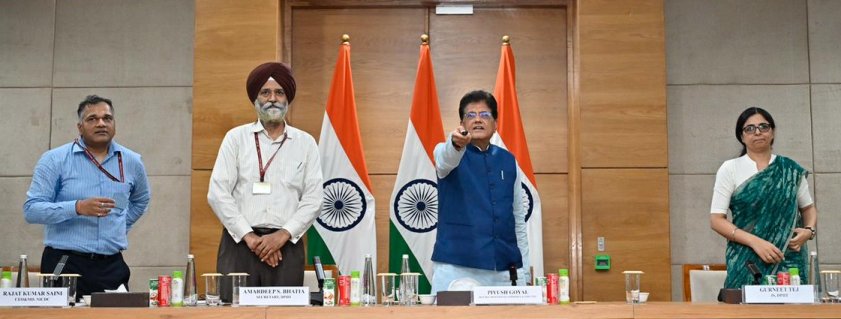
Launching the portal
in New Delhi, Union Commerce and Industry Minister Piyush Goyal said the BHAVYA
Scheme would usher in a new era of competitive industrial development by
encouraging states to compete for investment-ready projects based on their
industrial strengths, land availability, investor interest and sector-specific
potential. The initiative is expected to create large-scale employment opportunities,
attract substantial domestic and foreign investments, and strengthen India's
position as a global manufacturing hub.
The Minister said the
scheme has been designed to create industrial ecosystems tailored to the needs
of different sectors, including manufacturing, chemicals, data centres and
emerging industries. Through the BHAVYA Portal, investors will gain access to
comprehensive information on industrial parks, including land availability,
connectivity, infrastructure and investment opportunities, enabling informed
decision-making and accelerating project implementation.
Highlighting India's
economic transformation over the past decade, Goyal noted that investments in
highways, railways, airports, ports, power infrastructure, water resources and
digital connectivity have created a strong foundation for industrial growth. He
also pointed to landmark reforms such as the Goods and Services Tax (GST), the
Insolvency and Bankruptcy Code, labour reforms, expansion of 5G networks,
startup promotion and free trade agreements as key drivers of India's rising
global competitiveness.
Approved by the Union
Cabinet with an outlay of ₹33,660
crore, BHAVYA aims to develop 100 investment-ready industrial parks over six
years. The parks will vary in size depending on regional
requirements, ranging from 25 acres in hilly and Northeastern regions to as
much as 1,000 acres near major urban centres. State governments will provide
land, while infrastructure development will be undertaken through the National
Industrial Corridor Development Corporation under a 51:49 partnership model
with states.
The proposed parks
will feature plug-and-play infrastructure, assured water and power supply,
multimodal connectivity, digital single-window clearances, worker-support facilities
and sustainable development features. Dedicated zones for startups, deep-tech
enterprises, research and development activities, Global Capability Centres
(GCCs), worker housing and social infrastructure are also being considered. The
government is additionally exploring the creation of international industrial
enclaves in partnership with countries such as Japan, Singapore, Republic of
Korea and Switzerland to facilitate foreign investment and provide a familiar
business environment for global professionals.
Goyal said the scheme
seeks to address longstanding challenges faced by entrepreneurs in acquiring
industrial land and obtaining approvals by introducing transparent systems and
digital governance mechanisms. He stressed the importance of satellite-based
mapping and digital monitoring tools that would allow investors to assess
industrial sites remotely.
The Minister
expressed confidence that the Central Government’s investment would act as a
catalyst for far larger private sector participation, generating direct and
indirect employment while strengthening Centre-State collaboration in
industrial development. He noted that applications submitted between June 1 and
July 31 would be considered for the first phase involving 20 industrial parks,
followed by another 30 parks based on applications received by September 30.
The BHAVYA Portal,
developed by National Industrial Corridor Development Corporation, will
function as the single digital interface for project submission, appraisal,
evaluation and real-time monitoring. It will support the scheme’s
challenge-based competitive selection framework and ensure transparency,
accountability and efficient coordination among stakeholders.
Speaking at the
launch, Amardeep Singh Bhatia, Secretary of the Department for Promotion of
Industry and Internal Trade (DPIIT), said robust digital systems are essential
for managing large-scale programmes and ensuring effective implementation. He
observed that the portal would significantly accelerate the operationalisation
of industrial parks nationwide.
Rajat Kumar Saini
said the platform has been designed to support the complete project lifecycle
under BHAVYA, providing real-time visibility into progress while enhancing
transparency and stakeholder coordination.
The launch event
brought together representatives from state governments, industry associations,
export promotion councils, financial institutions, developers and MSMEs. It
concluded with an interaction between the Minister and industry stakeholders on
investment facilitation, logistics efficiency, ease of doing business and
strengthening India’s integration into global value chains.
Coming soon after the
Cabinet approval of the scheme and the release of its operational guidelines,
the launch of the BHAVYA Portal marks a major milestone in the government's
vision of creating globally competitive industrial infrastructure. With a
target of developing 100 modern industrial parks and attracting massive
investment inflows, BHAVYA is expected to play a pivotal role in advancing the
vision of a Viksit Bharat by 2047 and positioning India among the world's
leading manufacturing economies.