THEBUSINESSBYTES BUREAU
BOUDH, NOVEMBER 14, 2026
Collective efforts of the district administration, police, public
representatives, intellectuals, social workers and media have played a pivotal
role in making Boudh district Naxal-free, while sustained public participation
and effective communication will be crucial to preserving peace and
accelerating development, Collector and District Magistrate Bibhuti Bhushan
Nayak said on Saturday.
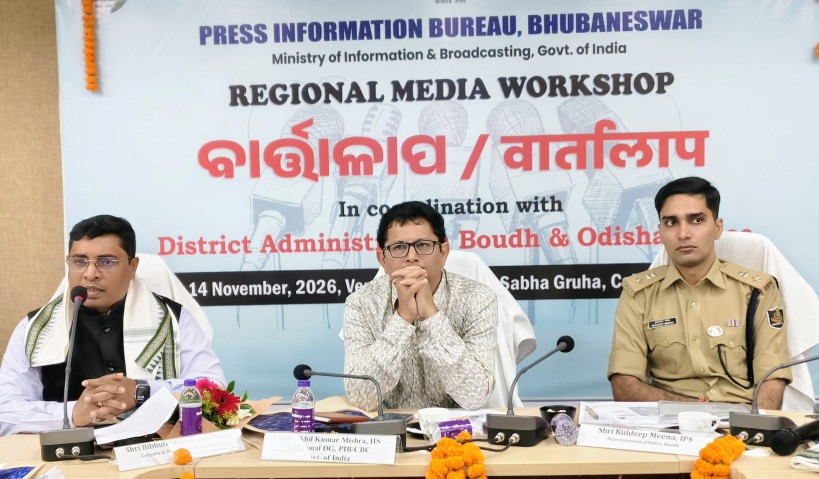
Addressing a Regional Media Workshop, ‘Vartalap’, organised by the Press
Information Bureau (PIB), Bhubaneswar, in collaboration with the Boudh District
Administration and Odisha Police at the Sadbhavana Conference Hall of the Boudh
Collectorate, Nayak emphasised that the collective achievement must be
protected through continued coordination among all stakeholders.
He said government rehabilitation measures and public welfare schemes had
significantly helped weaken the influence of Naxalism in the district. However,
he cautioned that sustained and coordinated efforts were essential to prevent
any resurgence of extremist activities and consolidate the gains made in
restoring peace.
Highlighting the role of the media in the district's development journey,
the Collector said newspapers, television and digital platforms could serve as
powerful instruments in creating awareness about government schemes and
ensuring that their benefits reached eligible beneficiaries. He called upon
media organisations to highlight initiatives relating to agriculture,
fisheries, horticulture, healthcare, education, scholarships and
self-employment.
Nayak also stressed the need to generate employment and self-employment
opportunities for local youth through skill development and technical training
so that they could build sustainable livelihoods in their own regions. Active
cooperation between the administration, media and different sections of
society, he said, would be vital to maintaining peace and security while
accelerating inclusive development.
Superintendent of Police Kuldeep Meena highlighted the achievements of
anti-Maoist operations and security measures undertaken in Boudh district. He
said the campaign, which began in June 2023, witnessed several encounters at
different locations between November 2023 and February 2024, culminating in a
major operational success for Boudh Police in April 2024.
During the operations, several police personnel sustained injuries in
gunfire exchanges and improvised explosive device (IED) blasts. In recognition
of their courage and dedication, the Government of India conferred gallantry
medals on personnel who fought bravely, while the then Superintendent of Police
and other officers involved in the operations received commendation
certificates from the Director General of Police.
Meena further said that Special Operations Group (SOG) teams continued
their efforts to dismantle Maoist networks, recovering arms, ammunition and
other materials concealed at different locations. Under the government's
rehabilitation policy, four surrendered Maoists were provided financial
assistance, three-year fixed deposits and skill development training. They are
currently living in their respective homes in Chhattisgarh, with the police
maintaining regular contact with them. Other surrendered cadres have also been
sent back to their respective villages.
He said the district administration was simultaneously implementing
development initiatives under the 'Gramodaya' programme to transform formerly
Naxal-affected areas into peaceful, violence-free and development-oriented
regions.
Addressing the workshop, Akhil Kumar Mishra, Additional Director General,
PIB and Central Bureau of Communication (CBC), Bhubaneswar, described
'Vartalap' as an important bridge of communication between the government and
the media. He said the initiative aimed to bring the development momentum in
areas freed from Naxal violence into the public domain and facilitate
meaningful interaction between officials and journalists.
He underscored the importance of infrastructure development, social
security, digital governance and administrative coordination in the
post-conflict phase. Sustaining peace, restoring public confidence and creating
hope among communities, he said, were as important as security operations. He
also called for adapting administrative strategies and security arrangements to
changing ground realities while ensuring that development initiatives gained
momentum.
Additional District Magistrate Biranchi Narayan Darwan observed that
Maoist activities had earlier obstructed developmental works in several
affected areas. With the decline of extremist influence, new opportunities had
emerged for the effective implementation of government welfare schemes.
He said various departments were implementing government schemes in
Naxal-affected villages under the 'Gramodaya' programme through a saturation
approach to ensure comprehensive socio-economic development. The initiative
aims to empower local communities and enable people to participate
independently in the district's development process. He expressed confidence
that platforms such as 'Vartalap' would help create a positive atmosphere in
the post-Naxal period and accelerate development at the district, state and
national levels.
District Information and Public Relations Officer Bidyapati Panda
highlighted the origins, expansion and social consequences of Naxalism,
pointing out that extremist violence had deprived tribal and remote communities
of essential facilities such as education, healthcare, connectivity and livelihood
opportunities for years.
He stressed that security operations alone could not address the
underlying challenges and needed to be complemented by welfare initiatives,
rehabilitation, skill development and self-employment opportunities. He also
called for stronger coordination between the administration and media to
sustain peace, safeguard tribal rights and cultural identity, and bring
marginalised communities into the mainstream development process.
Soumya Ranjan Nayak, Faculty of Sociology at Boudh Model Degree College,
discussed the socio-economic and geographical factors contributing to the
emergence and spread of Naxalism. He identified geographical isolation,
inadequate education and healthcare facilities, lack of basic amenities and
prolonged neglect of tribal communities as major factors that had created
conditions conducive to extremist activities.
He emphasised that a comprehensive approach combining security measures
with education, improved connectivity, skill development, self-employment and
rehabilitation was necessary to address the challenge. Protecting the dignity,
identity and rights of tribal communities and ensuring their meaningful
participation in development, he said, should remain central to the post-Naxal
development strategy. Effective implementation of government schemes and
impactful communication through the media would play a crucial role in
achieving these objectives.
A detailed presentation by Odisha Police outlined the security
strategies, joint operations, surrender and rehabilitation measures undertaken
to counter Naxalism in Boudh district. It highlighted that two Maoists were
killed during an operation in the Matakupa forest on April 25, 2024. The
presentation also underlined the importance of community policing and the
provision of basic amenities in strengthening public trust and ensuring the
district retains its Naxal-free status.
The workshop was chaired by Akhil Kumar Mishra and attended by senior administrative and police officials, media representatives and other stakeholders. The interactive session provided journalists an opportunity to directly engage with senior officials on various issues concerning security, governance, welfare schemes and the district's development priorities.
Pradeep Kumar Choudhury, Assistant Director, CBC and Nodal Officer of 'Vartalap', delivered the welcome address, while Mahendra Prasad Jena, Assistant Director, PIB Bhubaneswar, proposed the vote of thanks. Manoj Kumar Jali, Deputy Director, PIB Bhubaneswar, and Swadhin Shakti Prasad, Media and Communication Officer, coordinated the programme.