
THEBUSINESSBYTES
BUREAU
NEW
DELHI, SEPTEMBER 28, 2026
Union Agriculture
Minister Shivraj Singh Chouhan on Monday called for data-driven planning,
scientific assessment and close field-level monitoring to ensure timely sowing,
adequate inputs and better returns for farmers during the upcoming Rabi season.
Addressing the
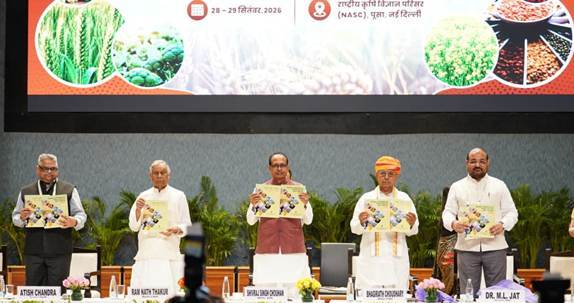
two-day National Agriculture Conference–Rabi Campaign 2026 here, Chouhan said
changing weather patterns, erratic rainfall and water constraints required a
shift from conventional agricultural planning to coordinated and
outcome-oriented strategies.
He said every state
and district should assess water availability and soil moisture before
finalising crop plans, with less water-intensive pulses and oilseeds
prioritised in water-stressed areas.
“There should be no situation where a crop
requiring more water is sown and adequate water is subsequently unavailable,
resulting in crop losses,” Chouhan said, stressing that preparations must begin
immediately as the Rabi sowing window approaches.
He expressed concern
over drought conditions in Maharashtra and Karnataka, saying a Central team
would undertake a ground assessment in Karnataka on October 3 and another team
would be sent to Maharashtra. He said he would also visit the affected states.
Chouhan said
Maharashtra, Karnataka, Telangana and Andhra Pradesh would need crop plans
based on water availability and soil moisture, with separate strategies for
rainfed and irrigated areas. Delayed sowing, he noted, could adversely affect
germination and productivity.
Calling quality seed
the “most critical link” in Rabi preparations, the minister asked states to
finalise their requirements and identify varieties suited to specific
agro-climatic conditions. He said delays in placing demands, lifting and
distributing seeds sometimes resulted in valuable varieties reaching farmers
after the sowing window.
States should prepare
a complete roadmap covering seed demand, procurement, lifting and distribution,
while consulting farmers and using the network of Krishi Vigyan Kendras, he
said.
Chouhan also called
for a major push to pulses and oilseeds, particularly in rice-fallow areas, to
advance the country's objective of achieving self-reliance in pulses and edible
oils. States have been asked to finalise by September 29 their Rabi plans,
including the area proposed for pulses such as chana and masoor and oilseeds
such as mustard.
He stressed that
production planning must go hand in hand with assured markets. If states are
unable to procure produce on time, central agencies NAFED and NCCF would
undertake direct procurement, subject to necessary state-level support. He also
urged states to make full use of procurement under the Price Support Scheme.
On fertilisers,
Chouhan advocated balanced application to reduce cultivation costs and protect
soil health. He called for extending the “Khet Bachao Abhiyan”, launched during
the Kharif season, to Rabi and cited experiences from southern states where
fertiliser use had declined without affecting production.
The minister also
sought wider adoption of natural farming, with emphasis on branding,
certification and marketing so farmers could secure better market recognition
for their produce.
He asked states to
expand Kisan Credit Card coverage, particularly among small and marginal
farmers, and speed up work on Farmer ID and AgriStack. Tenant farmers and
cultivators farming at multiple locations, he said, should not be excluded from
the digital framework.
Chouhan further
called for weekly monitoring of crop conditions, sowing, germination, pest and
disease outbreaks and market prices to enable timely intervention.
Agriculture Secretary
Atish Chandra stressed diversification, sustainable farming and research-based
practices, while Secretary DARE and ICAR Director General Mangi Lal Jat
identified climate-resilient agriculture, digital technology, risk mitigation
and crop diversification as key priorities.
Jat said large-scale demonstrations of green ammonia would be undertaken across 10,000 acres in 37 districts of six states during the coming season.
The conference, attended by senior officials, state agriculture authorities, ICAR scientists and other stakeholders, will conclude on September 29 after discussions on weather outlook, fertiliser availability, digital agriculture, Farmer Registry, pulses and edible oil missions, marketing reforms and farm infrastructure. The deliberations are expected to shape a coordinated action plan for Rabi Campaign 2026.