
THEBUSINESSBYTES
BUREAU
NEW
DELHI, JULY 10, 2026
In a major policy
initiative aimed at strengthening India's position in global telecommunications
standards and accelerating the Bharat 6G Mission, the Department of
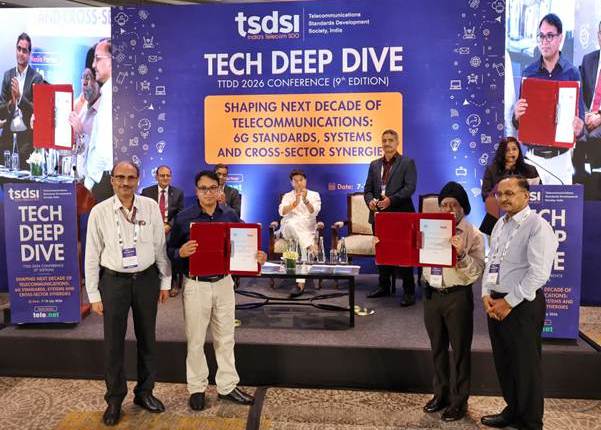
Telecommunications (DoT) has signed a Memorandum of Understanding (MoU) with
the Telecommunications Standards Development Society, India (TSDSI). The
agreement, signed under the Technology Development and Investment Promotion
(TDIP) Scheme during the 9th TSDSI Technical Deep Dive (TTDD) 2026, is expected
to enhance India's participation in global telecom standard-setting while
providing a significant boost to indigenous innovation, startups and MSMEs.
The MoU seeks to
deepen India's engagement with leading global Standards Development
Organizations (SDOs), including 3GPP, the International Telecommunication Union
(ITU) and oneM2M, while facilitating the inclusion of Indian technologies in
international standards. It also aims to expand opportunities for Indian
startups and MSMEs to play a greater role in shaping next-generation telecom
technologies.
Speaking at the
event, Union Minister for Communications and Development of North Eastern
Region, Jyotiraditya M. Scindia, said India has emerged as a global hub for
emerging technologies through collaboration, innovation and trusted
partnerships. He noted that the country's journey over the past decade has
transformed it into a laboratory of exponential growth, adding that continuous
dialogue and technological collaboration would help shape the future of
communication technologies not only for India but for the world. He also
highlighted telecommunications as the invisible force that has expanded human
possibilities and transformed societies across the globe.
A key feature of the
agreement is the extensive financial support for Indian companies and
innovators participating in global standardization activities. Eligible
DPIIT-recognised startups and MSMEs with annual turnover of up to ₹10 crore will receive
subsidies of up to 98% on TSDSI membership fees, while eligible MSMEs with
turnover between ₹10
crore and ₹500 crore will be entitled to support of up to 80%. Similar
financial assistance will also be extended for Individual Membership fees in
the 3rd
Generation Partnership Project (3GPP), enabling Indian innovators to directly
contribute to the development of global 5G Advanced and 6G standards.
The MoU also provides
travel assistance of up to 80% of eligible expenditure, subject to a ceiling of
₹5 lakh per participant
for each international standards meeting, encouraging Indian startups and MSMEs
to submit technical contributions in global forums. In addition, the government
will support hosting major international standards meetings such as 3GPP and
oneM2M in India, strengthening the country's profile as a preferred destination
for global telecom standardization discussions and enhancing participation from
industry, academia and startups.
The agreement further includes financial support for TSDSI's continued membership in key international standards bodies, ensuring sustained Indian engagement in global telecom policy and technology development.
The DoT believes the partnership will accelerate India's contribution to global telecom standards, strengthen indigenous intellectual property creation and promote innovation-led manufacturing. By expanding the presence of Indian startups, MSMEs and technology developers in international standardization processes, the initiative is expected to reinforce India's ambition of becoming a leading global contributor to next-generation telecom technologies and standards under the Bharat 6G Mission.