

THEBUSINESSBYTES
BUREAU
NEW
DELHI, MARCH 15, 2026
The Election
Commission of India on Sunday announced the schedule for assembly elections in
five politically significant regions, setting the stage for a high-stakes
electoral battle across Assam, Kerala, Tamil Nadu, West Bengal and the Union
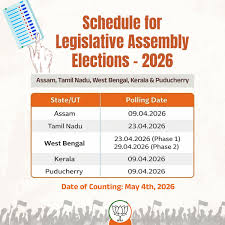
Territory of Puducherry. Polling will be held on three dates in April, with
counting of votes scheduled for May 4.
Chief Election
Commissioner Gyanesh Kumar said voting for all seats in Assam, Kerala and
Puducherry will take place in a single phase on April 9, while elections in
Tamil Nadu will be held on April 23. In West Bengal, polling will occur in two
phases on April 23 and April 29.
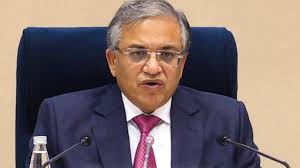 Announcing the
schedule at a press conference in the national capital, Kumar said a total of
17.4 crore voters are eligible to cast their ballots across 824 assembly
constituencies in the five assemblies. He was joined by Election Commissioners
Sukhbir Singh Sandhu and Vivek Joshi.
Announcing the
schedule at a press conference in the national capital, Kumar said a total of
17.4 crore voters are eligible to cast their ballots across 824 assembly
constituencies in the five assemblies. He was joined by Election Commissioners
Sukhbir Singh Sandhu and Vivek Joshi.
Compared to the 2021
assembly elections that were spread across eight polling days over nearly a
month, the upcoming elections will take place over three polling days within a
20-day window, significantly compressing the electoral timeline. The
announcement also triggered the immediate enforcement of the Model Code of
Conduct, restricting governments from announcing new policy decisions or benefits
that could influence voters.
The elections will
test the political strength of several ruling parties. In Tamil Nadu, the
Dravida Munnetra Kazhagam government led by Chief Minister M. K. Stalin will
seek another mandate in the 234-member assembly. In West Bengal, Chief Minister
Mamata Banerjee and her All India Trinamool Congress will defend their position
in the 294-seat legislature where the party has been in power since 2011.
 In Kerala, the ruling
Left Democratic Front government headed by Chief Minister Pinarayi Vijayan
faces the electorate in the 140-member assembly. Meanwhile in Assam, the
Bharatiya Janata Party government led by Chief Minister Himanta Biswa Sarma
will attempt to retain power in the 126-seat house. In Puducherry, the NDA ally
All India N R Congress led by Chief Minister N. Rangasamy is currently in
office in the 30-member assembly.
In Kerala, the ruling
Left Democratic Front government headed by Chief Minister Pinarayi Vijayan
faces the electorate in the 140-member assembly. Meanwhile in Assam, the
Bharatiya Janata Party government led by Chief Minister Himanta Biswa Sarma
will attempt to retain power in the 126-seat house. In Puducherry, the NDA ally
All India N R Congress led by Chief Minister N. Rangasamy is currently in
office in the 30-member assembly.
The Election
Commission also detailed the nomination timelines. For Assam, Kerala and
Puducherry, the notification will be issued on March 16 with the last date for
filing nominations on March 23. For Tamil Nadu, the notification will be issued
on March 30, while nominations close on April 6. West Bengal will have separate
notifications for the two phases on March 30 and April 2 respectively.
Polling in West
Bengal will cover 152 constituencies in the first phase and 142 in the second,
making it the only state among the five where elections will be conducted in
multiple stages.
Emphasising the need
for peaceful elections, Kumar said the Commission would take strict action
against violence, inducement or violations of electoral rules. He also
announced enhanced transparency measures, including presiding officers
uploading voter turnout data every two hours and immediately after polling
concludes.
In total, 2,18,807 polling stations will be set up across the five regions, with the largest number in West Bengal and Tamil Nadu. Nearly 25 lakh election officials, including polling personnel, security staff, observers and counting officials, will be deployed to ensure smooth conduct of the polls.
The terms of the current assemblies are set to end between May and June, with West Bengal’s tenure expiring on May 7, followed by Tamil Nadu on May 10, Assam on May 20, Kerala on May 23 and Puducherry on June 15. The results on May 4 are expected to shape the political trajectory in several key states ahead of future national contests.