THEBUSINESSBYTES
BUREAU
LANJIGARH,
MARCH 5, 2026
Empowerment
finds its deepest meaning when it begins at the grassroots — through access to
education, confidence-building opportunities, and the ability to build a
fulfilling career close to home. In Odisha’s Lanjigarh region, Vedanta
Aluminium has been quietly shaping such transformation by investing in
education and creating meaningful employment pathways for local communities. By
strengthening schooling infrastructure and opening doors to skilled industrial
roles, the company is enabling young women from the region to step into careers
that once seemed beyond reach.
One
such inspiring story is that of Priyanka Mahakhud, whose journey reflects how
access to education and opportunity can reshape not just individual futures,
but entire families. Born and raised in Lanjigarh, Priyanka studied at Vedanta
DAV International School — the first English-medium school in the area — from
UKG to Class 12. At a time when structured English-medium education was scarce
locally, the institution became a gateway to broader academic exposure and
personal development for many children in the region.
 Over
the years, the school has grown significantly in both infrastructure and
student strength, emerging as a cornerstone of quality education for families
in and around Lanjigarh. For Priyanka, it served as the foundation for both
higher education and professional ambition. She became the first member of her
family to study in an English-medium institution, inspiring a ripple effect
within her household. Today, her sister is pursuing law in Cuttack, while her
brother is studying engineering in Bhubaneswar—an outcome that underscores the
transformative power of educational access.
Over
the years, the school has grown significantly in both infrastructure and
student strength, emerging as a cornerstone of quality education for families
in and around Lanjigarh. For Priyanka, it served as the foundation for both
higher education and professional ambition. She became the first member of her
family to study in an English-medium institution, inspiring a ripple effect
within her household. Today, her sister is pursuing law in Cuttack, while her
brother is studying engineering in Bhubaneswar—an outcome that underscores the
transformative power of educational access.
After
completing her B.Sc. (Hons.) in Zoology from Maharishi College of Natural Law,
Bhubaneswar, Priyanka continued her academic journey with determination. She is
currently pursuing a post-graduation in Biotechnology through distance
learning, successfully balancing higher studies alongside the demands of a
technical career.
Today,
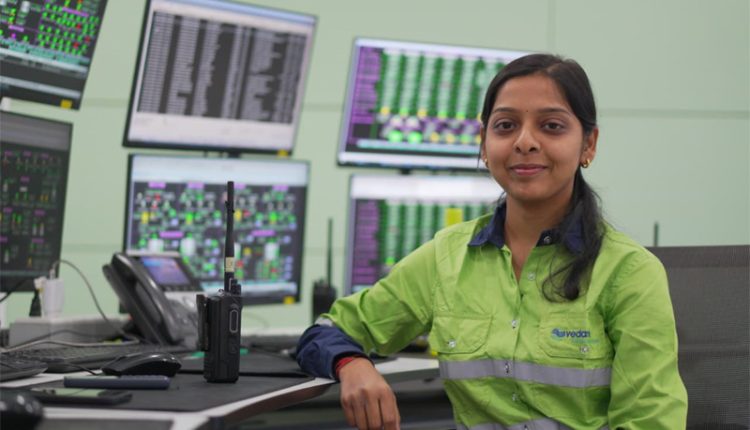
Priyanka works in one of the most critical sections of Vedanta Aluminium’s
Alumina Refinery — the Distributed Control System (DCS), widely regarded as the
nerve centre of plant operations. As a Control Room Operator, she monitors
essential process parameters such as temperature, pressure, flow and levels
through advanced real-time digital systems. Her responsibilities include
acknowledging alarms, maintaining zero overflow and zero trip conditions, and
taking preventive as well as corrective actions before any deviations escalate
into operational risks.
The
role demands exceptional precision, analytical ability and quick
decision-making. It also requires constant coordination with field operators
and process controllers, particularly during plant start-ups, shutdowns and
emergency situations. Handling such a high-responsibility position places
Priyanka at the very heart of refinery operations—an achievement that once
would have been considered unlikely for young women from remote industrial
regions.
Her
presence inside the core production control room represents a quiet yet
powerful shift. Traditionally dominated by men, the heavy industry sector is
now witnessing more women from local communities stepping into operational and
technical roles. With the right blend of education, training and opportunity,
these women are becoming an integral part of modern industrial workplaces.
Priyanka’s
story highlights how sustained investments in education and skill development
can translate into meaningful employment within the same ecosystem. From a
student in Lanjigarh’s first English-medium school to an operator managing the
refinery’s central control systems, her journey reflects the power of
opportunity created at the grassroots level.
Through
its continued focus on education, skill-building and inclusive employment,
Vedanta Aluminium is helping ensure that young women in Lanjigarh are not just
dreaming of opportunities—they are stepping forward to lead them. In doing so,
the company is contributing not only to industrial progress but also to the
larger narrative of social empowerment and community transformation in the
region.