
THEBUSINESSBYTES
BUREAU
NEW
DELHI, MAY 19, 2026
Reinforcing the
transformative potential of local creativity in shaping India’s development
trajectory, Dr. Jitendra Singh on Tuesday said that promoting grassroots
innovators can significantly strengthen the rural economy while reducing
regional imbalances through inclusive, innovation-led growth. He underlined
that India’s path to becoming a truly balanced and resilient economy depends on
integrating village-level ingenuity with formal scientific and technological
ecosystems.
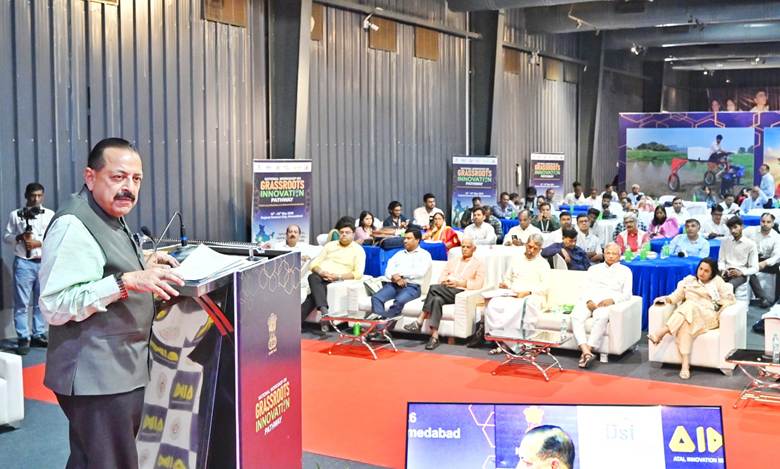
Addressing the
inaugural session of the two-day National Workshop on “Grassroots Innovation
Pathways: From Local Resilience to National Advancements” held at Science City
Ahmedabad, the Minister described grassroots innovators as “silent nation
builders” whose contributions often remain outside formal recognition systems
despite their deep societal and economic impact. The event has been organised
by NITI Aayog in collaboration with the National Innovation Foundation and the
Gujarat Council of Science & Technology (GUJCOST).
Dr. Singh emphasized
that innovation must not remain confined to metropolitan cities, laboratories,
or elite institutions, but must emerge organically from villages, small towns,
and community ecosystems where real-world challenges shape practical solutions.
He noted that many grassroots innovators, despite lacking formal academic
credentials, demonstrate exceptional problem-solving abilities rooted in lived
experience and traditional knowledge systems.
Recalling India’s
early scientific journey, he cited the pioneering efforts of India’s space
programme and the vision of Dr. Vikram Sarabhai, highlighting how
transformative achievements were made possible through determination and
indigenous capability even under resource constraints. He added that India’s
inherent strength lies in its ability to innovate frugally and effectively,
often turning limitations into opportunities.
The Minister stressed
the need to build strong institutional bridges between grassroots innovators
and formal innovation ecosystems, including research institutions, incubators,
and industry partners. He observed that while numerous government initiatives
exist to support innovation, many local innovators remain disconnected from
these frameworks, limiting the scaling potential of their ideas.
Highlighting emerging
trends, Dr. Singh noted the rapid rise of startups from Tier-2 and Tier-3
cities, calling it a clear indication of India’s expanding innovation footprint
beyond major urban centres. He also underscored the importance of integrating
traditional knowledge with modern technologies such as Artificial Intelligence
and advanced food processing techniques to enhance the commercial viability of
local products, citing successful examples involving millet-based innovations.
He further stated
that grassroots innovation must be treated as a strategic economic priority, as
rural empowerment is essential for achieving balanced national growth.
According to him, such innovation ecosystems can generate employment, foster community
entrepreneurship, and significantly reduce regional disparities.
Linking policy
direction with leadership vision, the Minister highlighted that Prime Minister
Narendra Modi has consistently promoted grassroots participation through
initiatives such as “Mann Ki Baat” and PM Vishwakarma, which aim to preserve
traditional skills while connecting them with technology and market
opportunities.
The workshop features thematic sessions on institutional enablers, community-driven innovation, and regional innovation models, with discussions expected to focus on policy frameworks, incubation support, and scalable mechanisms to strengthen India’s grassroots innovation landscape.
Concluding his address, Dr. Singh expressed confidence that sustained efforts in this direction would help build a more inclusive and interconnected innovation ecosystem, enabling innovators from rural and remote regions to play a central role in India’s journey towards Viksit Bharat @2047.