
THEBUSINESSBYTES
BUREAU
NEW
DELHI, OCTOBER 6, 2026
India on Tuesday
called for equal attention to adaptation, mitigation and means of
implementation as countries gear up for COP31, asserting that climate action
must be guided by equity and the principle of Common but Differentiated
Responsibilities and Respective Capabilities (CBDR-RC), while rejecting a
“one-size-fits-all” approach to tackling climate change.
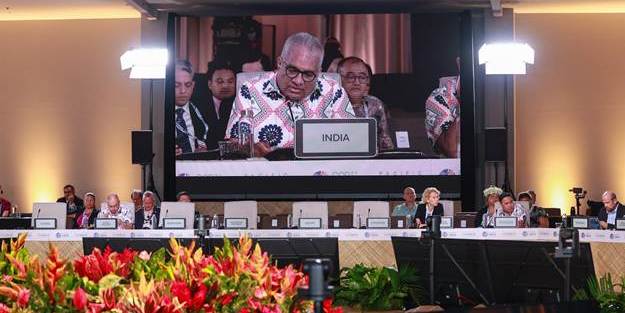
Union Environment,
Forest and Climate Change Minister Bhupender Yadav, leading the Indian
delegation at the UNFCCC’s Pre-COP31 meetings co-hosted by Australia, Fiji and
Tuvalu, made the remarks while addressing the Leaders’ Plenary in Fiji.
Yadav said meaningful
and sustained climate action requires solutions tailored to the specific
circumstances and vulnerabilities of individual countries and regions.
“There cannot be a one-size-fits-all pathway
to climate action,” he said, stressing the importance of local studies and
assessments to identify emerging challenges and determine appropriate
mitigation and adaptation measures, along with the resources required to
implement them.
The minister
emphasised that the principles of equity and CBDR-RC must be upheld “in letter
and spirit” as the global community advances towards COP31.
Highlighting India’s
own experience with climate vulnerabilities, Yadav said the country, with its
vast coastline and numerous islands, fully understands the challenges
confronting Pacific Island Countries.
He said India has
developed extensive expertise in ocean science through institutions such as the
Indian Space Research Organisation (ISRO), National Centre for Sustainable
Coastal Management (NCSCM) and National Centre for Coastal Research (NCCR).
India has built
capabilities in areas including coastal vulnerability assessment, mapping
shoreline changes, marine spatial planning, integrated coastal-area management
and unlocking the potential of the Blue Economy, he said.
Yadav also
highlighted the growing use of India’s space ecosystem, Earth-observation
capabilities and space-based applications for shoreline monitoring, inundation
assessment, cyclone and extreme-weather early warning, and climate-risk
assessment.
Offering to share
these capabilities with Pacific partners, he said India was ready to contribute
its coastal resilience and space-based expertise to help address the region’s
climate challenges.
The minister said
India has consistently stood with its Pacific partners and is working closely
with them across sectors such as health and wellness, renewable energy,
resilient infrastructure, early warning systems, information technology,
agriculture and capacity building.
Referring to his
recent visit to Tuvalu, Yadav said the Tuvalu Coastal Adaptation Project
demonstrated how international cooperation and adequate means of implementation
can translate into tangible resilience on the ground.
The experience, he said, further reinforced the importance of developing local solutions to emerging climate challenges.
Pre-COP is a preparatory meeting held a few weeks ahead of the annual UN Climate Change Conference. COP31 is scheduled to be held in Antalya, Türkiye, in November this year.