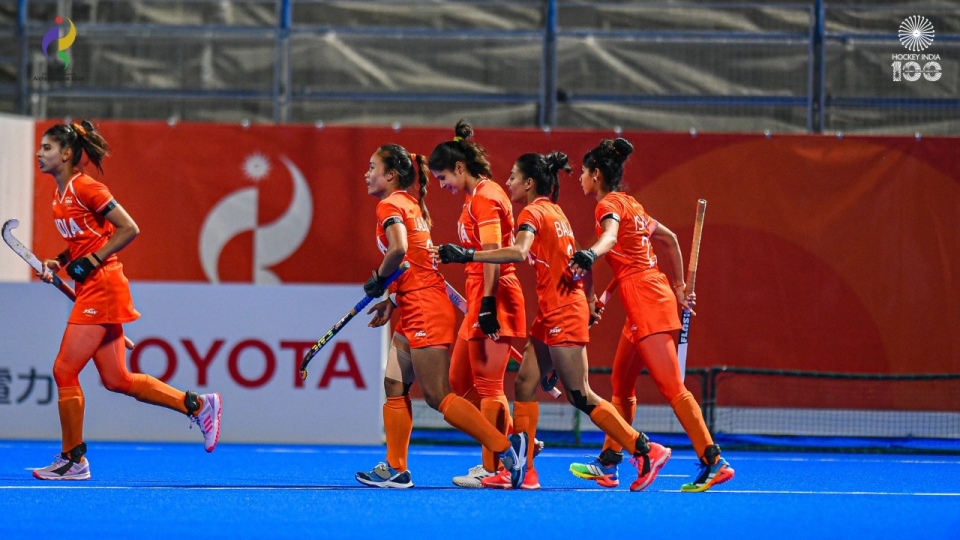
Lalremsiami’s
strike, Savita’s save script India’s golden return after 44 years
THEBUSINESSBYTES
BUREAU
KAKAMIGAHARA,
OCTOBER 2, 2026
Indian women’s hockey
finally reclaimed its place at the top of the Asian Games podium on Friday,
ending a 44-year wait for gold with a hard-fought 1-0 victory over defending
champion and world No. 4 China. The triumph not only brought India its second
Asian Games gold in women’s hockey, and its first since 1982, but also secured
direct qualification for the Los Angeles 2028 Olympic Games.
On a day when
resilience mattered as much as flair, it was Lalremsiami and goalkeeper Savita
who emerged as the architects of India’s historic triumph. Lalremsiami, marking
her 200th international appearance, scored the decisive goal in the 10th
minute, while the experienced Savita produced a stunning penalty-stroke save to
keep China at bay.
China began with
greater possession and territorial control, but India created the first real
opening in the fourth minute. Baljeet Kaur combined with Ishika inside the
23-yard area and broke into the circle, only for a timely flat-stick tackle
from a Chinese defender to snuff out the opportunity.
China appealed for a
penalty corner in the seventh minute after a suspected foot, but the umpire
waved play on. A minute later, India were reduced to 10 players when Baljeet
received a green card and was sent off for two minutes.
India, however,
responded to the pressure with a move of the highest quality.
In the 10th minute,
captain Salima Tete began the attack with a purposeful run before combining
with Sakshi Rana inside the circle. Sakshi then picked out Lalremsiami, who
unleashed a superb reverse-stick strike from a difficult angle. The ball flew
into the Chinese goal, giving India a 1-0 lead.
Three minutes later,
India nearly doubled its advantage. A clever one-two between Baljeet and
Navneet Kaur on the right opened up the Chinese defence, but Navneet’s
trademark direct strike from the resulting penalty corner went narrowly wide.
China continued to
dominate possession, enjoying 55 per cent of the ball and making eight circle
entries to India’s four. Yet India’s compact defensive structure ensured that
Lalremsiami’s goal remained the difference.
The second quarter
belonged largely to China as it intensified the pressure. In the 19th minute,
the Chinese earned a penalty corner and attempted a variation aimed at a
first-time deflection, but Indian sticks intervened.
Another penalty
corner followed soon after, only for Navneet to produce a superb goal-line
save.
China came even
closer two minutes later. After a dangerous move inside the Indian circle, the
umpire awarded a penalty stroke. India opted not to take a video referral,
leaving Savita alone to face the challenge.
The veteran
goalkeeper responded in emphatic fashion, diving to her left to make a
magnificent save and preserve India’s slender advantage.
China kept probing,
but India’s defensive organisation remained disciplined. In the 24th minute,
Shilpi Dabas read the danger perfectly and intercepted a threatening Chinese
move near the goal-mouth as Savita covered the near post.
India went into the
interval 1-0 ahead despite China continuing to enjoy the greater share of
possession and circle entries.
The third quarter
produced another major defensive moment. China won a penalty corner in the 33rd
minute and, following another chance on goal, was initially awarded a penalty
stroke after the ball appeared to strike Navneet’s foot.
India immediately
referred the decision. The review overturned the penalty stroke and reduced it
to a penalty corner.
Salima Tete then
produced another vital intervention, blocking the flick with her flat stick.
The India captain injured her right hand in the process and left the field for
treatment, but her contribution underlined the defensive resolve that was
keeping China at bay.
China’s frustration
began to show as loose passes and unforced errors crept into its game. India,
meanwhile, remained resolute, even though its midfield movement was less fluent
than it had been in the opening two quarters.
The third quarter
ended goalless, with India still 1-0 ahead after 45 minutes. China had
increased its circle entries to 21, compared with India’s nine, but the elusive
equaliser remained out of reach.
The final quarter
became a test of India’s defensive character. With the clock ticking away,
China threw players forward in search of a leveller. India absorbed wave after
wave of pressure, maintaining its shape and refusing to surrender the precious
lead.
And then came the
final hooter.
Lalremsiami’s
magnificent strike had survived the Chinese onslaught, while Savita and the
Indian defensive unit stood firm when it mattered most.
India were Asian
Games champions once again — 44 years after their previous women’s hockey gold
in 1982.
For Salima Tete’s side, the triumph was built not merely on one goal but on a collective display of discipline, courage and defensive resilience.
And for Indian hockey, the victory carried an even greater reward: a direct ticket to the Los Angeles 2028 Olympic Games.
Photo Credit: Asian Hockey Federation