THEBUSINESSBYTES
BUREAU
NEW
DELHI, MARCH 15, 2026
Declaring that India
is entering a transformative era where innovation and advanced science will
shape the nation’s growth trajectory, Union Minister Jitendra Singh said the
country is witnessing the rise of a technology-driven development model that
will redefine national security, economic expansion and global competitiveness.
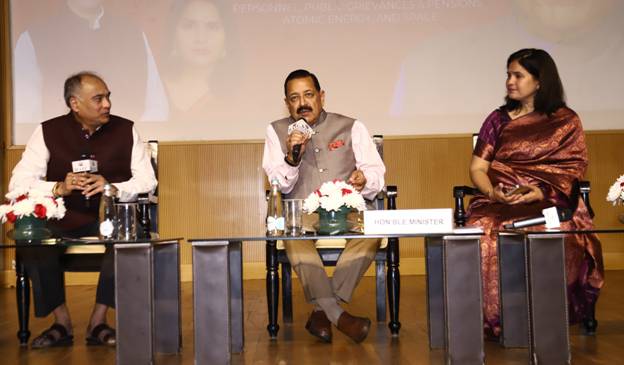
Speaking during a
fireside chat at the Alternate Media Conference titled “Unstoppable Bharat
2026” in New Delhi, the Union Minister of State (Independent Charge) for
Science & Technology and Earth Sciences noted that the nature of warfare
itself is undergoing a profound shift. He observed that traditional man-to-man
combat is steadily giving way to technology-driven strategic preparedness,
where advanced innovations increasingly determine the outcome of conflicts and
national defence capabilities.
 Dr Singh emphasised
that emerging domains such as space technology, nuclear energy, artificial
intelligence and cutting-edge scientific research will play a decisive role in
shaping India’s future security architecture as well as its broader national
development agenda. According to him, these sectors are not only strengthening
strategic capabilities but also creating new avenues for economic growth and
technological leadership.
Dr Singh emphasised
that emerging domains such as space technology, nuclear energy, artificial
intelligence and cutting-edge scientific research will play a decisive role in
shaping India’s future security architecture as well as its broader national
development agenda. According to him, these sectors are not only strengthening
strategic capabilities but also creating new avenues for economic growth and
technological leadership.
Referring to recent
policy reforms in the space sector, the Minister said the decision to open the
sector to private participation and startups has triggered a vibrant ecosystem
of innovation. He pointed out that India today hosts a rapidly expanding
network of space startups, with industry players, research institutions and
young innovators collaborating to accelerate the country’s space economy in the
coming years.
Highlighting India’s
deep reservoir of scientific talent, Dr Singh said the government has been
steadily working to create an enabling environment that nurtures innovation
from an early stage. He referred to initiatives aimed at encouraging students
in schools and universities to pursue careers in science and technology, noting
that programmes such as Vigyan Jyoti are helping young learners—particularly
girls—discover opportunities in research, innovation and advanced scientific
careers.
He further observed
that building a strong scientific base requires students to identify their
aptitude early and pursue diverse fields of research. The Minister said the
National Education Policy 2020 has created greater academic flexibility,
enabling students to move across disciplines and explore emerging areas of
science and technology that are critical to the future knowledge economy.
Dr Singh also
underlined the strategic importance of energy security in an increasingly
digital world. He explained that nuclear energy will play a vital role in
supporting technologies such as artificial intelligence and large-scale data
centres that require uninterrupted and reliable electricity. Nuclear power, he
noted, provides a clean and dependable energy source and will remain a key
pillar of India’s long-term energy strategy.
The Minister also
highlighted the growing contribution of nuclear science in the healthcare
sector, stating that nuclear medicine is opening new possibilities in the
treatment of serious illnesses, including cancer and blood disorders. Expanded
research and greater industry participation, he said, will help make advanced
medical technologies more accessible to patients across the country.
Concluding his
remarks, Dr Jitendra Singh said India is entering a phase where deeper
collaboration between government institutions, private industry and the
scientific community will accelerate innovation and strengthen national
capabilities across sectors such as defence, healthcare, clean energy and
advanced technologies.