THEBUSINESSBYTES
BUREAU
NEW
DELHI, SEPTEMBER 28, 2026
India and France are set to take their decades-old space
partnership into a new phase, with greater emphasis on human spaceflight,
microgravity research, astronaut health, start-ups and building a wider
new-space ecosystem, Union Minister of State for Science and Technology and
Space Jitendra Singh said on Monday.
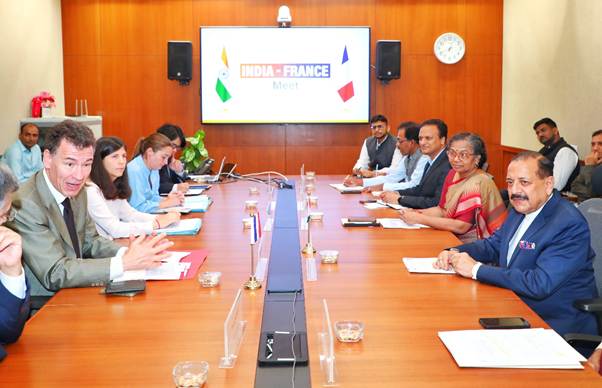
Singh made the remarks during a meeting with a high-level
French delegation led by French Minister for Higher Education, Research and
Space Philippe Baptiste in New Delhi, where the two sides reviewed the
expanding cooperation in space, science and technology, including priorities
under the India-France Year of Innovation 2026.
Tracing the partnership back to the sounding rocket experiments
of the 1960s, Singh said India-France space cooperation has evolved into a
broad relationship covering joint satellite missions, launch vehicle
technologies and human spaceflight.
He highlighted Megha-Tropiques and SARAL, jointly
developed by the Indian Space Research Organisation (ISRO) and France's CNES,
as important milestones, besides cooperation in launch vehicle engine
development.
The minister said work on the third joint satellite,
TRISHNA, is progressing well and appreciated French support to India's
Gaganyaan human spaceflight programme, including the supply of consumables and
training of flight surgeons.
Indian and French teams have also begun discussions on
microgravity research and parabolic flights in connection with human
spaceflight, he said.
Singh said India's rapidly transforming space sector had
opened opportunities to take bilateral cooperation beyond traditional government-to-government
engagement and bring industries, research institutions and start-ups into the
partnership.
India now has more than 400 space start-ups working in
areas ranging from rocket and satellite building to space applications, he
said, adding that the next phase of cooperation could create a larger pool of
expertise, resources and commercial opportunities by connecting the private
ecosystems of the two countries.
The minister also underlined the importance of the
India-France Year of Innovation 2026, inaugurated by Prime Minister Narendra
Modi and the French President in February, as a platform for expanding
collaboration in emerging technologies.
He referred to the Water Cycle and TRISHNA Mission event
scheduled in Bengaluru on October 11, where ISRO will contribute outreach
material and senior officials will discuss the TRISHNA satellite and its
applications.
The space partnership, Singh said, is part of a much wider
scientific relationship encompassing biotechnology, digital sciences and technologies
and ocean sciences. He pointed to institutions and mechanisms such as the
Indo-French Centre for the Promotion of Advanced Research (CEFIPRA) and
Indo-French joint centres as important channels of sustained scientific
engagement.
The two countries also see scope for deeper collaboration
in the Blue Economy and ocean sciences, including India's Deep Ocean Mission,
which seeks to explore the scientific and resource potential of the deep
oceans, Singh said.
Baptiste said France shares India's vision of taking
bilateral cooperation forward in science, technology and space and expressed
interest in expanding collaboration in human spaceflight, astronaut health,
microgravity research and parabolic flights.
He described TRISHNA as a strong example of what India and
France can achieve together and welcomed efforts to connect research
institutions and start-ups in the two countries.
The discussions assume added significance as India and France mark the Year of Innovation 2026, with the partnership expanding simultaneously across space, science, technology, biotechnology, digital technologies and ocean sciences.
The engagement, officials said, is expected to provide fresh momentum to a longstanding partnership while opening greater opportunities for institutional, industrial and start-up collaboration in emerging areas of the space and science economy.