THEBUSINESSBYTES
BUREAU
NEW
DELHI, JULY 15, 2026
India and the United
Kingdom on Wednesday operationalised their landmark Comprehensive Economic and
Trade Agreement (CETA), ushering in one of the most significant bilateral trade
partnerships in recent years. The pact grants duty-free access to nearly 99 per
cent of India's exports to the UK, while the accompanying Double Contribution
Convention eases the social security burden on Indian professionals, setting
the stage for a major boost in trade, investment, services and workforce
mobility between the two countries.
The implementation
follows the completion of all ratification and internal approval processes by
both governments, transforming years of negotiations into a comprehensive
economic framework aligned with India's vision of Viksit Bharat 2047. The
landmark pact is set to redefine commercial engagement between the two
countries by creating new opportunities across manufacturing, agriculture,
services, innovation and digital trade.
A major highlight of
the agreement is the immediate elimination of import duties on nearly 99 per
cent of India's exports to the UK, covering almost the entire value of
bilateral merchandise trade. This is expected to give Indian exporters a
decisive competitive edge in one of the world's largest consumer markets by
removing long-standing tariff barriers across key sectors including textiles,
leather, footwear, marine products, engineering goods, auto components,
chemicals, pharmaceuticals and processed foods.
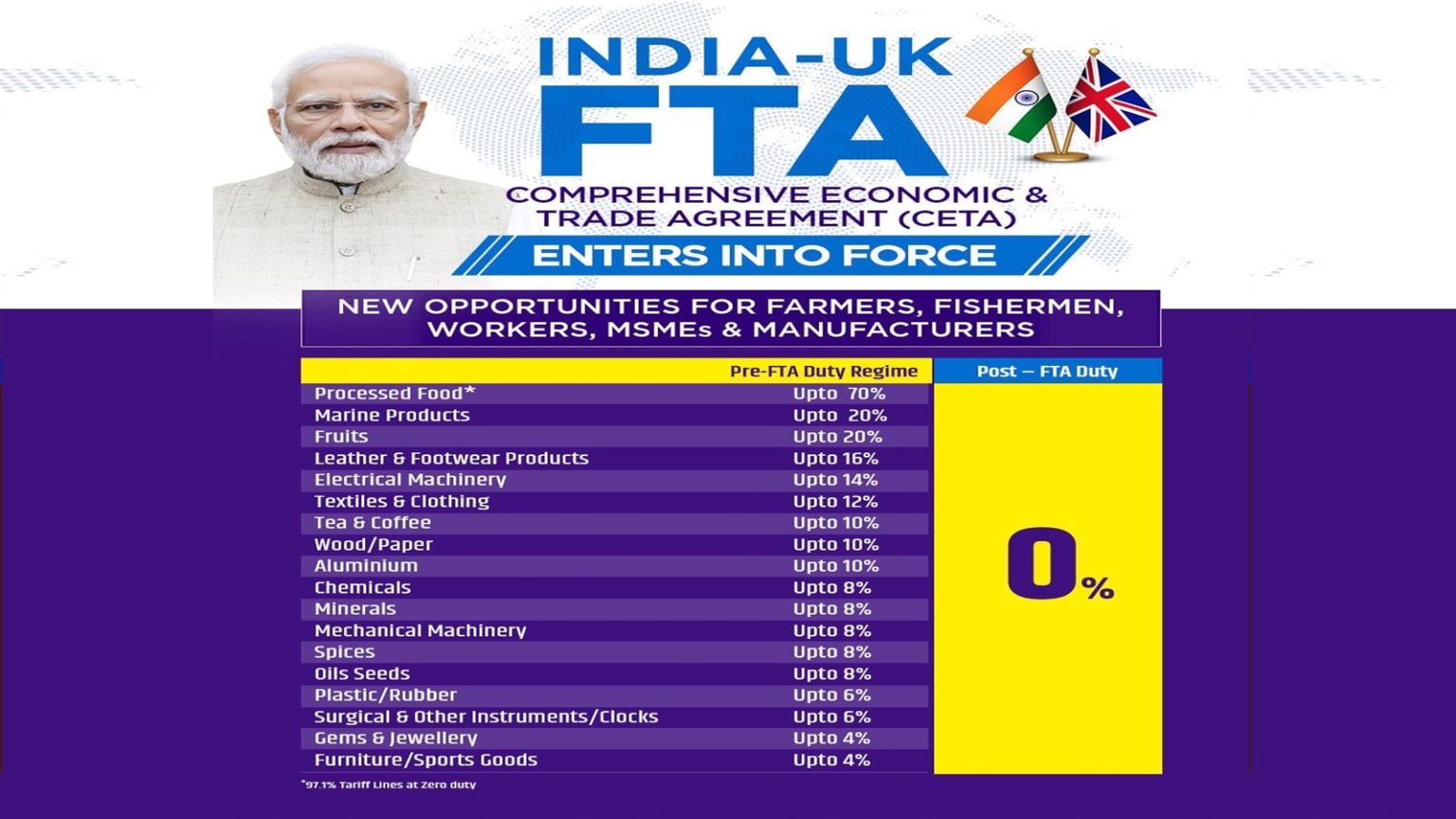
Products that earlier
attracted tariffs as high as 70 per cent on processed food, 21.5 per cent on
marine products, 18 per cent on engineering goods and auto components, 16 per
cent on leather goods, 12 per cent on textiles and clothing, and 8 per cent on
chemicals and pharmaceuticals will now enjoy zero-duty market access. The
government expects this to generate fresh export opportunities for farmers,
fishermen, MSMEs, manufacturers and artisans while boosting employment in
labour-intensive industries.
At the same time,
India has safeguarded sensitive domestic sectors by excluding products such as
dairy, cereals, millets, edible oils, oilseeds, apples and several vegetable
products from tariff liberalisation, ensuring that rural livelihoods and
agricultural interests remain protected.
The services sector
is also poised for substantial gains, with the United Kingdom offering one of
its most comprehensive market access commitments ever made to India, covering
all major services sectors and 137 sub-sectors. Indian companies and
professionals in information technology, financial services, healthcare,
education, engineering, telecommunications, consultancy and other
knowledge-driven industries are expected to benefit from greater regulatory
certainty and improved market access.
The agreement also
introduces structured mobility pathways for business visitors, intra-corporate
transferees, investors, contractual service suppliers and independent
professionals. In a first-of-its-kind arrangement, the UK will provide
dedicated annual mobility opportunities for 1,800 Indian chefs, yoga
instructors and classical musicians, opening fresh avenues for skilled
professionals.
Complementing the
trade pact, the Double Contribution Convention brings significant relief to
Indian professionals working on temporary assignments in the UK by extending
the exemption from dual social security contributions from three years to five
years. The government estimates that more than 75,000 Indian professionals and
over 900 companies will benefit from the move, reducing employment costs while
supporting greater workforce mobility.
The journey towards
the historic agreement began in May 2021 with the launch of the India-UK
Enhanced Trade Partnership and the Roadmap 2030, which envisaged doubling
bilateral trade to USD 100 billion by 2030. Following fourteen rounds of
negotiations, CETA was concluded in May 2025, formally signed in London in July
2025 by Union Commerce and Industry Minister Piyush Goyal and UK Secretary of
State for Business and Trade Jonathan Reynolds in the presence of Prime
Minister Narendra Modi and British Prime Minister Sir Keir Starmer. The
companion Double Contribution Convention was signed in February 2026.
Describing the
agreements as a landmark achievement in India's economic diplomacy, Commerce
and Industry Minister Piyush Goyal said the simultaneous implementation of CETA
and the Double Contribution Convention would unlock substantial new opportunities
for Indian exports while protecting domestic interests. He noted that the
agreement removes long-standing tariff barriers for exporters, incorporates
robust safeguards for sensitive agricultural sectors and protects the financial
interests of Indian professionals working temporarily in the UK.
Spread across 30
chapters, CETA establishes a next-generation trade framework that extends
beyond tariff liberalisation to include digital trade, telecommunications,
financial services, intellectual property, government procurement, innovation,
sustainability, transparency and support for small and medium enterprises. The
government believes the modern, rules-based architecture will strengthen supply
chains, encourage technological collaboration and enhance India's long-term
economic competitiveness.
The agreements also
address concerns relating to steel exports by ensuring that 85 per cent of
India's steel shipments remain outside the scope of the UK's recently
introduced steel measures. For the remaining product categories, India has
secured protection through country-specific quotas, residual quotas and access
under the Authorised Use Scheme, minimising potential disruptions to exporters.
The government has
described CETA as a people-centric trade agreement designed to deliver
broad-based benefits across society by creating new export opportunities for
farmers, fisherfolk, manufacturers, women entrepreneurs, startups, MSMEs and
skilled professionals. With the agreements now operational, India and the
United Kingdom have established a comprehensive economic architecture that is
expected to drive sustained growth in trade, investment, innovation and
services while reinforcing India's ambition of becoming a globally integrated,
resilient and competitive economy.