
THEBUSINESSBYTES
BUREAU
NEW DELHI,
MARCH 19, 2026
India’s bioeconomy has witnessed a
remarkable transformation over the past decade, expanding nearly twenty-fold
from $10 billion in 2014 to over $195 billion in 2025, Union Minister Dr
Jitendra Singh said on Thursday, underscoring the sector’s growing significance
in the country’s economic landscape. The Minister highlighted that the
bioeconomy registered an impressive annual growth rate of 17–18 percent in the
past year alone, signaling India’s rapid emergence as a global biotechnology
powerhouse.
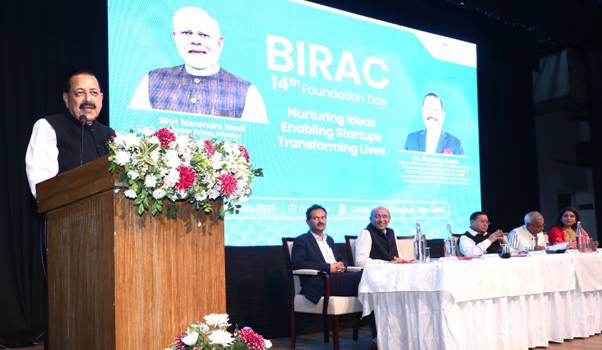
Speaking at the 14th Foundation Day
celebrations of Biotechnology Industry Research Assistance Council (BIRAC) in
New Delhi, Dr Singh emphasized that India is firmly on track to achieve its
ambitious $300 billion bioeconomy target by 2030. He noted that biotechnology
is increasingly becoming central to India’s development trajectory, catalyzing
innovation across healthcare, agriculture, climate solutions, and sustainable
manufacturing.
 The Minister credited BIRAC for
playing a pivotal role in nurturing India’s biotechnology ecosystem by bridging
the gap between research and industry, enabling the seamless translation of
ideas into commercially viable solutions. He highlighted that the sector’s
expansion is being powered by a vibrant base of over 11,800 startups, alongside
strong participation from scientists, entrepreneurs, and industry stakeholders.
The Minister credited BIRAC for
playing a pivotal role in nurturing India’s biotechnology ecosystem by bridging
the gap between research and industry, enabling the seamless translation of
ideas into commercially viable solutions. He highlighted that the sector’s
expansion is being powered by a vibrant base of over 11,800 startups, alongside
strong participation from scientists, entrepreneurs, and industry stakeholders.
Outlining the government’s strategic
vision, Dr Singh pointed to the BioE3 Policy — Biotechnology for Economy,
Environment and Employment — as a key driver of sustainable biomanufacturing.
The policy aims to accelerate innovation in cutting-edge domains such as
precision biotherapeutics, smart proteins, climate-resilient agriculture,
bio-based chemicals, and carbon capture technologies. He added that BIRAC is
strengthening this ecosystem through the development of shared infrastructure,
including bio-foundries, Bio-AI hubs, and advanced biomanufacturing platforms.
Further bolstering the sector, the
government’s Research, Development and Innovation (RDI) Fund, with an outlay of
₹1 lakh crore, is expected to provide
critical long-term capital for scaling up biotechnology ventures. Dr Singh
noted that BIRAC will play a central role in channeling investments into
high-potential, innovation-driven projects, thereby reinforcing India’s
deep-tech capabilities.
The occasion also marked the release
of the India Bioeconomy Report 2026 and the BIRAC Impact Report, which revealed
that the sector now contributes nearly 5 percent to India’s GDP, reflecting its
growing macroeconomic importance. The reports highlighted strong compounded
annual growth and showcased how targeted funding, incubation, and mentorship
have enabled the commercialization of technologies, expansion of startups, and
generation of employment opportunities.
Emphasizing inclusivity in innovation,
Dr Singh stressed the importance of nurturing young scientific talent,
particularly from tier-2 and tier-3 cities, and promoting participation from
students, researchers, and women entrepreneurs to build a robust, nationwide
innovation ecosystem.
Congratulating BIRAC on its milestone,
he called for deeper collaboration among science, industry, and policymakers to
translate innovation into scalable impact, positioning India as a global leader
in biotechnology while advancing the vision of a self-reliant and developed
nation.