
THEBUSINESSBYTES
BUREAU
NEW
DELHI, JULY 9, 2026
Integrated Textile
and Apparel Development Centres (ITADCs) are being transformed into one-stop
growth hubs to provide end-to-end support to textile entrepreneurs, micro,
small and medium enterprises (MSMEs), and other stakeholders, Union Textiles
Minister Giriraj Singh said on Thursday. He said the revamped centres would
play a pivotal role in strengthening India's textile ecosystem through skill
development, technology adoption, innovation, credit facilitation, export
promotion and market linkages.
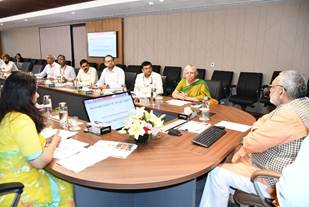
The Minister made the
remarks while chairing a high-level review meeting to assess the progress of
key initiatives aimed at modernising the textile sector through technology
upgradation, institutional reforms and enhanced industry support. The meeting
was attended by Textiles Secretary Neelam Shami Rao, Textile Commissioner
Vrunda Manohar Desai and senior officials of the Ministry of Textiles.
Reviewing the
transformation of the erstwhile Powerloom Service Centres into ITADCs, Singh
said the centres are being repositioned as integrated facilitation hubs capable
of supporting textile businesses from incubation to market expansion. The
revamped centres are expected to offer a comprehensive range of services,
including testing, design support, entrepreneurship development and
commercialisation of innovative textile products.
During the first
quarter of the financial year 2026-27, ITADCs trained more than 1,170
individuals and reached nearly 1,770 textile units through outreach programmes.
The centres also facilitated institutional credit, strengthened e-commerce
linkages, launched product-led entrepreneurship initiatives and promoted
commercialisation of emerging natural fibres such as bamboo, hemp, flax, banana
and pineapple.
The Minister also reviewed
the implementation of the Amended Technology Upgradation Fund Scheme (ATUFS),
highlighting its role in modernising the textile industry. According to an
independent third-party impact assessment, the scheme has supported 10,061
textile units with subsidy assistance of ₹2,776 crore, leveraging investments exceeding ₹53,121
crore. It has enabled the installation of nearly 6.7 lakh benchmarked textile
machines and generated around 3.6 lakh direct jobs.
The assessment
revealed that every ₹1
crore of subsidy under ATUFS mobilised nearly ₹19 crore of private investment while
creating about 130 direct jobs. It also found that 46 per cent of the subsidy
was utilised by the weaving sector, while composite textile units accounted for
nearly 1.7 lakh, or 46 per cent, of the new employment
generated under the scheme.
As part of the
Ministry's digital initiatives, Singh inaugurated the revamped website of the
Office of the Textile Commissioner. The upgraded portal features a
user-friendly interface, comprehensive information on schemes and services,
interactive maps of ITADCs and powerloom clusters, improved accessibility
features and a uniform design aligned with the Ministry's digital identity.
The Minister also
launched a new Key Performance Indicator (KPI) Portal for ITADCs to enable
real-time monitoring of institutional performance through digital dashboards,
field-level data capture, benchmarking and structured review mechanisms. The
portal is expected to improve governance, transparency and service delivery
across ITADCs nationwide.
Addressing the
meeting, Singh said the integrated centres would anchor India's next phase of
textile growth by serving as one-stop facilitation hubs for entrepreneurs and
industry. He said the initiative would strengthen MSMEs, boost exports,
generate sustainable employment and contribute to building a globally
competitive and self-reliant textile sector.
Textiles Secretary Neelam Shami Rao stressed the need for greater institutional convergence, calling for closer coordination among field formations, the Textile Committee, Export Promotion Councils, Textile Research Associations and industry bodies to maximise the impact of government initiatives and improve service delivery across the textile value chain.
The Minister also directed all field offices to work closely with State Governments and industry associations to ensure effective implementation of schemes and wider outreach to textile enterprises. The meeting concluded with a reaffirmation of the Ministry's commitment to strengthening institutional support, accelerating technology upgradation, promoting entrepreneurship and building an innovation-driven, employment-intensive textile sector.