
THEBUSINESSBYTES
BUREAU
MUMBAI,
JUNE 19, 2026
Reliance Jio Infocomm
Ltd. achieved a historic milestone in FY26 with its Profit After Tax (PAT)
crossing ₹30,000
crore for the first time, registering a 15.1 per cent year-on-year growth and
underscoring the telecom giant’s strong profitability amid rapid digital
expansion. The achievement was announced by Reliance Jio Infocomm
Ltd. Chairman Akash
Ambani at the 49th Annual General Meeting (Post-IPO) of
Reliance Industries Limited (RIL) held in Mumbai on Friday.
Highlighting Jio’s
remarkable decade-long journey, Ambani said the company has evolved into one of
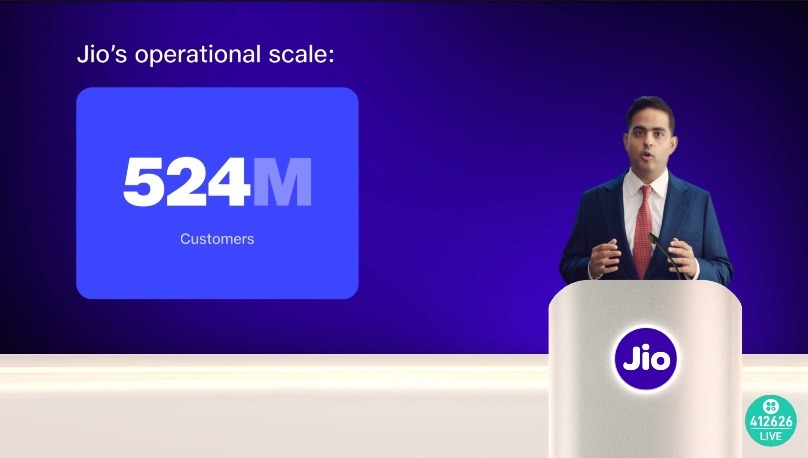
the world’s largest digital service providers, with its subscriber base
surpassing 524 million users. Jio’s 5G customer base has crossed 268 million,
making it the largest single-country 5G network operator outside China, with 77
million net additions during FY26 alone.
Jio Platforms posted
revenue of ₹1,46,885
crore in FY26, reflecting a robust 14.6 per cent annual growth. EBITDA rose
18.8 per cent to ₹76,255
crore, while EBITDA margin improved by 190 basis points to 51.9 per cent,
highlighting the company’s ability to scale profitably while maintaining operational
efficiency.
The company’s network
handled an unprecedented 241 exabytes of data traffic during the year,
registering a 30.8 per cent increase over FY25 and reinforcing Jio’s position
among the world’s largest data operators. Average monthly per-capita data
consumption reached 42.3 GB, among the highest globally.
A major highlight of
the AGM was the unveiling of JioHome’s next-generation broadband vision. Ambani
announced that Jio’s Multi-Gigabit-ready JioAirFiber will now offer speeds of
up to 5 Gbps download and 1 Gbps upload, enabling households to seamlessly
support multiple high-bandwidth activities simultaneously.
He said the future of
connectivity is no longer merely about internet access but about transforming
every home into an intelligent digital hub. With connected devices multiplying
rapidly in Indian households, the enhanced JioAirFiber network is designed to
support ultra-high-definition streaming, cloud gaming, immersive online
education, video conferencing and other bandwidth-intensive applications
without interruption.
The multi-gigabit
wireless technology, developed in India, is expected to pave the way for
widespread adoption of 8K entertainment, multi-screen experiences and
next-generation digital services. Ambani noted that significantly faster
download speeds will allow large files and content-rich applications to be
accessed within seconds, while the 1 Gbps upload capability will enable homes
to function as fully connected global workplaces supporting real-time
collaboration across geographies.
He further emphasized
that India is entering a new era of spatial computing, where artificial
intelligence, extended reality (XR) and volumetric video technologies will
create highly immersive and interactive digital experiences. The company sees
intelligent homes becoming centres for learning, entertainment, work and
creativity, powered by advanced broadband infrastructure.
JioAirFiber, which
already connects more than 13 million homes across the country, continues to
scale rapidly. More than 90 per cent of installations are completed within 24
hours, while new home connections are growing at a rate of up to 60,000 per
day, making reliable high-speed broadband accessible even in locations where
fibre deployment remains challenging.
Looking ahead, Ambani
outlined five strategic commitments that will drive Jio’s next phase of growth.
These include accelerating nationwide adoption of JioTrue5G, expanding
broadband penetration through JioAirFiber, digitising enterprises and small
businesses through the cloud-powered JioPC platform, embedding artificial
intelligence across consumer and enterprise services, and taking Jio’s
indigenous technology stack to international markets.
He said Jio aims to
migrate all subscribers to 5G by 2030 while simultaneously contributing to the
development of global 6G standards. The company expects its average revenue per
user (ARPU) to rise significantly as it rolls out premium 5G offerings,
AI-enabled services and advanced enterprise solutions.
In another
significant announcement, Ambani revealed Jio’s plans to enter the satellite
communications segment. The company is evaluating the development of a
sovereign Low Earth Orbit (LEO) satellite constellation for India while also
partnering with leading global satellite operators by leasing capacity to accelerate
service rollout.
Jio is building its
own ground station infrastructure across India to support both partner
constellations and future indigenous satellites, creating a comprehensive
satellite broadband ecosystem. The initiative aims to bridge connectivity gaps
in remote villages, island regions and border areas where terrestrial networks
remain difficult to deploy.
Describing satellite
broadband as the next frontier of digital inclusion, Ambani said the dual
strategy of global partnerships and sovereign capability would strengthen
India’s technological self-reliance while positioning the country as a major
player in the global satellite broadband ecosystem.
“With these initiatives, the best of Jio is
yet to come,” he said, signalling the company’s ambition to lead India’s
digital transformation across telecommunications, artificial intelligence,
cloud computing, broadband and space-based connectivity.