THEBUSINESSBYTES BUREAU
NEW DELHI, MAY 30, 2026
Launching an ambitious nationwide effort to promote sustainable farming
and strengthen rural agricultural resilience, Union Minister for Agriculture
& Farmers Welfare and Rural Development Shivraj Singh Chouhan has called
for the month-long “Khet Bachao Abhiyan” to evolve into a comprehensive
people-centric movement connecting farms, farmers and villages across the
country.
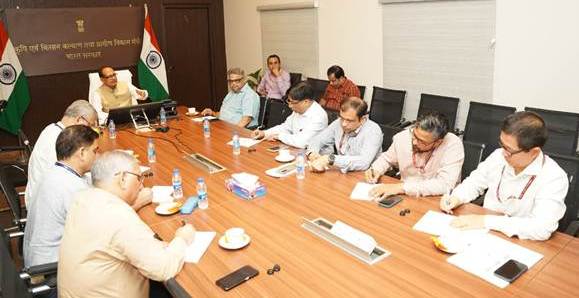
Chairing a high-level review meeting in Delhi on Saturday to assess
preparations for the campaign, which will run from June 1 to June 30, Chouhan
emphasized that the initiative should go beyond awareness generation and emerge
as a national mission focused on balanced fertiliser use, weather-responsive
farming practices, grassroots participation and doorstep delivery of government
benefits.
The Union Minister said the campaign’s core objective would be to
safeguard agricultural productivity while reducing cultivation costs through
scientific and sustainable farm management. Stressing that the programme would
not follow a top-down administrative approach, he directed officials to ensure
active collaboration among Panchayats, States and the Central Government to
make the initiative impactful and outcome-oriented.
Chouhan underscored that curbing the indiscriminate use of chemical
fertilisers would remain a key focus area of the campaign. Farmers will be
encouraged to adopt balanced nutrient management based on soil testing and
increase the use of green manure, organic inputs and bio-products.
Demonstrations on Integrated Nutrient Management (INM) will be conducted at the
grassroots level to promote scientific farming practices and improve long-term
soil health.
Highlighting the growing challenges posed by changing weather patterns,
the Minister said farmers would receive practical, field-level advisories
tailored to local conditions. Guidance on crop selection, diversification
strategies, water-efficient farming methods and precautionary measures during
adverse weather events will be provided. He stressed that the campaign aims not
merely to disseminate information but to equip farmers with actionable
solutions relevant to their specific circumstances.
The campaign will also seek to strengthen rural institutional
participation by creating a robust framework at the Panchayat level. Chouhan
instructed officials to integrate the distribution of agricultural machinery
and the outreach of various government welfare programmes into campaign
activities so that farmers can directly access available benefits.
Emphasizing broad-based public engagement, the Minister said the campaign
would not remain confined to departmental boundaries. Chief Ministers of States
will be requested to support the initiative, while efforts will be made to
involve ministers, Members of Parliament, MLAs and other elected
representatives. According to Chouhan, such participation will infuse the
campaign with political, social and community momentum, helping it evolve into
a powerful model of public participation from the outset.
Officials informed the meeting that Krishi Vigyan Kendras (KVKs) have
been designated as the principal coordinators for participating institutions.
More than 1,600 teams have already been constituted to implement the campaign.
Of these, 500 teams will focus on 100 districts identified for excessive
fertiliser use. These teams will comprise scientists from KVKs, ICAR
institutes, AICRP centres and Agriculture Department officials. In addition,
over 1,150 multidisciplinary teams from ICAR institutes and KVKs will
simultaneously undertake outreach and advisory activities across the country.
The Minister further noted that the initiative would adopt a holistic
approach extending beyond fertiliser management. It will facilitate access to a
range of agricultural and welfare schemes, including enrolment of eligible
farmers under Kisan Credit Card and PM-KISAN, while promoting programmes
related to pulses and oilseeds, oil palm cultivation, the Cotton Mission,
balanced nutrition, soil health management, water conservation and
region-specific agricultural advisories.
Chouhan said the true success of the campaign would depend on visible
impact at the grassroots level and meaningful participation from local
institutions. He reiterated that balanced fertiliser use, climate-responsive
farming advice, Panchayat-led implementation, access to agricultural machinery
and welfare schemes, and active involvement of public representatives would
form the foundation of the initiative.
“The direction of the campaign is
quite clear: save the farms, manage the costs, improve the soil, make farmers
aware and develop a new culture of agricultural management at the village
level,” he said, outlining a vision aimed at fostering sustainable agriculture
and empowering rural communities across India.