
THEBUSINESSBYTES
BUREAU
KOLKATA,
JULY 19, 2026
Describing language
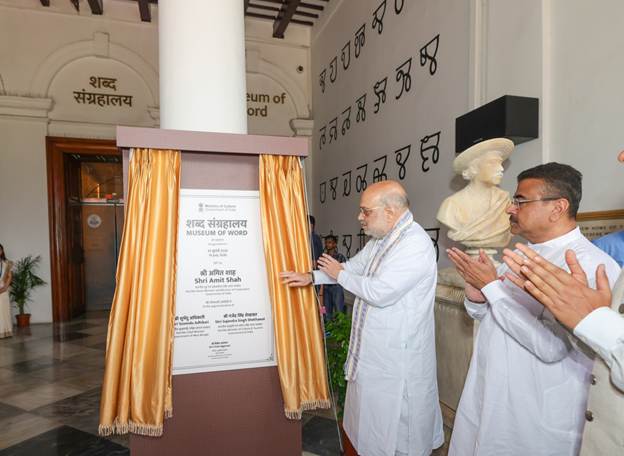
as the soul of civilization and words as the foundation of culture, Union Home
Minister and Minister of Cooperation Amit Shah on Sunday inaugurated the first
phase of the Museum of Word in Kolkata, asserting that the pioneering
initiative will become a powerful medium to carry the journey of India's
languages, culture, and cultural renaissance to future generations. Calling the
occasion a historic milestone, Shah said the museum gives concrete shape to
Prime Minister Narendra Modi's vision of a cultural renaissance by preserving
India's multilingual consciousness, knowledge traditions, and collective memory
through immersive, visual, and auditory experiences.
The inauguration
ceremony was attended by West Bengal Chief Minister Suvendu Adhikari, Finance
Minister Swapan Dasgupta, Union Home Secretary, Union Culture Secretary,
Director of the Intelligence Bureau (IB), and several other distinguished
dignitaries.
Addressing the
gathering, Shah said that the culture of any nation finds expression through
its language, while language itself is built upon words born from human
emotions. He emphasized that future generations must understand this intrinsic
relationship between words, language, and culture to ensure India's
civilizational continuity. Expressing confidence in the museum's transformative
role, he said it would preserve the nation's linguistic heritage while
inspiring generations to embrace India's rich cultural legacy.
Highlighting the
museum's unique concept, Shah said it beautifully narrates the evolution of
language — from the sacred Omkar and Panini's grammar to the Shrutis, Smritis,
manuscripts, inscriptions, the printing press, and the digital era. He noted
that the initiative captures India's intangible heritage in a tangible,
immersive format, enabling visitors to experience the science of words through
artefacts, handwritten manuscripts, copper plates, Bhojpatra texts, printed
books, folk traditions, and audio-visual exhibits.
Quoting the Rigveda, Shah said Indian civilization
has always welcomed noble ideas from every direction and has never allowed
narrow-mindedness to shape its cultural foundation. He observed that India's
prayers seek peace not only for humanity but for all living beings and the
universe, reflecting the inclusive and universal character of Indian thought.
The Home Minister
stressed that the Museum of Word must evolve further by integrating digital
technologies and Artificial Intelligence to ensure Indian languages remain
relevant in the technological age. He said India has consistently embraced
innovation without compromising its cultural values and urged that the
country's linguistic wealth be made AI-enabled to preserve its vitality for
centuries to come.
Shah remarked that
every gallery of the museum has been scientifically curated, beginning with the
origins of language and tracing its evolution through myths, lullabies, and
sensory experiences. He underlined the deep emotional connection every
individual shares with their mother tongue and said this attachment should
become an enduring part of one's personality.
Describing
linguistics as a naturally evolving science shaped by human needs, Shah
acknowledged the contributions of countless poets, writers, and scholars who
enriched India's diverse languages. He said the museum honours these literary
icons through a dedicated gallery while inspiring young people to value
language as a vehicle of knowledge and creativity.
Calling upon the
youth to cultivate reading habits, Shah said the future of a nation depends not
merely on the strength of its universities but on how many young minds visit
libraries. He urged students to make libraries an integral part of their
intellectual and personal development.
Reflecting on
Bengal's cultural legacy, Shah described the state as a historic beacon of
India's civilizational consciousness and the land of Maharshi Aurobindo, Swami
Vivekananda, Ramakrishna Paramahansa, Chaitanya Mahaprabhu, Netaji Subhas
Chandra Bose, and numerous eminent scientists and litterateurs. He expressed
confidence that under the leadership of Prime Minister Narendra Modi and
Suvendu Adhikari, Bengal would once again emerge as a guiding force of India's
intellectual and cultural resurgence and reclaim its identity as "Sonar
Bangla."
Shah also highlighted
that the inauguration coincides with the nationwide celebration of the 150th
anniversary of Vande Mataram, calling it a fitting moment to launch a museum
dedicated to the power of words. He expressed satisfaction that the complete
rendition of the national song is now being sung in schools across the country,
fostering deeper patriotic consciousness among younger generations.
Recalling that the
Modi government conferred Classical Language status on Bengali in 2024, Shah
also paid tribute to Dr. Syama Prasad Mookerjee, noting that he had invited
Gurudev Rabindranath Tagore to deliver the first convocation address in an
Indian language at the University of Calcutta during British rule.
Emphasizing that language shapes humanity rather than the other way around, Shah outlined five guiding principles for preserving India's linguistic heritage: making the family the first school of language, ensuring education begins in the mother tongue, transforming universities into centres of original thought, enabling every Indian language through digital technologies and AI, and taking libraries and museums beyond physical spaces through public outreach. He also encouraged every young Indian to learn at least one additional Indian language alongside their mother tongue to strengthen national unity and preserve the country's rich linguistic diversity.
Concluding his address, Shah called upon the nation to strengthen its culture through the power of words, saying a confident civilization rooted in its linguistic heritage would pave the way for a Viksit Bharat by 2047 and help restore Bharat's position as the Vishwa Guru. He described the Museum of Word as a visionary institution that would play a foundational role in achieving that national aspiration.