THEBUSINESSBYTES
BUREAU
NEW
DELHI/BHUBANESWAR, OCTOBER 22, 2026
Odisha is finalising
its dedicated Agri-PV Policy 2026 to empower farmers by combining agricultural
production with solar power generation, Deputy Chief Minister Kanak Vardhan
Singh Deo said on Thursday, announcing an ambitious target of developing 1 GW
of agrivoltaic capacity in the state by 2030.
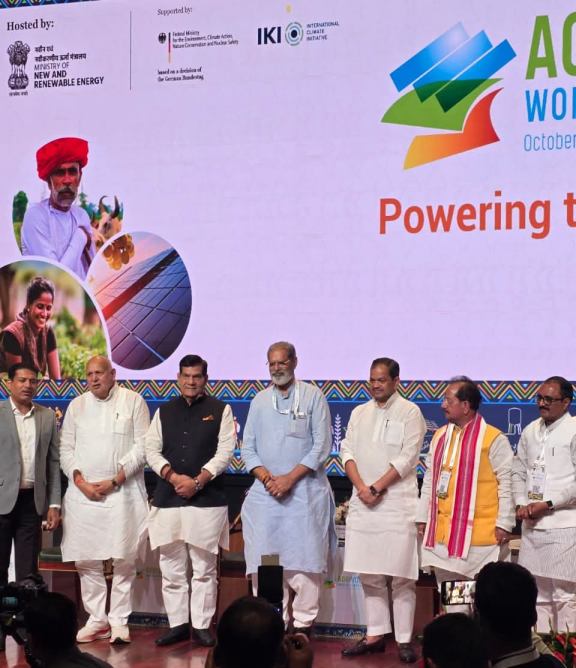
Addressing the 7th
Agrivoltaics World Conference 2026 at Bharat Mandapam in New Delhi, Singh Deo
said the proposed policy would promote the concept of "One Field, Two
Harvests", enabling farmers to earn income from both crop cultivation and
clean energy generation while safeguarding agricultural land.
"We want to make
our farmers empowered with Annadata se Urjadata tak," the Deputy Chief
Minister said during his keynote address at the ministerial session,
co-organised with the Ministry of New and Renewable Energy, the International
Institute for Sustainable Development (IISD) and the Council on Energy,
Environment and Water (CEEW).
He said the policy
was being designed around the principle that farmers' interests must remain
paramount, with agricultural production taking precedence over solar power
infrastructure.
Odisha aims to become
the first state in India to introduce a dedicated policy for agrivoltaics, an
emerging approach that allows solar panels to be installed above agricultural
land, enabling farming and electricity generation to take place simultaneously.
 Under the proposed
framework, at least 90 per cent of the land covered by each project would have
to remain under active cultivation, with agricultural land classification and
eligibility for crop insurance protected. The safeguards are intended to ensure
that the expansion of renewable energy does not come at the cost of
agricultural activity or farmers' livelihoods.
The policy seeks to
provide farmers with flexible participation models, allowing them either to own
agrivoltaic systems and earn from both crop sales and electricity generation or
to partner with solar developers in return for assured long-term lease rentals.
To attract private
investment and provide greater certainty to project developers, the proposed
framework includes 25-year power purchase agreements with GRIDCO, assured power
offtake, grid connectivity and open-access provisions.
The state also plans
to simplify the process of bringing farmers into agrivoltaic projects by
integrating incentives with existing support for drip irrigation, solar pumps,
cold storage facilities and agro-processing, creating opportunities to improve
farm productivity alongside renewable energy generation.
Highlighting the
growing threat posed by climate change, Singh Deo said agrivoltaics could help
farmers adapt to rising temperatures and erratic rainfall, which are projected
to pose increasing challenges to agriculture in Odisha by 2070.
Elevated solar panels
can create cooler microclimates, reduce soil moisture loss and provide protection
from extreme heat for crops and agricultural workers, potentially strengthening
the resilience of small and marginal farmers, he said.
The proposed policy
is expected to combine climate-resilient agriculture with the state's clean
energy ambitions while creating additional income opportunities for rural
households.
Odisha's initiative
builds on the momentum generated by its Renewable Energy Policy 2022 and the
state's renewable energy investor conclave held in February 2026, which secured
clean energy investment commitments worth Rs 67,000 crore across projects with a
combined capacity of 6.8 GW.
Ground-level
implementation of agrivoltaics has already begun in the state with a 1 MW
project. Odisha is also pursuing a pilot collaboration with Singapore's Nanyang
Technological University to test advanced agrivoltaic technologies and assess
their suitability for local agricultural conditions.
According to the
state government's assessment cited at the conference, Odisha has around 40.7
lakh acres of suitable cropland and 47.7 lakh acres of fallow land that could
be examined for potential agrivoltaic applications.
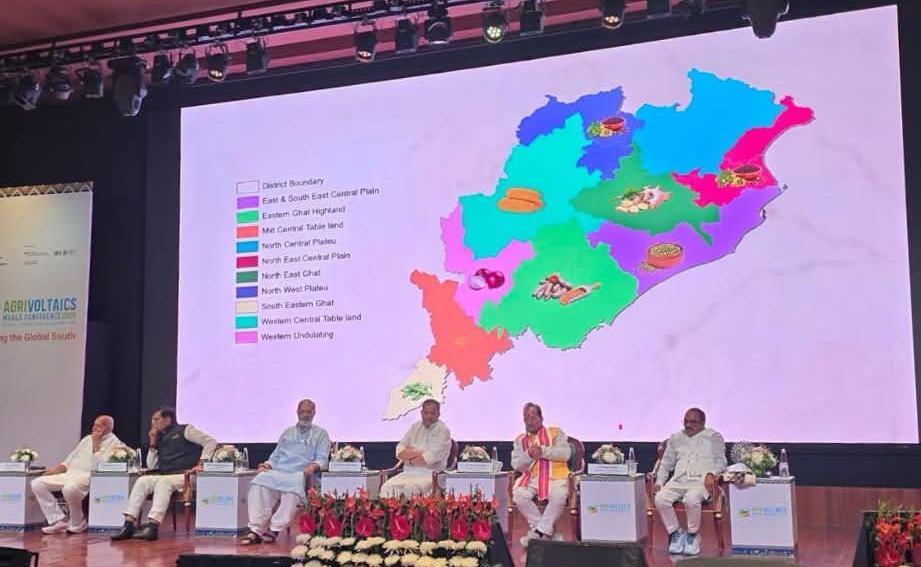
The proposed
deployment is expected to provide a framework for assessing the technical and
economic viability of combining farming with solar energy production across
different agricultural landscapes.
Concluding his
address, Singh Deo invited international research institutions, private
investors and other states to collaborate with Odisha in developing a
farmer-centric agrivoltaics ecosystem and advancing the model as a potential
component of India's clean energy transition.
The conference brought together international delegates, scientists, policymakers and investors to discuss the potential of agrivoltaics in reconciling food production with renewable energy generation.
Vishal Kumar Dev, Additional Chief Secretary in charge of Energy, Sachin Ramchandra Jadhav, Commissioner-cum-Secretary of Agriculture and Farmers' Empowerment, and other senior Odisha government officials also participated in the conference.