THEBUSINESSBYTES BUREAU
BHUBANESWAR, AUGUST 19, 2026
Odisha Chief Secretary Anu Garg on Wednesday emphasised that
technology interventions under the Business Reforms Action Plan (BRAP) 2026 and
District Business Reforms Action Plan (DBRAP) 2025-26 must translate reform
commitments into simple, transparent and end-to-end digital services for
businesses, with minimal physical interfaces, repeated document submissions and
avoidable delays.
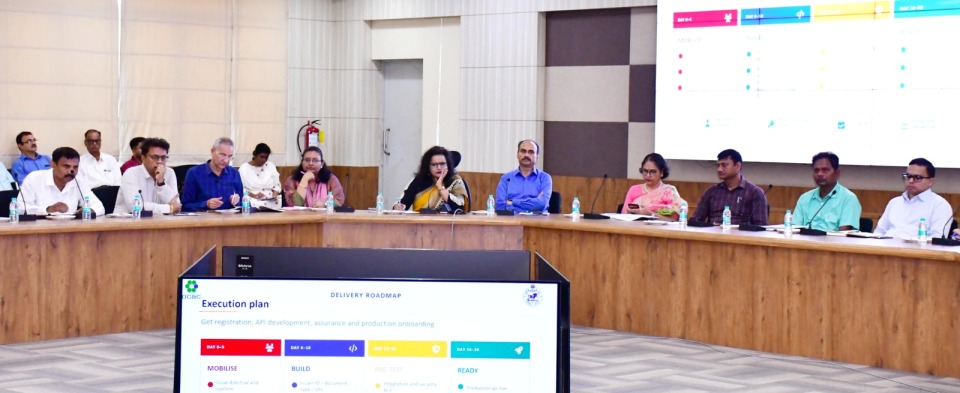
Garg made the remarks while chairing a high-level review
meeting to assess the implementation of IT-enabled reforms under BRAP 2026 and
DBRAP 2025-26, with a particular focus on expediting pending technology
interventions required for compliance.
The Chief Secretary emphasised that technology interventions
should translate the reform requirements into simple, transparent and
end-to-end digital services for businesses, while reducing physical interfaces,
repeated submission of documents and avoidable delays. Departments and their
System Integrators were asked to work closely with NIC and OCAC to close the
identified technical gaps within the stipulated timelines.
The meeting was attended by senior officials from 21
departments, their respective IT System Integrators, representatives of the
Odisha Computer Application Centre (OCAC) and the leadership team of the National
Informatics Centre (NIC).
Department-wise gaps were reviewed at the level of individual
services and reform points, with particular emphasis on completing pending
portal development, system integrations, onboarding Entity Locker on online
service modules and strengthening public dashboards.
ACS, Industries and MD, IPICOL presented the department-wise
status and action plans, while Principal Secretaries and
Commissioner-cum-Secretaries of the concerned departments participated in the
deliberations.
A major area of review was the integration of departmental
Government-to-Business (G2B) and Government-to-Citizen (G2C) services with GO
SWIFT and Odisha One. Departments were asked to ensure seamless two-way
integration so that applications can be routed through the appropriate
single-window platform and transaction status updated in real time.
Such integrations are also critical for automated monitoring
of industrial projects through state-level project tracking systems, officials
said.
The meeting also reviewed the adoption of Entity Locker
across departmental G2B portals. Entity Locker is envisaged as a common
repository through which documents already submitted to or issued by the
government can be securely fetched and reused, thereby reducing the need for
investors to repeatedly submit the same documents.
Integration with Entity Locker is also a specific requirement
under BRAP 2026. Departments where the integration is pending were asked to
immediately coordinate with their System Integrators and the concerned
technology agencies to complete the process.
Another key focus was the development and updation of public
dashboards covering applications, inspections and inspection reports.
Departments were directed to ensure that the dashboards provide district-level
information on applications received, approvals, pendency, statutory timelines
and processing time.
Inspection dashboards are also required to capture adherence
to prescribed timelines and uploading of inspection reports, the meeting was
told.
The review further covered specific IT interventions relating
to online land and property records, Revenue Court dashboards, property tax
information, GST monitoring, building approvals, electricity services,
employment services, health and education-related approvals and other G2B
services covered under BRAP and DBRAP.
Garg stressed the need for close coordination among
departments, their System Integrators, NIC, OCAC and IPICOL, with clear
ownership of each pending intervention. All departments were asked to accord
priority to reforms involving portal development and integration and ensure
that technical dependencies are resolved without delay.
As per the implementation schedule reviewed during the
meeting, the targeted IT reforms are to be implemented by August 31, 2026.
ACS, Industries and MD, IPICOL, as the nodal department and agency, were advised to further review the status and progress on August 25 and resolve pending issues, if any, so that the Reform Action Plans at the state and district levels are completed before the scheduled date.
The government reiterated its commitment to strengthening Odisha's business regulatory environment through technology-led reforms, greater transparency and simplified service delivery, with the objective of providing businesses and investors a faster, more predictable and seamless interface with the government.