
THEBUSINESSBYTES
BUREAU
BHUBANESWAR,
MARCH 26, 2026
The Odisha government has announced a
comprehensive new three-year excise policy that will come into effect from
April 1, 2026, and remain in force until March 31, 2029, marking a significant
shift in the state’s approach towards regulation of the liquor trade and
promotion of public health initiatives.
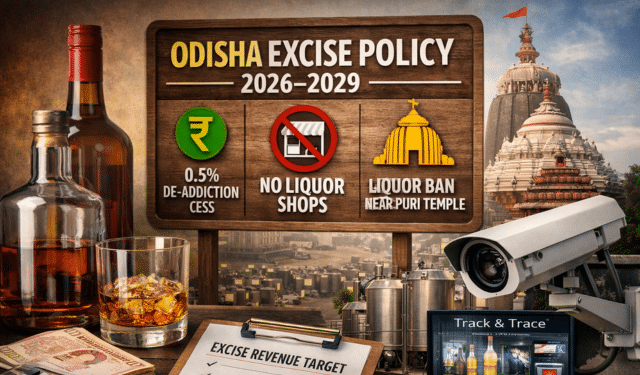
For the first time, the state has
officially recognised alcohol consumption as a harmful habit by introducing a
0.5 per cent “De-Addiction Cess” on excise duty. The revenue generated from
this cess will be utilised exclusively for establishing and operating model
de-addiction centres across Odisha, signalling a stronger focus on
rehabilitation and social well-being.
 Announcing the policy in the Odisha
Assembly on Thursday, Excise Minister Prithviraj Harichandan said the move from
an annual excise policy to a structured three-year framework is aimed at
bringing greater regulatory stability to the liquor sector while strengthening
de-addiction measures in the state.
Announcing the policy in the Odisha
Assembly on Thursday, Excise Minister Prithviraj Harichandan said the move from
an annual excise policy to a structured three-year framework is aimed at
bringing greater regulatory stability to the liquor sector while strengthening
de-addiction measures in the state.
Under the new policy, liquor shops
will no longer be permitted on either side of the Grand Road (Bada Danda) near
the Sri Jagannath Temple in Puri. The government has also imposed a complete
prohibition on home delivery of liquor across the state. Additionally, no new
off-shops, country liquor outlets or out-still shops will be allowed, and new
on-shop licences in rural areas will not be issued. Such permissions will be
limited to industrial zones and will apply only to three-star and above hotels
and clubs.
All country liquor manufacturing units
will be required to obtain mandatory FSSAI certification. To curb illegal
trade, a Track and Trace system will be implemented across manufacturing units
and retail outlets, supported by compulsory CCTV surveillance with direct
monitoring from the office of the Excise Commissioner.
The policy also introduces financial
revisions, including an increase in annual licence fees by 10 to 20 per cent
and a 10 per cent hike in application fees for various excise licences. Excise
duty on Indian Made Foreign Liquor (IMFL) and country liquor has also been
raised, which is expected to increase retail prices.
In a major reform aimed at easing
pressure on legitimate businesses, the government has scrapped the earlier
Minimum Guaranteed Quantity (MGQ) system and replaced it with a Minimum
Guaranteed Excise Revenue (MGER) system, a step expected to discourage illegal
“kuchia” (spurious) sales.
Furthermore, all Odisha State
manufacturing units have been directed to undertake mandatory modernisation,
adopt improved packaging and secure FSSAI certification. Units completing
modernisation within the stipulated timeframe will be eligible for government
incentives. The state’s excise chemical laboratories will also undergo
strengthening and modernisation.
The new policy is being positioned as
a balanced approach that tightens oversight of the liquor trade while
generating dedicated funds for de-addiction and rehabilitation initiatives,
reinforcing the government’s dual focus on regulation and public health.