THEBUSINESSBYTES BUREAU
BHUBANESWAR, JUNE 26, 2026
Odisha
has unveiled the ambitious 'Go East' platform and announced sweeping amendments
to its Industrial Policy Resolution (IPR)-2022, signalling a major push to
transform the state into eastern India's premier industrial hub while promoting
balanced regional development.
Launching
the Government
of Odisha – Eastern Investment Accelerator and Special Task Force (Go East)
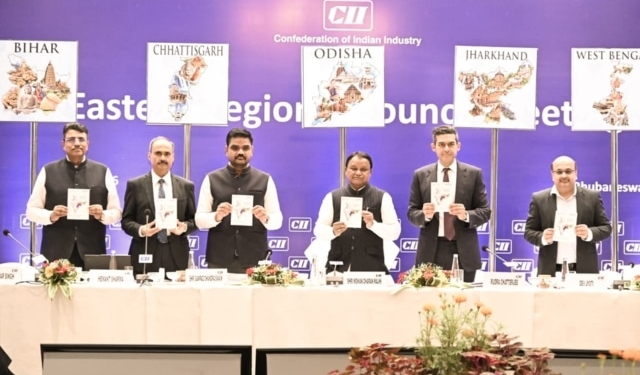
at the CII Eastern Regional Council Meeting 2026 in Bhubaneswar on Friday,
Chief Minister Mohan Charan Majhi said the state is determined to emerge as the
leading industrial destination in eastern India within the next five years
through faster approvals, investor-friendly policies and efficient project
execution.
The
Go East initiative has been designed to attract investments from eastern and
northeastern states by offering dedicated facilitation, policy support and
time-bound implementation of projects. The Chief Minister said the platform
would enable industries to retain their manufacturing base and existing markets
in their home states while expanding operations in Odisha with full government
support.
To
ensure speedy execution, the state will constitute a Special Task Force to
fast-track investment proposals, establish a dedicated Go East Cell within the
Industrial Promotion and Investment Corporation of Odisha (IPICOL), and
introduce a new Go Swift digital module for real-time monitoring and tracking
of investment approvals.
Majhi
said the initiative would place special emphasis on Odisha's border districts,
where new industrial growth centres are expected to emerge, fostering inclusive
industrialisation and generating employment in underserved regions.
In
a significant policy announcement, the Chief Minister said 15 economically
backward districts, including Balangir, Kalahandi, Nuapada, Kandhamal, Boudh
and Gajapati, have been accorded 'Thrust Sector' status for promoting
non-mineral-based industries under the amended IPR-2022. The move is expected
to diversify Odisha's industrial landscape beyond mining while encouraging
manufacturing investments across backward regions.
Highlighting
governance reforms, Majhi said industrial approval timelines have been slashed
from nearly 400 days to less than 160 days through the state's Deregulation 1.0
and 2.0 initiatives, with the government now targeting approvals in under 100
days.
Showcasing
Odisha's strong investment momentum, the Chief Minister said the state has
approved 477 industrial projects worth nearly ₹9.5
lakh crore since June 2024, with the potential to create around six lakh jobs.
Of these, 12 mega
projects involving investments exceeding ₹3.11
lakh crore have already entered the implementation stage and are nearing
inauguration, reflecting the state's ability not only to attract investments
but also to execute them at record speed.
Majhi
said Odisha is steadily expanding beyond its mineral-based economy by promoting
sunrise sectors such as steel, aluminium, chemicals, petrochemicals,
semiconductors and electronics. He added that the state's 'Samruddha Odisha
2036' vision is aligned with the national goal of 'Viksit Bharat 2047',
positioning Odisha as one of India's most investor-friendly manufacturing
destinations.
Further strengthening investor confidence, seven strategic Memoranda of Understanding (MoUs) were signed across six sectors — steel, metal downstream, textiles, power, green energy equipment and chemicals. The agreements represent a cumulative investment potential of approximately ₹24,823 crore and are expected to generate nearly 29,500 employment opportunities.
Industries Minister Sampad Chandra Swain also addressed the gathering, highlighting Odisha's skilled youth workforce and the government's efforts to align skill development programmes with industry requirements. Inviting CII members to partner in the state's growth journey, he called for collaboration in identifying sector-specific investment opportunities, integrating MSMEs into national and global supply chains through partnerships with large industries, and equipping young people with future-ready skills to meet evolving industrial demands.