THEBUSINESSBYTES BUREAU
NEW DELHI, MAY 30, 2026
In a landmark milestone for India’s skill development ecosystem,
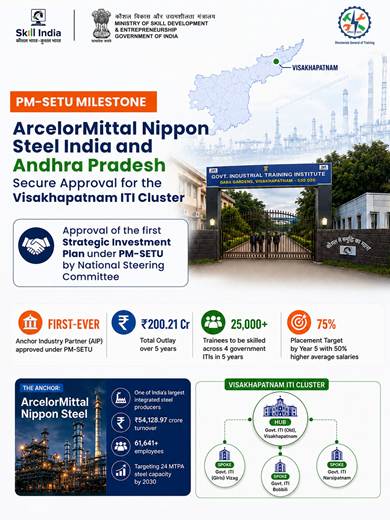
ArcelorMittal Nippon Steel India (AM/NS India) has secured the first-ever
approval of a Strategic Investment Plan (SIP) under the Pradhan Mantri Skilling
and Employability Transformation through Upgraded ITIs (PM-SETU) scheme,
positioning Andhra Pradesh at the forefront of the country’s industry-led
vocational education transformation.
The National Steering Committee (NSC) approved the Strategic Investment
Plan for the Visakhapatnam ITI Cluster, submitted by AM/NS India in partnership
with its academic collaborator, New Age Makers Institute of Technology
(NAMTECH). The approval not only marks the first SIP to be cleared under the
ambitious PM-SETU initiative but also makes Andhra Pradesh the first state in
the country to operationalize an industry partnership under the scheme.
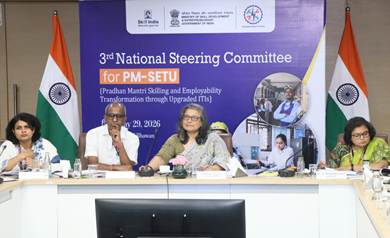
 The approval was granted during the third meeting of the National
Steering Committee convened by the Ministry of Skill Development and
Entrepreneurship (MSDE), Government of India, at Kaushal Bhawan in New Delhi.
The development represents a significant step forward in realizing PM-SETU’s
vision of transforming Government Industrial Training Institutes (ITIs) into
industry-managed, outcome-oriented institutions through robust partnerships
between state governments and leading industry players.
The approval was granted during the third meeting of the National
Steering Committee convened by the Ministry of Skill Development and
Entrepreneurship (MSDE), Government of India, at Kaushal Bhawan in New Delhi.
The development represents a significant step forward in realizing PM-SETU’s
vision of transforming Government Industrial Training Institutes (ITIs) into
industry-managed, outcome-oriented institutions through robust partnerships
between state governments and leading industry players.
The meeting was chaired by Debashree Mukherjee, Secretary, Ministry of
Skill Development and Entrepreneurship, and attended by Dilip Kumar, Director
General, Directorate General of Training (DGT), along with members of the
National Steering Committee. Senior representatives from the Capacity Building
Commission (CBC), National Council for Vocational Education and Training
(NCVET), Ministry of Commerce and Industry, Ministry of Heavy Industries,
Ministry of Labour and Employment, participating state governments, industry
leaders including Hindustan Aeronautics Limited (HAL), Hero MotoCorp, Bajaj
Auto, ITC Limited and ArcelorMittal Nippon Steel India, NAMTECH, as well as
development partners such as the Asian Development Bank (ADB) and the World
Bank, participated in the deliberations.
A major outcome of the meeting was the approval of the Visakhapatnam ITI
Cluster proposal, which establishes Andhra Pradesh as the first state under
PM-SETU to onboard an Anchor Industry Partner (AIP). The achievement marks a
defining moment in the operationalization of the industry-led Hub-and-Spoke
model envisioned under the flagship programme.
The approved project is expected to accelerate the transformation of
Industrial Training Institutes into modern, industry-managed centres of
excellence capable of meeting rapidly evolving workforce requirements. By aligning
training infrastructure, curriculum and governance with industry needs, the
initiative seeks to create a highly skilled and employable workforce equipped
for emerging sectors and advanced manufacturing.
The successful clearance of the Visakhapatnam proposal is also expected
to serve as a benchmark for other states looking to deepen industry
participation in vocational education and training. Policymakers believe the
project will provide a replicable framework for strengthening public-private
collaboration and expediting PM-SETU implementation across the country.
During the meeting, the National Steering Committee reviewed the overall
progress of PM-SETU implementation across participating states and discussed a
range of policy and operational measures aimed at strengthening industry
engagement, improving institutional governance, enhancing the financial
sustainability of Special Purpose Vehicles (SPVs), and accelerating project
execution.
The deliberations focused on advancing industry-led governance
mechanisms, promoting outcome-based skilling models and fostering stronger
partnerships among industry, state governments and training institutions. These
measures are intended to ensure that India’s vocational education and training
ecosystem remains agile, future-ready and responsive to emerging sectoral
demands.
PM-SETU, one of the Government of India’s flagship skilling initiatives
with an outlay of ₹60,000 crore, aims to transform 1,000
Government ITIs through an industry-led Hub-and-Spoke model. The scheme seeks
to modernise infrastructure, deepen industry engagement, improve employability outcomes and
establish National Centres of Excellence (NCoEs) in high-growth sectors,
thereby building a future-ready workforce equipped with the skills required for
advanced manufacturing and emerging technologies.
The programme has already gained significant momentum nationwide. As many
as 32 States and Union Territories have constituted their State Steering
Committees, while 12 States and UTs have floated Requests for Proposals to
invite industry participation for the selection of Anchor Industry Partners.
Several of these processes are nearing completion and are expected to conclude
in the coming weeks.
A growing pipeline of state-industry consultations, with multiple rounds already completed and several more scheduled, reflects increasing convergence between industry interest and state preparedness. The development underscores rising confidence in the PM-SETU framework and its potential to transform India’s vocational training landscape.
With the Central and State Governments working in close coordination, the momentum generated through these preparatory milestones is expected to translate rapidly into on-ground implementation. As additional Strategic Investment Plans come up for National Steering Committee approval in the coming months, PM-SETU is poised to usher in a new era of industry-led ITI transformation, strengthening India’s skilling ecosystem and contributing significantly to the vision of Viksit Bharat 2047.