
THEBUSINESSBYTES
BUREAU
NEW DELHI,
MARCH 24, 2026
Strengthening cooperative federalism
to secure sustainable rural water supply, the Centre on Tuesday signed
reform-linked Memorandums of Understanding (MoUs) with the governments of
Andhra Pradesh and Odisha under Jal Jeevan Mission 2.0, reinforcing a
structured roadmap for transparent, accountable and community-driven water
governance across rural India.
The MoUs mark a significant step in
accelerating reforms aimed at ensuring long-term sustainability of drinking
water infrastructure, strengthening service delivery, and enhancing community
participation in operation and maintenance of rural water supply systems. The
agreements were signed in the presence of Union Minister of Jal Shakti C. R.
Patil at the Department of Drinking Water and Sanitation (DDWS), Ministry of
Jal Shakti.
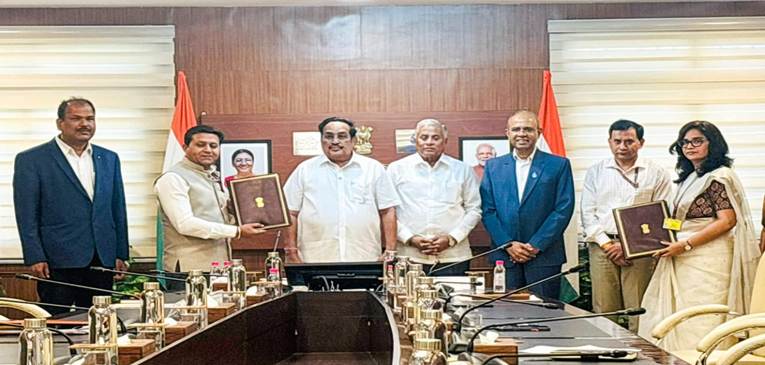 The MoU with Andhra Pradesh was
formalised between Swati Meena Naik, Joint Secretary (Water), DDWS, and Shashi
Bhushan Kumar, Special Chief Secretary to the Government of Andhra Pradesh. The
event was attended virtually by Chief Minister N. Chandrababu Naidu and Deputy
Chief Minister Pawan Kalyan, along with senior officials of the state
government, underscoring Andhra Pradesh’s commitment to achieving universal
household tap water coverage within the stipulated timeline.
The MoU with Andhra Pradesh was
formalised between Swati Meena Naik, Joint Secretary (Water), DDWS, and Shashi
Bhushan Kumar, Special Chief Secretary to the Government of Andhra Pradesh. The
event was attended virtually by Chief Minister N. Chandrababu Naidu and Deputy
Chief Minister Pawan Kalyan, along with senior officials of the state
government, underscoring Andhra Pradesh’s commitment to achieving universal
household tap water coverage within the stipulated timeline.
Marking another milestone in
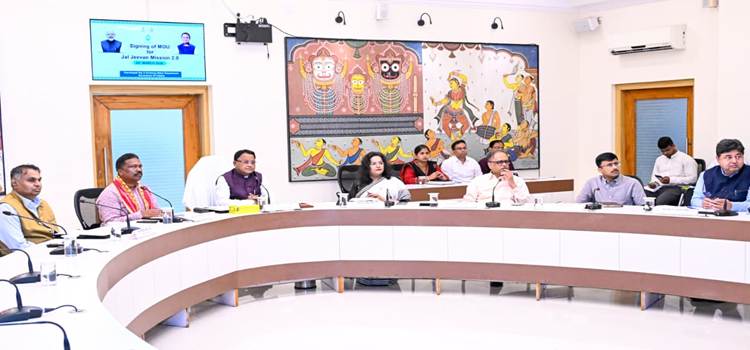
Centre-State collaboration, the MoU with Odisha was signed in the virtual
presence of Chief Minister Mohan Charan Majhi, Minister of Rural Development,
Panchayati Raj and Drinking Water Rabi Narayan Naik, Chief Secretary Anu Garg,
Development Commissioner, and other senior officials. The agreement was signed
between Swati Meena Naik and Girish S.N, Commissioner-cum-Secretary, Panchayati
Raj & Drinking Water Department, and exchanged by Visal Gagan, Principal
Resident Commissioner, Government of Odisha.
Addressing the gathering, Union
Minister C. R. Patil emphasised that while crores of rural households have
already received tap water connections under the Jal Jeevan Mission, the focus
under JJM 2.0 is on bridging infrastructure gaps, covering the remaining
households, and ensuring reliable, sustainable water supply systems. He
highlighted the importance of formally handing over completed schemes to
communities with proper documentation and strengthening community-led
management frameworks for efficient operation and maintenance. Stressing the
mission’s social impact, he noted that nearly nine crore women have been
relieved from the burden of fetching water, enabling greater participation in
education and economic activities. He also underscored the Prime Minister’s
emphasis on water-use efficiency through pipeline-based irrigation, drip
irrigation, and source sustainability initiatives under the spirit of “Jal
Sanchay se Jan Bhagidari”.
Andhra Pradesh Chief Minister N.
Chandrababu Naidu reaffirmed Andhra Pradesh’s commitment to the mission,
stating that the extension of the programme timeline has enabled the state to advance
towards universal household tap water coverage. He described the initiative as
a transformative step for improving public health, quality of life, and rural
development, and reiterated the state’s focus on sustainable and reliable
service delivery with strong community participation.
 Odisha Chief Minister Mohan Charan
Majhi termed the MoU a significant milestone in advancing the vision of “Har
Ghar Jal” and contributing to the national goal of Viksit Bharat by 2047. He
highlighted the state’s focus on community participation, financial
sustainability, and effective monitoring under JJM 2.0, supported by a
comprehensive operation and maintenance framework. The Chief Minister also
pointed to key digital initiatives, including registration of water supply
assets on the Sujal Bharat platform and allocation of unique Sujal Gram IDs to
enhance transparency and accountability. Citizen-centric services are being
strengthened through the Basudha helpline and WhatsApp interface, while Village
Water and Sanitation Committees continue to promote Jan Bhagidari in rural
water governance.
Odisha Chief Minister Mohan Charan
Majhi termed the MoU a significant milestone in advancing the vision of “Har
Ghar Jal” and contributing to the national goal of Viksit Bharat by 2047. He
highlighted the state’s focus on community participation, financial
sustainability, and effective monitoring under JJM 2.0, supported by a
comprehensive operation and maintenance framework. The Chief Minister also
pointed to key digital initiatives, including registration of water supply
assets on the Sujal Bharat platform and allocation of unique Sujal Gram IDs to
enhance transparency and accountability. Citizen-centric services are being
strengthened through the Basudha helpline and WhatsApp interface, while Village
Water and Sanitation Committees continue to promote Jan Bhagidari in rural
water governance.
Appreciating Odisha’s progress, the
Union Minister lauded the state’s efforts in strengthening digital monitoring
systems, advancing water conservation initiatives under the Jal Shakti Abhiyan,
and expanding citizen grievance redressal mechanisms that enhance community
participation and service delivery outcomes.
The reform-linked MoUs aim to ensure
that every rural household receives adequate and safe drinking water on a
regular basis through strengthened community participation and structural
reforms that support sustainable operation and maintenance of water supply
systems. The initiative is expected to significantly improve living standards
in rural areas, strengthen long-term water security, and contribute to the
national vision of Viksit Bharat @2047.