THEBUSINESSBYTES
BUREAU
MUMBAI,
JUNE 19, 2026
Reliance Industries’
ambitious New Energy venture has moved decisively from the construction phase
to commercial execution, with the conglomerate commissioning key manufacturing
facilities, scaling up its clean energy ecosystem and positioning the business
to become a significant contributor to earnings from FY27 onward. The
developments were announced by Anant Ambani, Executive Director of Reliance
Industries Ltd., during the company’s 49th Annual General Meeting (Post-IPO)
held on Friday.
Describing New Energy
as Reliance’s “most ambitious generational undertaking,” Ambani said the
business is designed to address India’s energy trilemma of security,
affordability and sustainability while creating a globally competitive clean
energy ecosystem built entirely in India.
At the centre of the
initiative is the 5,000-acre Dhirubhai Ambani Green Energy Giga Complex at
Jamnagar, which has emerged as one of the world’s most integrated clean energy
manufacturing ecosystems. Reliance has already commissioned its solar
photovoltaic cell and module manufacturing lines, producing nearly 1 GW of
advanced Heterojunction Technology (HJT) modules. According to the company,
these modules deliver around 2 per cent higher energy yield, 15 per cent better
temperature performance and 25 per cent lower degradation compared to
conventional technologies.
Reliance has also
secured India’s first Approved List of Models and Manufacturers (ALMM) listing
for HJT technology, marking a significant milestone for indigenous solar
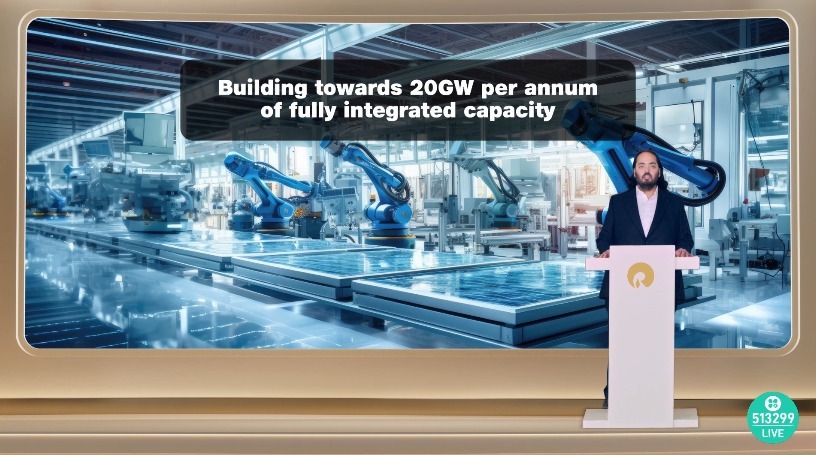
manufacturing. The company is steadily progressing toward its target of
establishing 20 GW per annum of fully integrated solar manufacturing capacity spanning
polysilicon, ingots, wafers, cells, modules and glass.
In energy storage,
Reliance’s first-phase 40 GWh Battery Energy Storage System (BESS) and cell
giga-factory remains on track for commissioning this year, with all major
equipment already delivered. The company has further raised its ambition by
committing to expand annual battery manufacturing capacity to 120 GWh. Once
operational, the facility is expected to rank among the world’s largest lithium
iron phosphate battery manufacturing operations.
The company is
simultaneously developing one of the world’s largest integrated renewable
energy hubs in Gujarat’s Kutch region across 5,50,000 acres. Combining
large-scale solar generation with battery storage, the project is designed to
provide round-the-clock green power at gigawatt scale. Upon full commissioning,
the hub is expected to generate more than 40 billion units of clean electricity
annually — equivalent to nearly 3 per cent of India’s total electricity
requirement.
Construction is also
progressing on the dedicated Kutch-to-Jamnagar transmission corridor, while
Reliance is targeting daily installation rates of 55 MWp of solar modules and
150 MWh of battery storage containers, reflecting the unprecedented scale of
the project.
Beyond electricity generation,
Reliance is building a comprehensive green chemicals platform anchored on green
hydrogen. The company is preparing to commission its alkaline electrolyser
manufacturing giga-factory and plans to monetise green molecules through
multiple streams including green urea, urea ammonium nitrate (UAN), green
ammonia and bio-methanol.
In a major commercial
breakthrough, Reliance has signed a landmark USD 3 billion long-term green
ammonia supply agreement with Samsung C&T, one of the largest green ammonia
offtake contracts globally. The deal validates the commercial viability of
Reliance’s green hydrogen strategy and strengthens its export ambitions. The
company is also engaged in advanced discussions for additional long-term supply
agreements with buyers in Japan, South Korea and Europe. Reliance continues to
target 3 million metric tonnes of green hydrogen-equivalent green chemicals
capacity over the next decade.
Ambani emphasised
that the company is building what he described as the world’s first fully
sovereign clean energy ecosystem, integrating solar power, battery storage and
green molecules while minimising dependence on imported fuels and foreign
technologies. He noted that commercial revenues from solar module manufacturing
will begin flowing in during the current financial year, while the battery
factory will also be commissioned this year, paving the way for meaningful
financial contributions from the New Energy business beginning FY27.
Reliance is also
strengthening its position in bioenergy. The company currently accounts for
over 40 per cent of India’s compressed biogas (CBG) production and plans to
operate 55 plants producing around 1,100 tonnes per day by the end of FY27.
Over the next five years, it aims to establish integrated CBG hubs with a
combined annual capacity of 1 million tonnes. Additionally, Reliance is
advancing underground coal gasification projects to convert low-grade domestic
coal reserves into cleaner syngas, reducing dependence on imported liquefied
natural gas.
One of the most significant outcomes of the New Energy programme, Ambani said, will be employment generation. The Jamnagar Giga Complex and Kutch renewable energy hub together are expected to create nearly 200,000 green jobs spanning engineering, manufacturing, construction, operations, agriculture and entrepreneurship.
Framing the initiative as both an industrial and national mission, Ambani said the clean energy transition would reduce India’s import dependence, strengthen exports, lower energy costs and create inclusive prosperity. “The world built its old energy on Middle Eastern oil. The world will now build its new energy on Indian sunshine,” he said, summing up Reliance’s long-term vision for its third-generation growth engine.