THEBUSINESSBTES BUREAU
BHUBANESWAR, FEBRUARY 27, 2026
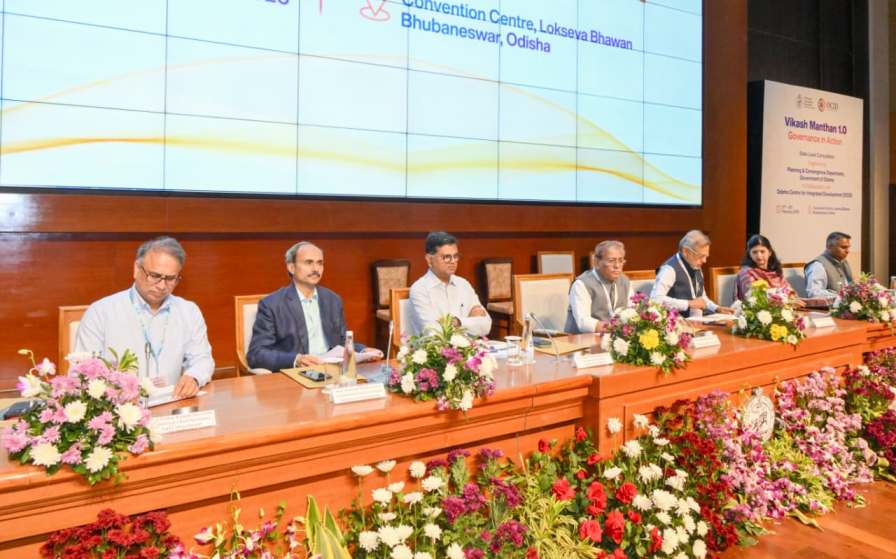
The fourth plenary session of Vikash Manthan 1.0 – consultation, themed
“Samruddha Odisha,” laid out an ambitious and integrated roadmap for the
State’s high-growth future, bringing together senior officials to deliberate on
industry expansion, services transformation, urban reforms, logistics
strengthening and rural economic revitalisation. The discussions reflected
strong confidence in Odisha’s economic trajectory while emphasising the urgency
of focused and time-bound execution to translate vision into measurable
outcomes.
Hemant Sharma, Additional Chief Secretary, Industries Department, noted that
the industrial sector currently contributes about 42 percent to Odisha’s
economy and is poised for further expansion. He highlighted the employment
potential of manufacturing and services and called for a calibrated transition
from a predominantly mining-led economy to metallurgy and allied value-addition
sectors. Leveraging Odisha’s coastal advantage, he stressed the importance of
building a robust petrochemical and coastal chemicals ecosystem, while
identifying food processing and textiles as high-potential sunrise sectors. He
added that emerging domains such as green energy equipment and semiconductors
have already gained initial traction and could significantly broaden the
State’s industrial base in the coming years.
 Vishal Kumar Dev, Additional Chief Secretary, Electronics & IT
Department, underlined Odisha’s strong macro-fiscal fundamentals, pointing to
the State’s revenue surplus and prudent debt-GSDP ratio that provide strategic
headroom for future investments. He observed that the relatively lower share of
the services sector compared to the national average represents a major
opportunity corridor. With around 350 IT companies already operating in Odisha,
he said that upgraded IT and Semiconductor Policies and India’s first dedicated
AI Policy aim to facilitate the establishment of more than 100 Global
Capability Centres across BFSI, healthcare, retail and manufacturing.
Highlighting the State’s low attrition levels as a marker of a strong work
culture, he stressed inclusive technology adoption, noting that AI systems are
being trained on Odia language datasets to democratise access for vulnerable
sections. He described the overarching vision as a transition from a
“mine-driven economy to a mind-driven economy.”
Vishal Kumar Dev, Additional Chief Secretary, Electronics & IT
Department, underlined Odisha’s strong macro-fiscal fundamentals, pointing to
the State’s revenue surplus and prudent debt-GSDP ratio that provide strategic
headroom for future investments. He observed that the relatively lower share of
the services sector compared to the national average represents a major
opportunity corridor. With around 350 IT companies already operating in Odisha,
he said that upgraded IT and Semiconductor Policies and India’s first dedicated
AI Policy aim to facilitate the establishment of more than 100 Global
Capability Centres across BFSI, healthcare, retail and manufacturing.
Highlighting the State’s low attrition levels as a marker of a strong work
culture, he stressed inclusive technology adoption, noting that AI systems are
being trained on Odia language datasets to democratise access for vulnerable
sections. He described the overarching vision as a transition from a
“mine-driven economy to a mind-driven economy.”
Usha Padhee, Additional Chief Secretary, Housing & Urban Development
Department, emphasised the need for forward-looking urban planning as Odisha’s
urbanisation level stands at around 17 percent. Advocating calibrated urban
expansion, she spoke about the shift from a city-centric approach to an
economic-region framework. She highlighted the forthcoming Livable City Mission
focused on improving urban livability through seamless mobility and integrated
infrastructure. Referring to the Bhubaneswar–Cuttack–Puri–Paradeep Economic
Region (BCPPER), she stated that nearly one-third of the State’s GDP is
expected to originate from this proposed growth cluster, underscoring its
transformative potential.
Sanjay Kumar Singh, Principal Secretary, Works Department, described road
infrastructure as the backbone of Samruddha Odisha, enabling industrial growth,
tourism, rural development and logistics efficiency. He noted that for freight
movement up to 600 km, industries show a clear preference for road
connectivity. While acknowledging that Odisha currently trails the national
average in road network density and has a limited share of six-lane National
Highways, he outlined a data-driven strategy to bridge the gap and position the
State among the top ten in road density. The plan includes new economic
corridors and systematic capacity augmentation to strengthen the logistics
ecosystem.
Girish S.N., Commissioner-cum-Secretary, Panchayati Raj & Drinking Water Department, presented a comprehensive rural transformation framework centred on non-farm employment, model village development, Gram Panchayat capacity building and last-mile connectivity. He announced plans to establish micro-skilling hubs across all 314 blocks, promote self-help groups into SMEs and develop high-skill rural industry clusters to curb distress migration. The roadmap also envisages saturation of basic amenities under the Model Village Mission, performance-linked GPDPs to strengthen local planning and the construction of about 6,505 km of roads to connect the remaining 2,601 unconnected habitations under MMSY, with an estimated investment of ₹7,800 crore. He said the approach is anchored in creating dignified rural livelihoods while ensuring balanced regional growth.
Moderated by Prof. Kshiti Bhusan Das with Shri Rajiv Shekhar Sahoo as Co-Moderator, the session underscored the State’s commitment to a coordinated and future-ready development strategy. The deliberations collectively highlighted that with strong fiscal fundamentals, sectoral diversification and accelerated infrastructure development, Odisha is well-positioned to advance decisively towards the goals of Viksit Odisha 2036 in alignment with Viksit Bharat 2047.