
THEBUSINESSBYTES
BUREAU
NEW
DELHI, OCTOBER 5, 2026
India’s telecom
sector continued its strong expansion in 2025-26, with the number of internet
subscribers crossing the 1-billion mark by a wider margin and wireless data
consumption jumping nearly 25 per cent, even as operators earned less per
gigabyte, according to a TRAI report released on Monday.
The total number of
internet subscribers rose 12.76 per cent year-on-year to 1,092.79 million at
the end of March 2026, from 969.10 million a year earlier, the Telecom
Regulatory Authority of India (TRAI) said in its annual performance indicators
report for 2025-26.
Broadband
subscriptions accounted for the bulk of the growth, rising 12.90 per cent to
1,065.88 million, while narrowband subscribers increased 7.72 per cent to 26.91
million.
The broader telecom
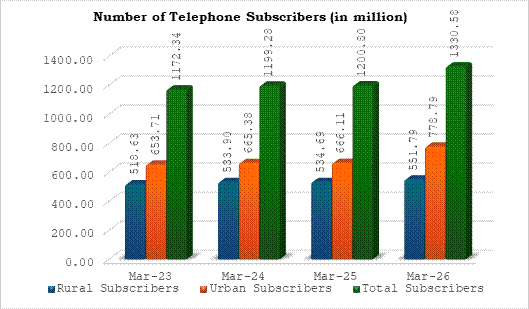
subscriber base also expanded at a robust pace. Total telephone subscribers
increased 10.81 per cent to 1,330.58 million at the end of March 2026, from
1,200.80 million a year earlier, pushing overall tele-density up to 93.26 per
cent from 85.04 per cent.
Wireless
subscriptions, including mobile and fixed wireless access, rose 10.19 per cent
to 1,282.33 million, with operators adding 118.58 million subscribers during
the year. Mobile subscribers alone grew 9.40 per cent to 1,265.73 million,
registering a net addition of 108.74 million.
The strongest growth,
however, was visible in the wireline segment, where subscriber numbers jumped
30.25 per cent to 48.25 million at the end of March 2026 from 37.04 million a
year earlier.
The urban market
continued to account for a larger share of the subscriber expansion. Urban
telephone subscriptions rose 16.92 per cent to 778.79 million, while rural
subscriptions grew a more modest 3.20 per cent to 551.79 million. Consequently,
the rural share of total telephone subscriptions declined to 41.47 per cent
from 44.53 per cent.
Data consumption
remained a key growth engine for the industry. Wireless data subscribers
increased 9.29 per cent to 1,026.75 million, while total wireless data usage
surged 24.74 per cent to 2,85,376 petabytes in 2025-26 from 2,28,779 petabytes
in the previous fiscal.
Average wireless data
usage per subscriber per month rose 18.49 per cent to 25.51 GB from 21.53 GB,
underscoring the continued shift towards heavier mobile data consumption.
Despite the surge in
traffic, average revenue realisation per GB declined 10.59 per cent to Rs 8.02
from Rs 8.97 in 2024-25. Revenue from wireless data usage, however, increased
11.53 per cent to Rs 2,39,874 crore from Rs 2,15,078 crore.
Average revenue per
user (ARPU) for wireless services rose 3.59 per cent to Rs 180.73 per month in
2025-26 from Rs 174.46 in the previous fiscal. Prepaid services recorded an
ARPU of Rs 190.66, while the corresponding figure for postpaid services was Rs
119.76.
Overall telecom industry
revenues also moved higher. Gross Revenue increased 8.59 per cent to Rs
4,04,067 crore, while Applicable Gross Revenue rose 7.12 per cent to Rs
3,81,645 crore. Adjusted Gross Revenue (AGR), a key metric for the sector,
increased 10.44 per cent to Rs 3,34,659 crore during the year.
Access services
remained the dominant contributor, accounting for 83.95 per cent of total AGR.
AGR from access services increased 10.85 per cent during 2025-26, while gross
revenue rose 7.32 per cent.
Pass-through charges,
meanwhile, declined 13.63 per cent to Rs 45,673 crore, reducing their share of
gross revenue to 11.30 per cent from 14.21 per cent in the previous fiscal.
Spectrum usage
charges rose 6.12 per cent to Rs 4,040 crore, while licence fee collections
increased 10.40 per cent to Rs 26,763 crore.
The report also
highlighted continued changes in the wider communications and broadcasting
ecosystem. As of March 31, 2026, around 917 private satellite TV channels had
been permitted by the Ministry of Information and Broadcasting, of which 908
were available for downlinking in India.
Of these, 342 were
satellite pay-TV channels, including 238 standard-definition and 104
high-definition channels, while the remaining 566 permitted channels were
considered free-to-air channels.
The pay-DTH segment,
however, continued to contract, with the active subscriber base of four pay-DTH
service providers falling to around 49.05 million at the end of March 2026 from
56.92 million a year earlier.
Private FM radio
expanded marginally, with 390 operational channels across 120 cities at the end
of March 2026, compared with 388 channels across 113 cities a year earlier. The
number of private FM radio operators stood at 31.
Advertising revenue
reported by FM radio operators, however, declined to Rs 1,616.42 crore in
2025-26 from Rs 1,818.71 crore in the previous fiscal.
Community radio
continued to expand, with 564 operational stations at the end of March 2026
compared with 531 a year earlier.
TRAI said the annual performance indicators report provides a broad perspective of telecom services in India and covers key parameters and growth trends in telecom, cable TV, DTH and radio broadcasting services for the period from April 1, 2025 to March 31, 2026.
The report has been compiled mainly on the basis of information furnished by service providers, it said.