
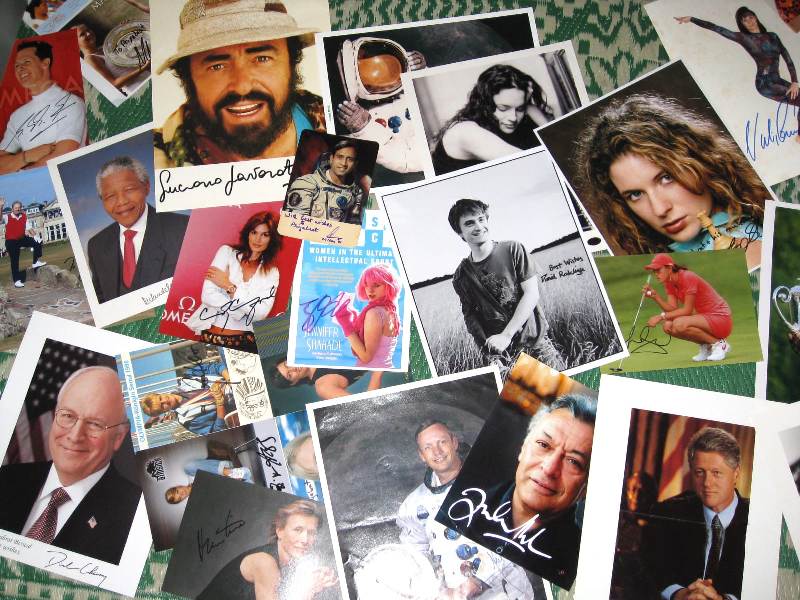
He never stood beside a celebrity for a photograph. He never chased an autograph at an airport or a public event. For nearly four decades, Priyabrat Biswal has done something far more old-fashioned: he writes letters. From a village in Odisha, his handwritten requests have travelled across the world — and returned carrying pieces of history.
By ARCHANA
THERE
are no red carpets, flashing cameras or celebrity encounters behind Priyabrat
Biswal’s collection. There is only a pen, a sheet of paper, an envelope and the
long, uncertain wait for the postman. From Olihan, a village near Astarang in
Puri district, the 57-year-old has spent nearly four decades writing to some of
the most famous people on earth, requesting one thing: an autographed
photograph. He has never met any of them. Yet, tucked away in his albums are
more than 600 signed photographs and letters from presidents, prime ministers,
astronauts, Nobel laureates, sporting legends, writers and film personalities.
What began as
curiosity has quietly turned into an extraordinary personal archive. Priyabrat
did not even know, when he started, that collecting autographed photographs was
a recognised hobby elsewhere in the world. He was simply testing a question
that had occurred to him: would a celebrated personality actually respond to a
letter from an ordinary man living in a remote village? The answer, when it
came, changed the course of his life. “Out of curiosity, I started writing
letters to eminent personalities of the world, hardly realising that it could
develop into a hobby,” he recalls. What followed was a lifelong experiment in
patience, persistence and human connection.
His first attempt was
made to the then Prime Minister Indira Gandhi. Fate, however, intervened before
the experiment could produce an answer; Gandhi was assassinated in 1984.
Priyabrat gave up for a while, but eventually tried again, this time writing to
British Prime Minister Margaret Thatcher. When a response arrived from the
woman famously known as the ‘Iron Lady’, it was more than a reply — it was validation.
Someone he had never met, someone living in a world unimaginably distant from
his own, had answered his letter. He began writing again, and this time he did
not stop.
The list of those who
responded reads almost like a roll call of modern history. His collection
includes photographs and replies associated with US presidents Jimmy Carter,
Ronald Reagan, George H.W. Bush, Bill Clinton, Barack Obama and Donald Trump,
besides Margaret Thatcher, Tony Blair and Kofi Annan. There are literary names
such as Manoj Das, Vikram Seth and Dominique Lapierre, and icons from sport
including Pele, Michael Jordan, Martina Navratilova, Chris Evert, Steffi Graf,
Michael Phelps and Usain Bolt. Indian sporting greats — Prakash Padukone, Sunil
Gavaskar, Kapil Dev, Sachin Tendulkar, P.T. Usha and Neeraj Chopra — also find
their place in his albums. Bollywood, too, has contributed its share, with
names such as Amitabh Bachchan, Shabana Azmi and Nandita Das.
But for Priyabrat, a
signature becomes meaningful not because the person is famous, but because the
photograph carries a story. Among all his possessions, he holds the responses
from Mother Teresa and Neil Armstrong particularly close to his heart. One
represented a global symbol of compassion; the other, the first human to set
foot on the Moon. “With each autographed photograph, I feel like possessing a
rare treasure, reading a slice of history,” he says. That perhaps explains why
his collection feels less like celebrity memorabilia and more like a private
museum of the people who shaped the world he grew up reading about.
The cruellest chapter
in the story arrived in 1999. Odisha’s super cyclone devastated lives, homes
and livelihoods, and Priyabrat’s collection suffered a devastating blow too.
Nearly 1,500 pieces that he had painstakingly gathered over the years were lost
or damaged. For a conventional collector, rebuilding such a collection might
have seemed impossible; many of the photographs represented one-time
opportunities, personalities who would never again be accessible in the same
way, and correspondence that could not simply be recreated. Priyabrat, however,
returned to his pen and began again. Slowly, the collection grew back to its
present strength of more than 600 pieces.
His success rate, he
admits, is tiny — less than one per cent. For every response that arrived,
there were countless letters that disappeared into silence. But failure has
never really discouraged him because, in his view, the attraction lies as much
in the possibility as in the result. “Convincing a celebrity for an autographed
photograph is really a tough job,” he says. Yet he continues to send his
requests, patiently trusting the old machinery of India Post.
That persistence
seems almost eccentric today. The world in which Priyabrat began writing has
vanished. A person can now send a message to a celebrity in seconds, leave a
comment on a social-media post or communicate through email without ever
touching a sheet of paper. Priyabrat could easily have moved with the times. He
chose not to. He still writes his letters by hand because he believes
handwriting carries something digital communication cannot — the unmistakable
presence of the person who wrote it.
And there are still
absences in his collection that he regrets. He had hoped to receive autographed
photographs from Valentina Tereshkova, the first woman to travel into space,
Kalpana Chawla, the celebrated astronaut of Indian origin, and legendary
athlete Milkha Singh. He is also disappointed that repeated letters to
President Droupadi Murmu and Prime Minister Narendra Modi have so far not
produced the response he has been hoping for. Yet even these unanswered letters
have not made him put away his pen. For a collector who has spent four decades
waiting for replies, an unanswered letter is perhaps not an ending — it is
simply a story without its final page.
Priyabrat now wants
his private archive to become a public one. He dreams of an exhibition, and
eventually a museum, where the photographs and handwritten correspondence can
be preserved and shown to visitors, particularly young people who may have
little understanding of the value of an old-fashioned letter or a genuine
signed photograph. The idea requires an investment beyond his present means,
but the dream remains alive.
Perhaps that is what makes Priyabrat’s story larger than his collection. He has spent almost forty years reaching across enormous distances without travelling very far himself. His letters have gone from a small village in Odisha to the desks and homes of people whose names are known around the world. Most never answered. A few did. Those few replies became treasures.
In an age when communication is measured in seconds, Priyabrat Biswal has chosen to measure it in patience. His collection is therefore not merely a record of famous people. It is a record of faith — the faith that a handwritten letter can still cross a great distance, find an unknown person on the other side, and sometimes, against all odds, come home carrying a piece of history.
The author may be reached at: [email protected]