
Odisha’s focus should now shift from counting installations to
measuring the actual green electricity generated, suggests Priyabrat Biswal
Odisha has crossed
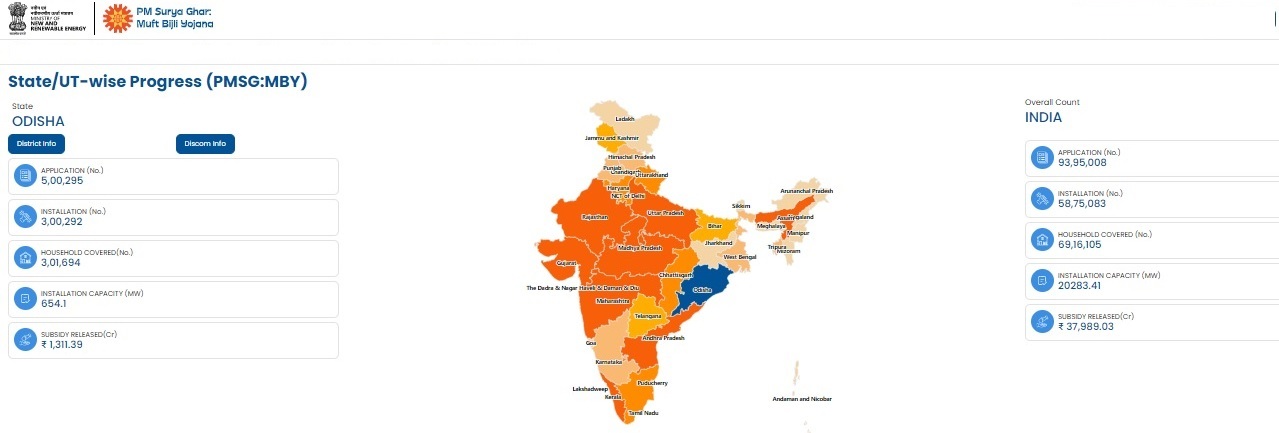
the milestone of three lakh rooftop solar installations under the PM Surya Ghar: Muft Bijli Yojana, well
ahead of its March 2027 target, but the achievement raises a critical question:
is the state generating enough clean electricity to transform its energy mix,
or is it merely racing to meet installation numbers?
The state achieved
3,00,292 rooftop solar installations with a cumulative capacity of 654.1 MW as
on November 25, 2026, against 5,00,295 applications received under the scheme.
The milestone is
significant, but the installed capacity remains modest against Odisha’s
conventional power infrastructure.
The state’s
utility-installed power generation capacity stood at 9,638.38 MW as of
September 2026, according to Central Electricity Authority data reported by
CEIC. Thermal power accounted for 5,972.47 MW and hydroelectricity 2,179.23 MW
as of April 2026.
The rooftop solar
capacity of 654.1 MW is equivalent to around 6.8 per cent of Odisha’s
utility-installed capacity. While this comparison is between installed
capacities and not actual electricity generation, it highlights the limited
scale of rooftop solar in the state’s overall power landscape.
Discom-wise
performance
The four electricity
distribution companies have played a crucial role in expanding rooftop solar
adoption.
 TP Central Odisha
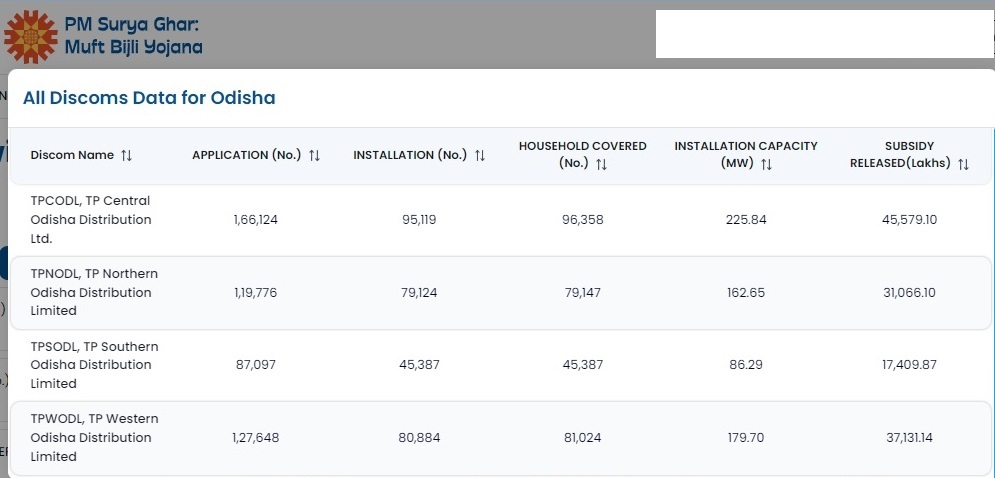
Distribution Ltd (TPCODL) has emerged as the largest contributor, recording
95,119 installations with a capacity of 225.84 MW against 1,66,124
applications.
TP Western Odisha
Distribution Ltd (TPWODL) follows with 80,884 installations and 179.70 MW
capacity from 1,27,648 applications.
TP Northern Odisha
Distribution Ltd (TPNODL) has reported 79,124 installations with 162.65 MW
against 1,19,776 applications, while TP Southern Odisha Distribution Ltd
(TPSODL) has recorded 45,387 installations and 86.29 MW from 87,097
applications.
At the state level,
Odisha has received 5,00,295 applications and recorded 3,00,292 installations
with 654.1 MW capacity.
The figures also
reveal a sizeable application-to-installation gap. Nearly two lakh applications
are yet to translate into installations, indicating that the next phase of the
programme must focus on converting consumer interest into commissioned systems.
Uneven
district-level adoption
The district-wise
distribution of installations presents an interesting picture of consumer
response.
Baleshwar has emerged
as the leading district in the number of installations, reflecting growing
acceptance of rooftop solar in northern Odisha.
Cuttack stands third
with 21,524 installations and Khordha fourth with 21,377. However, Puri,
despite its tourism-driven economy and urban concentration, is placed 10th with
11,571 installations.
The relatively lower
adoption in Puri, compared with other prominent coastal districts, raises
questions about consumer awareness, rooftop suitability, access to vendors and
the effectiveness of local outreach.
The ranking of
Baleshwar at the top also suggests that rooftop solar adoption is not
necessarily confined to the state’s largest urban centres.
Subsidy is
attractive, but is it enough?
The Centre and the
Odisha government are offering combined financial assistance of up to Rs 1.38
lakh for a 3-kW rooftop solar system, making the scheme financially attractive
for eligible households.
The subsidy is
intended to reduce the upfront investment and encourage consumers to shift
towards solar energy. Yet, district-level variations and the
application-to-installation gap suggest that financial assistance alone may not
be enough.
Upfront expenditure,
access to reliable vendors, technical feasibility, awareness, maintenance
concerns and the perceived complexity of installation and net-metering
processes may continue to influence consumer decisions.
A significant driver
of the state’s rapid growth has been the Utility-Led Aggregation (ULA) model,
under which discoms aggregate consumers and facilitate installations, reducing
the burden on individual households.
The model can help
bring rooftop solar within reach of low-income and smaller-consumption
households. However, the exact statewide break-up of installations under ULA
and individual consumer-led adoption is not readily available in a consolidated
public format.
The PM Surya Ghar
portal does not clearly reflect the precise number of ULA installations, while
discoms have not provided a comprehensive public break-up. This data gap makes
it difficult to assess how much of the achievement represents sustained
consumer demand and how much has been driven by utility-led mobilisation.
From
installation targets to clean power
Odisha’s progress is
undeniable. Crossing three lakh installations ahead of the March 2027 target is
a milestone worth celebrating, and the 654.1 MW capacity represents a meaningful
beginning in decentralised renewable energy.
But the real test of
the scheme lies beyond the installation count.
The government and
discoms need to publish regular district- and discom-wise data on commissioned
capacity, actual electricity generation, consumer savings, system performance
and ULA installations. Such transparency would help identify districts where
adoption remains weak and ensure that installed systems translate into
dependable clean power.
The state must also
focus on converting pending applications into functioning systems and ensuring
that installed rooftop panels generate electricity consistently.
The ultimate
objective of PM Surya Ghar:Muft Bijli
Yojana is not simply to put solar panels on rooftops, but to reduce
dependence on conventional power, lower household electricity bills and
contribute to a cleaner energy future.
For Odisha, the next
challenge is clear: move from counting installations to accounting for green
electricity.
The
author may be contacted at [email protected] or by
phone at 7978664134