THEBUSINESSBYTES
BUREAU
NEW
DELHI, JUNE 8, 2026
Trust, innovation and
partnerships are the three pillars powering India’s pharmaceutical growth
story, Union Commerce and Industry Minister Piyush Goyal said on Monday as he
invited global pharmaceutical companies to join India’s journey towards
innovation-led and inclusive healthcare. Expressing confidence in the sector’s future,
he said India’s pharmaceutical industry, currently valued at around $60
billion, has the potential to double in size over the next five years.
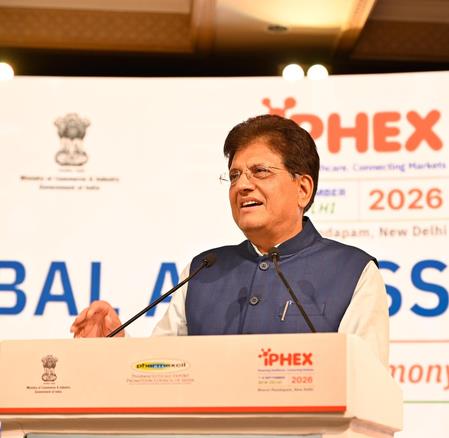
Addressing the Global
Ambassador Meet on the Pharmaceutical Sector and the curtain raiser ceremony of
GDRC 2026 and IPHEX 2026 in New Delhi, Goyal said India is steadily
transitioning from being primarily a producer of generic medicines to becoming
a hub for innovation-driven pharmaceutical products while continuing its
commitment to supplying affordable medicines worldwide.
Highlighting India’s
growing role in global healthcare, the minister said the country has emerged as
a trusted partner in international pharmaceutical supply chains, serving as an
innovator, manufacturing destination, technology collaborator and clinical
trial hub. He noted that India continues to be the world’s fastest-growing
major economy despite global challenges such as geopolitical conflicts and
rising trade barriers, recording economic growth of 7.7 per cent at constant
prices during the financial year ended March 2026.
Goyal underscored
India’s expanding global trade footprint, pointing out that the country has
signed nine Free Trade Agreements in recent years and now enjoys preferential
market access across more than 50 countries. He said India is equally open to
providing market access for high-quality innovative pharmaceutical products
from partner nations, fostering a mutually beneficial healthcare ecosystem.
Emphasising the
significance of India’s generic pharmaceutical sector, Goyal said millions of
patients across the world depend on affordable medicines produced in India. He
observed that while generic drugs account for 80-90 per cent of medicine
volumes sold in the United States, they represent only 10-15 per cent of the
market value, highlighting their crucial role in reducing healthcare costs.
India’s vast talent pool and comparatively lower operating costs, he added,
continue to strengthen the country’s competitiveness.
Explaining the three
defining strengths of India’s pharmaceutical industry, Goyal said trust remains
its strongest foundation. India has aligned its Good Manufacturing Practices
framework with global standards, supplies nearly 65-70 per cent of the World
Health Organization’s vaccine requirements and hosts 10 of the world’s 25
largest generic pharmaceutical companies. The country also has the highest
number of US FDA-approved pharmaceutical manufacturing facilities outside the
United States.
On innovation, the
minister pointed to a near doubling of patent filings in recent years and
highlighted initiatives such as the Biopharma Shakti programme and the
government’s $10-billion innovation support programme. These efforts, he said,
are designed to accelerate research, product development and technological
advancement in the pharmaceutical sector.
Inviting greater
international collaboration, Goyal called upon global pharmaceutical companies
to deepen their engagement with India and leverage opportunities arising from a
market of 1.4 billion people, a rapidly expanding middle class and sustained
economic growth.
Drawing from India’s
ancient healthcare philosophy, Goyal cited the Sanskrit expression “Sarve Santu
Niramaya” — “May all beings be free from illness” — and said India’s healthcare
vision has always been rooted in collective well-being. He noted that the
COVID-19 pandemic reinforced the global responsibility of ensuring equitable
access to healthcare and medicines.
Commending the Indian
pharmaceutical industry for its resilience during the pandemic, he said Indian
companies not only met domestic needs but also supplied medicines and vaccines
to countries across the Global South, emerging economies and developing
nations. More than 100 countries received medicines from India free of cost,
while all nations seeking assistance were supplied medicines at pre-pandemic
prices.
Goyal reiterated that India seeks long-term partnerships extending beyond crises and remains committed to advancing innovation, sustainable pharmaceutical production and universal access to quality healthcare. Referring to the theme of India’s G20 Presidency, “Vasudhaiva Kutumbakam” or “One Earth, One Family, One Future”, he said India views all nations as part of a global family and will continue working with the international community to ensure that quality healthcare reaches every corner of the world.
The minister concluded by thanking ambassadors, diplomats and international delegates for their participation and expressed confidence that GDRC 2026 and IPHEX 2026 would further strengthen India’s position as a leading global pharmaceutical partner.