THEBUSINESSBYTES
BUREAU
NEW
DELHI, MAY 11, 2026
In a landmark reform
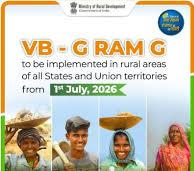
aimed at reshaping India’s rural development landscape, the Government of India
on Monday notified the implementation of the Viksit Bharat – Guarantee for
Rozgar and Ajeevika Mission (Gramin) [VB–G RAM G] Act, 2025, which will come
into force across the country from July 1, 2026.
With the commencement
of the new legislation, the Mahatma Gandhi National Rural Employment Guarantee
Act (MGNREGA), 2005 will stand repealed from the same date, marking what the
government described as a historic transition towards a future-ready, productivity-driven
and integrated rural transformation framework aligned with the vision of Viksit
Bharat @2047.
Under the VB–G RAM G
Act, every rural household whose adult members volunteer to undertake unskilled
manual work will receive a statutory guarantee of 125 days of wage employment
in a financial year, an increase aimed at strengthening livelihood security,
enhancing rural incomes and accelerating sustainable village development.
The new framework
also retains the legal safeguard for workers by ensuring that employment is
provided within the prescribed timeframe after demand for work is raised. In
case of failure, workers will continue to remain eligible for unemployment
allowance under the provisions of the Act.
Emphasising
transparency and accountability, the government said wages will continue to be
transferred directly into workers’ bank or post office accounts through Direct
Benefit Transfer (DBT). Payments are to be made weekly or within fifteen days
from the closure of the muster roll, failing which workers will be entitled to
delay compensation as provided under the Act.
For effective
implementation of the programme, the Centre has earmarked ₹95,692.31 crore for the financial
year 2026–27, the highest-ever Budget Estimate allocation for a rural
employment programme in the country. Including the expected contribution from
States, the total outlay is projected to cross ₹1.51 lakh crore, providing major impetus to rural infrastructure
creation, employment generation and income enhancement.
The government
assured that employment under MGNREGA will continue uninterrupted till June 30,
ensuring a smooth transition to the new framework. Ongoing projects under
MGNREGA will be seamlessly carried forward under VB–G RAM G while maintaining
consistency with the provisions of the new law. The Centre reiterated that
timely availability of work and prompt wage payment remain key priorities.
Adequate labour
budget provisions have also been made available to States and Union Territories
in line with demand patterns and field requirements to ensure that no eligible
rural household faces inconvenience during the transition period.
The government
further clarified that existing e-KYC verified MGNREGA Job Cards will remain
valid under the new scheme until Gramin Rozgar Guarantee Cards are issued.
Workers without Job Cards can continue to register at the Gram Panchayat level
and no worker will be denied employment due to pending e-KYC formalities. State
Governments will continue facilitation support for e-KYC completion at the
grassroots level.
Meanwhile, the
Ministry of Rural Development is preparing a series of draft rules under the
VB–G RAM G Act, 2025 in consultation with States and Union Territories. These
include rules related to normative allocation parameters, transitional
provisions, steering committee structure, administrative expenditure, grievance
redressal, wage and unemployment allowance payment procedures and
expenditure-sharing mechanisms for Union Territories without legislatures.
The government said the Transitional Provisions Rules are expected to be published shortly to facilitate a smooth migration from MGNREGA to VB–G RAM G, while other draft rules will also be released soon for public consultation.
Describing Gram Panchayats as the central pillar of rural transformation, the government expressed confidence that the Viksit Bharat – G RAM G Act, 2025 would provide fresh momentum to employment generation, rural self-reliance and holistic development, emerging as a major milestone in building an empowered and prosperous rural Bharat.