THEBUSINESSBYTES
BUREAU
BHUBANESWAR, JANUARY 27, 2026
India’s
emergence as the world’s fourth-largest economy stands as a testament to years
of sustained focus on domestic manufacturing, massive infrastructure expansion
and a deliberate effort to reduce import dependence in strategically critical
sectors. However, as the country positions itself for the next phase of
industrial acceleration and energy-led growth, a significant strategic gap is
becoming increasingly evident. Despite possessing abundant domestic reserves,
India continues to underutilise its bauxite resources—particularly in
mineral-rich Odisha—leaving a vital raw material inadequately leveraged at a
time when self-reliance, resilience and supply-chain security matter more than
ever.
The urgency
of addressing this challenge is underscored by recent developments in the
private sector. Hindalco’s proposed ₹8,000-crore greenfield
alumina refinery in Odisha represents a strong vote of confidence in the
state’s industrial potential and India’s long-term aluminium demand outlook.
The project is expected to strengthen the national aluminium ecosystem,
generate large-scale employment and catalyse downstream manufacturing. Yet, the
success of such investments hinges fundamentally on one indispensable input — a
secure, affordable and predictable supply of bauxite. Without unlocking
domestic bauxite resources at scale, even flagship industrial projects risk
becoming increasingly dependent on imported raw materials, exposing them to
global price volatility, freight disruptions and geopolitical uncertainties.
 The scale of
opportunity that Odisha offers is both significant and strategic. India
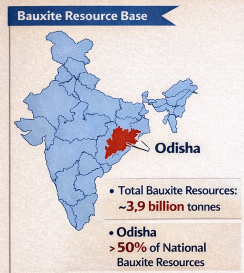
possesses nearly 3.9 billion tonnes of bauxite resources, with Odisha alone
accounting for more than 50 per cent of this total. The state’s mineral-rich
districts — including Kalahandi, Koraput, Sundargarh, Bolangir and Sambalpur —
host some of the highest-grade bauxite deposits in the country. These reserves
form the backbone of aluminium production, a metal that has become
indispensable to electric vehicles, renewable energy infrastructure, railways,
construction, aerospace and defence manufacturing, all of which are priority
sectors for India’s growth story.
The scale of
opportunity that Odisha offers is both significant and strategic. India
possesses nearly 3.9 billion tonnes of bauxite resources, with Odisha alone
accounting for more than 50 per cent of this total. The state’s mineral-rich
districts — including Kalahandi, Koraput, Sundargarh, Bolangir and Sambalpur —
host some of the highest-grade bauxite deposits in the country. These reserves
form the backbone of aluminium production, a metal that has become
indispensable to electric vehicles, renewable energy infrastructure, railways,
construction, aerospace and defence manufacturing, all of which are priority
sectors for India’s growth story.
Yet, despite
this natural advantage, India’s reliance on imported bauxite continues to rise.
In FY2023, the country imported approximately 3.6 million tonnes of bauxite.
This figure increased sharply to around 4.5 million tonnes in FY2024 as
aluminium producers expanded capacity to meet growing domestic and export
demand. Trade data indicates that India sources bauxite from a diverse set of
countries, including Guinea and China, highlighting a deepening dependence on
external supply chains for a mineral that is available domestically in
substantial quantities.
This trend
carries tangible economic and strategic costs. Aluminium imports — encompassing
raw materials as well as semi-finished products — now account for more than
half of domestic consumption. Over the past five years, the value of
aluminium-related imports has climbed steadily, with estimates suggesting that
the import bill has approached ₹30,000 crore in FY2026. This persistent outflow of
foreign exchange strains India’s trade balance and leaves domestic
manufacturers exposed to geopolitical disruptions and global price
fluctuations. Such exposure runs counter to the
core objectives of *Atmanirbhar Bharat* and the Aluminium Vision 2047 released
by the Ministry of Mines, both of which underscore the need for resilient
domestic supply chains for critical industrial materials.
Demand-side
pressures are only expected to intensify in the coming years. Projections
outlined in Aluminium Vision 2047 indicate that India’s aluminium requirement
could exceed 8 million tonnes per annum by 2030, up from roughly 5.5 million
tonnes today. While domestic primary aluminium production has increased to
around 4.2 million tonnes in FY2025 and further capacity additions are planned,
sustained growth will be contingent upon assured access to raw materials —
something that continued reliance on imported bauxite cannot guarantee in the
long term. Given that producing one million tonnes of aluminium requires nearly
six million tonnes of bauxite, the imperative to scale up domestic bauxite
production becomes unavoidable.
India’s
growing import dependence is therefore not a reflection of resource scarcity,
but rather the outcome of structural and regulatory bottlenecks. Although
domestic bauxite production crossed 23 million tonnes in 2023, new mine
development has lagged due to prolonged delays in land acquisition,
environmental and forest clearances, and inadequate infrastructure development
in mineral-bearing regions. As a result, several economically viable deposits
remain underutilised, compelling producers to rely on imports to bridge supply
gaps despite the availability of domestic resources.
Environmental
and social considerations must remain central to any mining expansion strategy.
However, the solution lies in responsible acceleration rather than continued
inertia. Advances in monitoring technologies — including satellite surveillance,
remote sensing and real-time data analytics — allow for far stronger oversight,
transparency and regulatory compliance than ever before. Best-practice water
management, progressive mine closure planning and responsible tailings handling
can significantly mitigate environmental risks. Importantly, Odisha’s Mineral
Bearing Areas Development Corporation already provides a robust framework for
channeling mining revenues into local development, supporting investments in
healthcare, education, infrastructure and sustainable livelihood creation in
mining-affected communities.
Globally,
the race for resource security is intensifying at an unprecedented pace. China
continues to consolidate access to bauxite assets across Africa and other
regions, while several countries are fast-tracking domestic mineral exploration
and extraction to insulate their industries from supply shocks. In this global
context, India cannot afford prolonged hesitation or policy paralysis.
Unlocking Odisha’s bauxite resources through transparent, scientifically
managed and socially responsible mining is essential to safeguarding the
country’s industrial future.
The bauxite
beneath Odisha’s plateaus is far more than a geological asset. It represents a
strategic foundation for India’s manufacturing ambitions, economic resilience
and long-term global competitiveness. The time for cautious delay has passed.
What is required now is decisive, well-governed action to align India’s mineral
development strategy with its broader economic aspirations and ensure that
domestic resources power the nation’s next growth cycle.