
Prime Minister highlights technology, AI and
data-driven governance as key pillars of future administration
THEBUSINESSBYTES BUREAU
NEW DELHI, JUNE 23, 2026
Calling upon the next generation of civil servants to become
architects of a developed India, Prime Minister Narendra Modi on Tuesday urged
young officers to dedicate themselves to nation-building with innovation,
integrity and a citizen-first approach, saying their leadership would be
crucial in realising the vision of Viksit Bharat@2047.
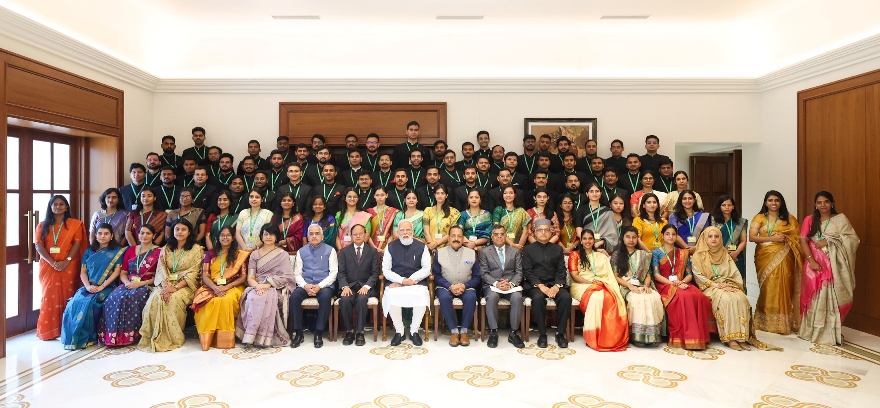
The Prime Minister was interacting with 183 IAS Officer
Trainees of the 2024 batch, currently serving as Assistant Secretaries in
various Ministries and Departments, at Seva Teerth in New Delhi.
During the interaction, the officer trainees shared insights
from their field training and experiences gained during their attachment with
different Ministries. Addressing them, Modi said that after two years of field
exposure and administrative learning, they now stand at a decisive stage in
their careers where their decisions will influence not only their professional
journey but also the lives of crores of citizens.
He emphasized that the true test of public service begins
with handling real-life situations with integrity, sensitivity and commitment.
Urging the officers to remain focused on citizen-centric governance, he reminded
them that every administrative file carries the aspirations, concerns and hopes
of countless people.
Stressing the principle of “Nagrik Devo Bhava”, the Prime
Minister called upon the young civil servants to place citizens at the heart of
every decision and ensure that governance remains empathetic, responsive and
inclusive.
Highlighting the need for a whole-of-government approach,
Modi said that major developmental challenges cannot be addressed in isolation.
Effective coordination and collaboration among departments, he noted, are
essential for delivering meaningful and sustainable outcomes.
Referring to the vision of Viksit Bharat 2047, he said every
policy and administrative decision taken over the coming decades must
contribute towards building a developed India. He identified key national
priorities including Aatmanirbhar Bharat, Make in India, manufacturing growth,
energy security and the creation of opportunities for the country's youth.
The Prime Minister also underscored the transformation in
governance over the past decade, observing that administration has evolved from
a process-centric framework to a result-oriented model. He highlighted the
increasing role of digital governance, artificial intelligence and emerging
technologies in improving service delivery and making governance more
transparent and accessible.
Emphasising the importance of data-driven governance, Modi
said data should not be viewed merely as statistics but as a reflection of the
lives, challenges and aspirations of millions of citizens. He urged officers to
continuously assess whether policies are translating into tangible outcomes on
the ground.
The Prime Minister also noted the growing participation of
women in governance, pointing out that more than 40 per cent of the current IAS
officer trainee batch comprises women officers, reflecting their expanding role
in nation-building.
Encouraging the officers to regularly evaluate their
contribution to national development, Modi said satisfaction should come not
from positions held but from measurable outcomes achieved. He expressed
confidence that the energy, talent and dedication of the young officers would
play a pivotal role in accelerating India’s development journey and achieving
the goal of a developed nation by 2047.
Minister of State for Personnel Dr. Jitendra Singh, Principal
Secretary to the Prime Minister P. K. Mishra, Principal Secretary-2 to the
Prime Minister Shaktikanta Das, Cabinet Secretary T.V. Somanathan, DoPT
Secretary Rachna Shah, LBSNAA Director Sriram Taranikanti and other senior
officials were present during the interaction.