
THEBUSINESSBYTES
BUREAU
MUMBAI,
JANUARY 13, 2026
As Artificial
Intelligence rapidly reshapes global industries, India’s education ecosystem
must undergo a fundamental reset to remain future-ready, industry leaders and
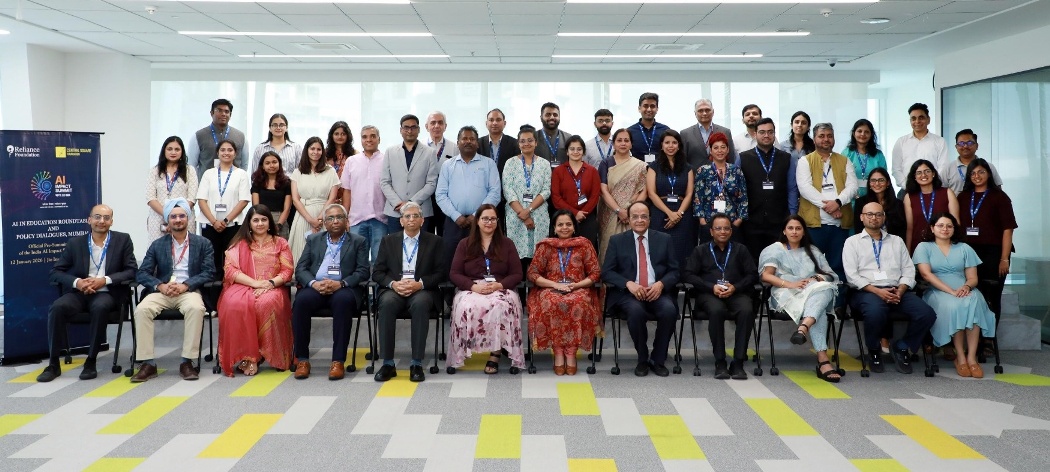
policymakers asserted at a high-level AI in Education dialogue hosted by
Reliance Foundation in partnership with Central Square Foundation. Held at Jio
Institute, Navi Mumbai, the roundtable served as an official pre-summit event
of the India AI Impact Summit 2026 and brought together over 50 leaders from
philanthropy, EdTech, academia and the private sector.
The half-day
deliberations focused on how AI-enabled education technologies can move beyond
innovation pilots to deliver measurable, inclusive and scalable learning
outcomes. Participants emphasised that while AI is transforming classrooms
worldwide, better technology alone does not guarantee better learning. Instead,
the dialogue stressed the need for deep collaboration between governments,
businesses, innovators and funders to integrate AI meaningfully into education
systems at scale, particularly in low-resource and multilingual environments.
Setting the
tone, Dr Shailesh Kumar, Chief Data Scientist at Jio and Dean of Jio Institute,
highlighted the urgency of reimagining education for a digital- and AI-first
world. He called for a decisive shift away from one-size-fits-all education
models towards personalised, student-centric learning systems that build
mastery and critical thinking skills. Emphasising AI’s transformative
potential, he noted that personalised education at scale is no longer
aspirational but achievable.
Discussions
explored emerging business and innovation opportunities across personalised
instruction, teacher support, assessment and early childhood learning. Experts
also examined the operational realities of scaling AI in education, including
cost structures, multilingual content development, data infrastructure, and
adoption within government and community-based systems.
A key business
insight from the dialogue was the catalytic role of philanthropy in shaping
sustainable AI and EdTech markets. Participants underscored that philanthropy’s
value extends beyond funding innovation to de-risking early-stage solutions,
generating long-term evidence and strengthening organisational capacity. The
LiftEd EdTech Accelerator was cited as a successful example of this approach,
having reached over three million children through sustained, evidence-led
support. Backed by leading philanthropic institutions including Reliance
Foundation, the initiative demonstrated how responsible AI integration can
deliver credible learning impact at scale.
Dr Vanita
Sharma, Advisor – Strategic Initiatives at Reliance Foundation, highlighted
that building AI-driven education solutions requires deep understanding of
classroom and community realities. She noted that contextualised design and
evidence-based implementation are essential to ensure technology translates
into meaningful learning outcomes.
The dialogue
also addressed the next growth phase for the EdTech sector — system-wide scale.
Participants agreed that scaling proven solutions is a complex systems
challenge requiring alignment across policy, pedagogy, delivery models and
ecosystem partnerships. Designing for India’s diversity, including
shared-device usage, low-bandwidth access and alignment with state curricula,
was identified as critical for long-term success.
Gouri Gupta,
Senior Project Director, EdTech at Central Square Foundation, remarked that the
future of the sector lies not merely in innovation, but in embedding effective
solutions within government systems and community adoption frameworks to drive
outcomes at scale.
As the
discussions concluded, a clear consensus emerged: AI and EdTech must function
as force multipliers for equity, not just efficiency. Teachers and parents,
participants reiterated, remain central to the learning process, with AI acting
as a powerful enabler through personalisation, feedback and data-driven
insights.
With India
positioning itself as a global hub for AI-led social impact, the insights from
this dialogue are expected to shape policy and investment conversations at the
India AI Impact Summit 2026, signalling a pivotal moment for the business of
learning in the AI era.