
THEBUSINESSBYTES BUREAU
BHUBANESWAR, SEPTEMBER 13, 2026
Artificial Intelligence will
transform the nature of work rather than simply replace jobs, eminent HR
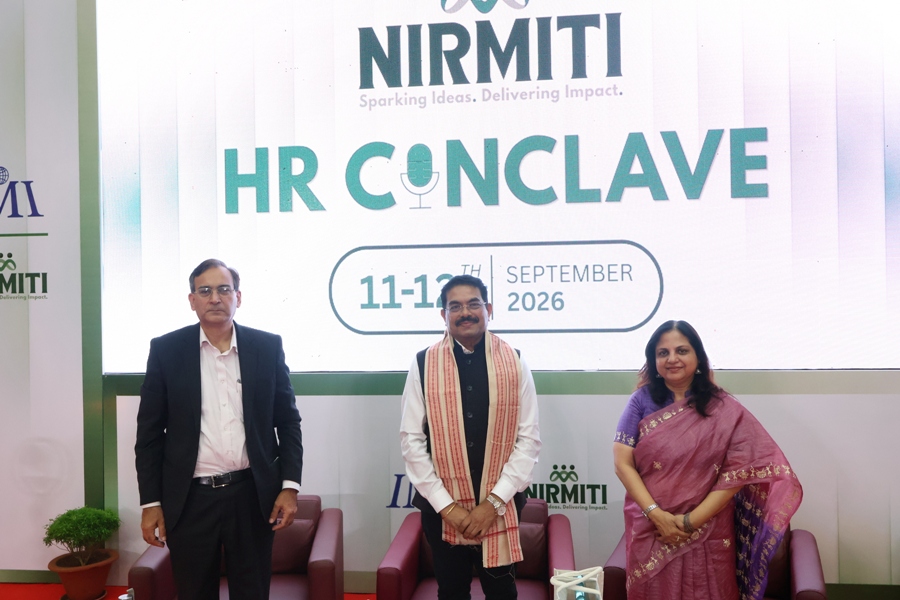
leaders said at the annual HR Conclave 2026 — NIRMITI hosted by International
Management Institute (IMI), Bhubaneswar, here.
The conclave brought together
senior HR professionals and industry leaders from across the country to
deliberate on AI, emerging technologies, changing job roles, curriculum redesign
and the skills required to prepare management graduates for the future
workplace.
In his inaugural address, IMI
Bhubaneswar Director Prof Amit Sareen stressed the need to align academic
curricula with evolving industry requirements and prepare students for an
AI-driven workforce while ensuring that ethics and human values remain
essential guardrails.
Dean Academics Prof (Dr) Supriti
Mishra underlined the changing expectations of employers and called for greater
emphasis on problem-solving, Artificial Intelligence, design thinking and
human-centric capabilities to ensure students remain prepared for emerging
careers.
The keynote address was delivered
by Asutosh Rath, Executive Director (Human Resources), NALCO, who challenged
the widespread perception of AI as a threat to employment.
Drawing parallels with the
emergence of computers decades ago, Rath said technological advances have
historically transformed existing jobs, simplified tasks and created new forms
of work.
The first panel discussion, on
"Track-based Curricular Revamp — Implications and Opportunities",
brought together Ashish Banka, Vice President-Human Resources, Algoworks;
Samriti Malhotra, Chief Human Resources Officer, UDS Group; Durga Prasad Nayak,
Chief Human Resources Officer, Aster DM Healthcare; Rabi Agrawal, Head of
Talent Acquisition, Cashfree Payments; Amritapa Banerjee, India Head-Human
Resources, EFS Facilities; and Roy Joseph, Vice President-Human Resources, MRF.
The panel examined the
competencies and mindsets required by management graduates to navigate an
increasingly dynamic job market. Speakers highlighted the importance of
industry-relevant curricula, AI and analytics, emotional intelligence,
experiential learning and critical thinking.
They also stressed the need for
graduates to prioritise competence and long-term career growth over immediate
compensation, while developing entrepreneurial and problem-solving mindsets.
Agility, resilience, ownership, trustworthiness and the ability to learn from
failures were identified as key attributes of future-ready professionals.
The second panel focused on
"Job Disruption Due to AI: Collaboration or Competition?" and
featured Rahul Sharma, Associate Director-People and Culture, GT Bharat; Amit
Singh, Vice President-People and Culture, Group Bayport; Prakash Panda,
Head-HR, McNroe Consumer Products Pvt Ltd; Swapnil Shendage, Senior Talent
Acquisition Manager, Trinamix; Surya Mukherjee, Senior Vice President-Human
Resources, InCred Finance; and Romsha Sharma, Head of HRBP, Last Mile,
Hyperlocal and Dark Stores, Shadowfax.
The discussion explored how rapid
technological advances are reshaping recruitment models, task automation and
workplace dynamics.
Panelists said AI is increasingly
capable of handling routine execution and administrative tasks but remains a
collaborator rather than a substitute for human intellect. Moral reasoning,
emotional intelligence and complex strategic judgement, they noted, continue to
require distinctly human capabilities.
The speakers emphasised that professionals
seeking to remain relevant in the evolving job market would need to combine
deep domain expertise with practical exposure to AI and emerging technologies.
The third panel, "Digital
Transformation in Learning & Development — Emerging Trends and Future
Directions", featured Varinder Singh, AVP and Head-HR, Juniper Green
Energy; Kamaljeet Kour, Senior Manager-Talent Engagement, Infosys; Moiz S
Bardawala, Fulfilment IQ; Kabir Singh, Senior General Manager, AIPL; Ankit
Sharma, L&D Head, SMC; and Rishika Verma, Senior Manager-Talent Academy,
Niva Bupa.
The panel explored the
effectiveness of digital investments in learning and development and stressed
that digital transformation should focus on building future-ready capabilities
rather than merely maintaining conventional training calendars.
Speakers discussed AI's dual role
as an automation engine and a thought partner, cautioning employees against
blindly accepting AI-generated outputs. They emphasised the importance of
asking the right questions, critically evaluating responses and applying human
judgement.
The discussion also highlighted
the emergence of modern learning ecosystems that offer accessible, personalised
and technology-enabled learning journeys. Speakers said training programmes
should be linked to measurable business and employee outcomes rather than being
treated as a compliance exercise.
For future professionals, high emotional intelligence — including self-awareness, empathy and social skills — was described as increasingly important alongside the ability to learn, unlearn and relearn.
The conclave concluded with a strong call for closer academia-industry collaboration to address the disruptions caused by AI, redesign management education and equip young professionals with the skills needed to navigate the future of work.