THEBUSINESSBYTES BUREAU
NEW DELHI, NOVEMBER 5, 2026
Union Coal and Mines Minister G Kishan Reddy on Thursday called for
accelerating structural reforms in the coal and mining sectors, with a strong
focus on coal gasification, critical minerals, artificial intelligence-driven
technologies and greater private sector participation to strengthen India's
energy security and achieve self-reliance.
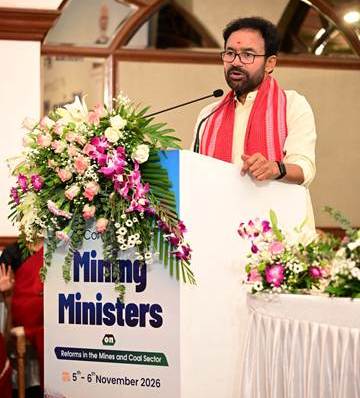
Addressing the 4th Conference of Mining Ministers on Reforms in the Mines
and Coal Sector in Goa, Reddy said sustained policy reforms under the
leadership of Prime Minister Narendra Modi had enhanced transparency,
efficiency and professionalism in the mining and coal industries, strengthening
their contribution to economic growth.
He stressed that coal gasification must be scaled up to unlock the
economic potential of India's vast domestic coal reserves, promote industrial
diversification, generate employment and reduce dependence on imported energy
resources.
Highlighting the growing strategic importance of critical minerals amid
changing global geopolitical dynamics, the minister called for strengthening domestic
capabilities across exploration, mining, processing, refining and recycling.
Developing an integrated and self-reliant mineral ecosystem is essential to
reducing import dependence and safeguarding India's strategic and economic
interests, he said.
Reddy also urged state governments to embrace artificial intelligence,
digitalisation and advanced technological solutions across mineral exploration,
mine operations and resource recovery to improve productivity, operational
efficiency and environmental sustainability.
He called upon states to expedite the operationalisation of auctioned
mines, accelerate the auction of fresh mineral blocks and expand exploration
activities to tap the country's untapped resource potential.
The minister said mining sector reforms had emerged as an important
catalyst for strengthening state economies by attracting investments,
generating employment, increasing revenue and promoting development in
mining-affected regions.
Emphasising cooperative federalism, Reddy sought closer coordination
between the Centre and state governments to accelerate reforms and ensure
sustainable and inclusive development of the coal and mining sectors.
Union Minister of State for Coal and Mines Satish Chandra Dubey said
mining remained a key pillar of India's economic progress, industrial
development and energy security.
He highlighted the Centre's initiatives to promote transparent auctions,
attract investments and create employment opportunities, while stressing that
higher production must go hand in hand with environmental protection, mine
safety and community welfare.
Dubey called for incorporating mine rehabilitation and alternative
livelihood opportunities for local communities into mining projects from the
planning stage itself. He also emphasised the need to increase coal production
through modern and safe mining technologies, promote coal gasification and
innovative utilisation methods, and strengthen logistics through initiatives
such as First Mile Connectivity.
Secretary, Ministry of Coal, Vikram Dev Dutt said India's domestic coal
production had crossed the one-billion-tonne mark for the second consecutive
year, reflecting significant progress towards energy self-reliance and reduced
dependence on imported coal.
He called for further structural reforms to make the sector more
competitive, transparent, efficient and investment-friendly, highlighting
initiatives such as commercial coal mining, the revised SHAKTI framework and
Coal SETU.
These measures are aimed at facilitating greater private sector
participation, simplifying procedures and accelerating mine operationalisation,
he said.
Dutt described coal gasification as a major opportunity for value
addition, industrial diversification and employment generation, urging
coal-bearing states to facilitate investments, develop supporting
infrastructure and speed up project implementation.
He said the next phase of growth in the coal sector must go beyond
extraction and focus on value creation, positioning coal as a catalyst for
industrial development, higher state revenues and job creation.
Additional Secretary in the Ministry of Coal Rupinder Brar made a
detailed presentation on recent coal sector reforms, their impact on ease of
doing business, and the challenges requiring state-level intervention. She
highlighted how simplified procedures, improved transparency and
investment-friendly policies were creating a more competitive business
environment.
The two-day conference, organised by the Ministry of Mines on November
5-6 in Goa, brought together mining ministers from various states and senior
officials from the Centre and state governments to deliberate on reforms,
investment opportunities, operational challenges and sustainable mining
practices.
The discussions underscored the importance of coordinated policy action, technology adoption and responsible resource development in unlocking India's coal and mineral potential.
The government is seeking to position the coal sector not merely as a source of fuel but as a driver of industrial value addition, energy security, employment generation and the broader vision of Viksit Bharat 2047.