Global Capability Centres, startups, incubators
and policymakers join hands to accelerate India's innovation ecosystem and
drive the vision of Viksit Bharat 2047
THEBUSINESSBYTES BUREAU
NEW DELHI/BENGALURU, JUNE 30, 2026
In a major push to strengthen India's innovation ecosystem
and foster deeper collaboration between industry and startups, the Atal
Innovation Mission (AIM), NITI Aayog, in partnership with the Software
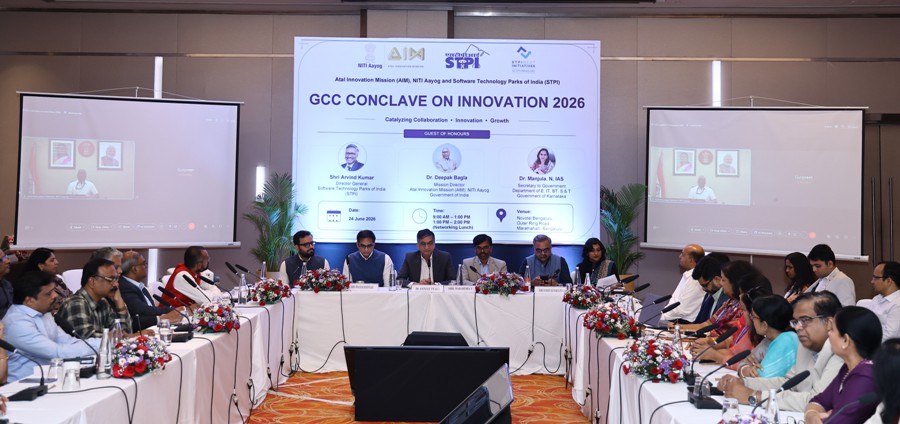
Technology Parks of India (STPI), hosted the GCC Conclave on Innovation 2026 in
Bengaluru. The conclave brought together leaders from Global Capability Centres
(GCCs), technology companies, startups, incubators and policymakers to chart a
collaborative roadmap for innovation-led economic growth.
The high-profile event witnessed participation from leading
multinational technology and engineering companies, including Intel, IBM,
Bosch, Amazon, SAP, Thermo Fisher Scientific, CGI, Shell, Mercedes-Benz,
Philips, Morgan Stanley, NVIDIA, Samsung, SanDisk, Wipro and Yahoo, along with
representatives from Atal Tinkering Labs (ATLs), Atal Incubation Centres
(AICs), Atal Community Innovation Centres (ACICs), STPI Centres of
Entrepreneurship, the Karnataka Digital Economy Mission (KDEM), and other key
innovation ecosystem stakeholders.
The conclave aimed to build stronger linkages between India's
thriving startup ecosystem and GCCs while creating opportunities for
collaboration across AIM's innovation value chain — from nurturing young
innovators through Atal Tinkering Labs and supporting startups via incubators
to scaling high-potential enterprises through the upcoming Atal Acceleration
Centres for Scale-up of Startups (AACESS) initiative.
Addressing the gathering, STPI Director General Arvind Kumar
highlighted India's emergence as a global GCC powerhouse, noting that the
country now hosts over 2,100 Global Capability Centres generating nearly USD
100 billion in annual revenue. He said STPI, which has been instrumental in
developing India's technology infrastructure since 1991, is now taking its
partnership with AIM to the next level by connecting its nationwide network of
technology parks and entrepreneurship centres with AIM's innovation ecosystem.
He invited GCCs to actively partner with AIM and STPI to
co-create frontier technologies, mentor startups, validate innovations and help
build globally competitive enterprises that contribute to the vision of Viksit
Bharat 2047.
AIM Mission Director Deepak Bagla underscored the pivotal
role of GCCs in India's innovation-driven growth story. Referring to Prime
Minister Narendra Modi's vision of 'Jai Anusandhan', he said AIM has spent the
past decade building a robust innovation pipeline — from more than 10,000 Atal
Tinkering Labs in schools to over 100 incubators supporting startups and
grassroots innovators.
Bagla said that integrating GCC expertise with AIM's
innovation ecosystem would nurture talent, accelerate entrepreneurship,
encourage industry adoption of new technologies and create globally competitive
enterprises. He urged industry leaders to engage with AIM through mentorship,
innovation challenges, pilot projects, market access initiatives and
startup-industry partnerships.
STPI Bengaluru Director Dr. Sanjay Tyagi said Bengaluru's
vibrant GCC ecosystem provides the ideal platform for creating structured
collaborations between industry and innovators. He noted that India's GCCs have
evolved beyond cost-efficiency centres into globally recognised hubs for
technology development, product engineering and innovation. According to him,
closer collaboration between STPI, AIM and GCCs would unlock fresh
opportunities for technology commercialisation, startup scale-up and
industry-led entrepreneurship.
The conclave featured focused deliberations on four strategic
themes: reimagining school innovation through Atal Tinkering Labs; accelerating
startups through Atal Incubation Centres and Atal Community Innovation Centres;
scaling innovation through the upcoming AACESS Industrial Accelerator
Programme; and promoting industry-led innovation via joint accelerator
platforms and STPI Centres of Entrepreneurship.
Participants discussed practical avenues for collaboration,
including mentorship, technology validation, pilot deployments,
challenge-driven innovation programmes, market access and sector-specific
accelerator initiatives. A major focus was the forthcoming AACESS Industrial
Accelerator Programme, designed to help growth-stage startups gain access to
industrial validation, mentorship, pilot opportunities and commercialisation
support.
The conclave also explored deeper institutional collaboration
between AIM and STPI to leverage their complementary strengths in nurturing
innovators, entrepreneurs and technology enterprises across the country.
The event concluded with a strong commitment from industry
leaders, government agencies and innovation ecosystem partners to pursue
structured collaborations that will accelerate startup growth, promote
technology adoption and further strengthen India's position as a leading global
innovation and technology hub.