
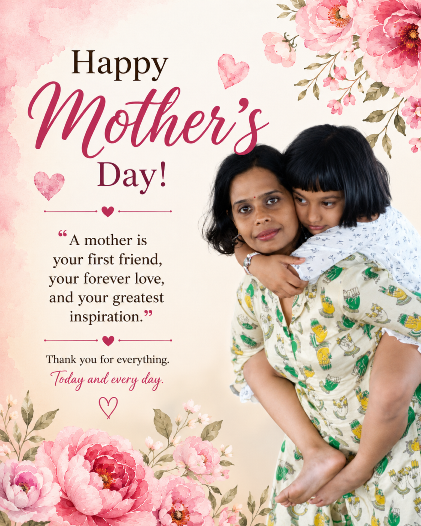
Let
love for mothers transcend one-day celebrations — honour them daily through
compassion, gratitude, responsibility, and respect, beyond social media posts,
symbolic gestures, and commercialised traditions, says
Priyabrat Biswal
In an age dominated
by digital trends, influencer culture, and relentless consumerism, Mother’s Day
has increasingly transformed into a carefully packaged commercial event rather
than a heartfelt celebration of motherhood. Newspapers overflow with sponsored
greetings, social media timelines are flooded with curated tributes, and online
marketplaces aggressively promote gifts, flowers, and discounts — all wrapped
in the language of love and gratitude. Yet amidst this annual spectacle, an
important question arises: Are we truly honouring our mothers, or merely
participating in a ritual designed by commerce and amplified by social
validation?
The modern celebration
of Mother’s Day often appears less like an intimate expression of affection and
more like a public performance. Many people feel compelled to post emotional
messages online, not necessarily because they lack sincerity, but because
digital culture increasingly equates love with visibility. The worth of
emotions is subtly measured through likes, shares, comments, and public
acknowledgment. In this race for virtual appreciation, genuine emotions
sometimes become secondary to appearance and social display.
For many Indians who
grew up before the explosion of globalization and social media, occasions like
Mother’s Day, Father’s Day, or Valentine’s Day were virtually unknown during
childhood and college years. Respect for parents was not confined to a
designated calendar date. Gratitude was woven into everyday life — expressed
through care, obedience, shared responsibilities, and emotional bonds nurtured
within the family. These observances largely entered Indian society through
Western cultural influence, aided by advertising, entertainment media, and an
increasingly aspirational urban culture eager to imitate global trends.
Sensing an enormous
business opportunity, sections of the media and digital platforms have turned
such occasions into profitable campaigns. Advertisements invite people to
publish greetings for a fee, participate in contests, or purchase expensive
gifts in the name of love. Retail industries thrive on emotional marketing,
encouraging consumers to equate affection with spending power. Ironically, the
more commercialized the celebration becomes, the farther it drifts from its
original purpose.
The history of
Mother’s Day itself offers a profound irony. The occasion was initiated by
American social activist Anna Jarvis after the death of her mother in 1905,
with the noble intention of honouring the sacrifices and unconditional love of
mothers. However, Jarvis later became deeply disturbed by the commercialization
surrounding the observance. She openly criticized the growing culture of greeting
cards, gifts, and profit-making associated with the day and even campaigned to
remove Mother’s Day from the holiday calendar. What began as a sincere tribute
to maternal devotion gradually evolved into a consumer-driven enterprise —
precisely the outcome its founder feared.
The essence of
motherhood can never be captured through hashtags, expensive bouquets, or
carefully crafted social media captions. A mother’s contribution transcends
material valuation. She is often the first teacher, protector, guide,
caregiver, and emotional anchor in a child’s life. Her sacrifices are usually
silent, her struggles invisible, and her love unconditional. From sleepless
nights and unspoken worries to lifelong support and endless compromises,
motherhood represents one of humanity’s purest forms of selflessness.
This truth was
beautifully articulated by Manushi Chhillar during the Miss World competition
in 2017, when she said that mothers deserve the highest respect because of the
immense sacrifices they make for their children. When asked which profession
deserved the highest salary, her resounding answer emphasized the invaluable
contribution of mothers: “…I think that a mother deserves the highest
respect…All mothers, they just sacrifice so much for their kids. So, I believe
the profession which deserves the highest salary, respect and love should be of
a mother.” Her heartfelt response resonated globally because it reflected a
universal truth: no profession demands more emotional strength, patience,
sacrifice, and unconditional commitment than motherhood.
The timeless words
often attributed to Rudyard Kipling — “God could not be everywhere, and
therefore, he made mothers” — continue to hold deep emotional significance. A
mother’s love remains one of life’s most enduring and sacred realities, beyond
social trends or cultural fashions.
Mother’s Day, therefore, should not be rejected entirely; rather, it should be reclaimed from the grip of commercialization. The occasion can still serve as a meaningful reminder to pause and acknowledge the immeasurable role mothers play in shaping our lives. But genuine appreciation need not be extravagant or performative. Sometimes, the most sincere tribute lies in spending quality time, offering emotional support, expressing gratitude privately, caring for ageing parents, or simply being present when they need us most.
If we truly wish to honour our mothers, let us move beyond symbolic gestures and market-driven celebrations. Let our love not be confined to a single day, a social media post, or a purchased gift. Instead, let respect for mothers become a lifelong practice reflected in our behaviour, compassion, responsibility, and gratitude. For motherhood is not a trend to celebrate annually — it is a timeless blessing to cherish every single day.