THEBUSINESSBYTES
BUREAU
NEW
DELHI, OCTOBER 23, 2026
Bank of India (BOI)
and the Centre for Development of Advanced Computing (C-DAC) have joined hands
to advance indigenous quantum technologies and explore their applications in
banking, with a focus on cybersecurity, financial analytics and next-generation
digital solutions.
The two organisations
signed a memorandum of understanding (MoU) on October 22 to collaborate on
quantum financial innovation and the adoption of emerging technologies,
including artificial intelligence (AI), blockchain and quantum-safe solutions,
aimed at strengthening the security and resilience of India's banking
ecosystem.
The partnership will
facilitate joint research and development, pilot implementations,
proof-of-concept projects, technology demonstrations and capacity-building
initiatives to translate indigenous technological capabilities into practical
banking applications.
C-DAC, an autonomous
scientific society under the Ministry of Electronics and Information Technology
(MeitY), will bring its expertise in high-performance computing, AI, quantum
technologies, blockchain, cybersecurity and indigenous technology development
to the collaboration. Bank of India will contribute its banking expertise,
nationwide network and large-scale technology infrastructure.
A key objective of
the partnership is to develop a quantum ecosystem for financial innovation,
preparing banks to harness emerging technological opportunities while
addressing the security challenges posed by advances in quantum computing.
The organisations
will explore quantum-inspired and quantum-safe technologies to strengthen data
protection, operational resilience, decision-making and trust in financial
services. The initiative will also identify priority banking use cases, test
solutions in secure sandbox environments, evaluate their technical feasibility
and commercial value, and benchmark new approaches against existing systems.
Congratulating Bank
of India on its contribution to technological advancement, MeitY Secretary S
Krishnan emphasised the importance of building a quantum-resilient financial
ecosystem amid growing cybersecurity concerns and emerging technological
threats.
He also underscored the
need to prepare the banking sector to address the challenges and opportunities
arising from the advent of the quantum era.
C-DAC Director
General E Magesh said the collaboration marked an important step towards
translating India's indigenous quantum and emerging technology capabilities
into practical banking solutions.
Through joint
research, development and capacity building, C-DAC aims to support the creation
of a secure, resilient and future-ready financial ecosystem, he said.
Bank of India
Executive Director Rajiv Mishra said quantum technologies could reshape several
aspects of banking, ranging from cybersecurity to complex financial
decision-making.
The partnership would
enable the bank to explore and evaluate these emerging possibilities in a structured
manner while developing the knowledge and capabilities required to prepare for
the next generation of technology, he said.
Beyond quantum
computing, the MoU envisages cooperation in AI, blockchain and other
technologies relevant to financial services. Potential applications include
intelligent document processing, customer and employee assistance systems,
fraud analysis, credit assessment, financial analytics, secure AI platforms,
responsible AI, smart contracts, digital identity and secure data sharing.
The agreement also
places emphasis on developing a skilled workforce through training and
capacity-building programmes in quantum computing, quantum security, AI,
blockchain and other emerging digital technologies.
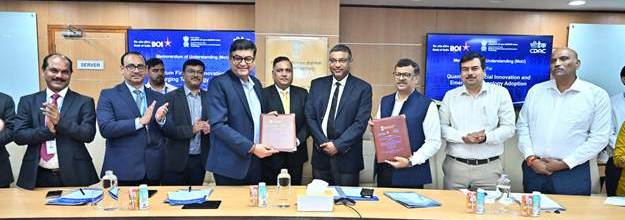
The MoU was formally exchanged by C-DAC Mumbai Executive Director Aditya Kumar Sinha and Bank of India Chief General Manager and Chief Information Officer Satyendra Singh in the presence of Krishnan, Mishra, MeitY Joint Secretary Sudeep Shrivastava, Magesh and other senior officials from the ministry and the two organisations.
The collaboration is expected to establish a structured pathway for converting indigenous research into deployable financial technology solutions, while supporting India's efforts to build a secure, resilient and technologically advanced banking sector.