THEBUSINESSBYTES
BUREAU
NEW
DELHI, OCTOBER 23, 2026
India has set an
ambitious target of increasing annual fish production to 30 million tonnes over
the next five years, while aiming to boost seafood exports to Rs 1.25 lakh
crore, Union Fisheries Secretary Abhilaksh Likhi said on Friday, underscoring
the government's focus on sustainable growth, stronger value chains and
improved livelihoods for small-scale fishers.
India currently
produces 19.7 million tonnes of fish annually, with inland fisheries accounting
for nearly three-fourths of the total output, while seafood exports have
crossed Rs 70,000 crore, Likhi said, highlighting the sector's growing
contribution to the country's economy and livelihood generation.
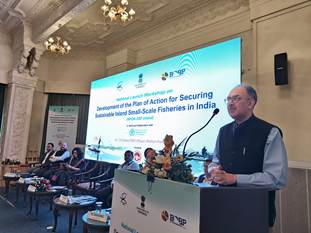
Addressing a national
workshop in Bhopal, Likhi formally launched the development phase of India's
National Plan of Action (NPOA) for small-scale inland fisheries, an initiative
aimed at improving the management of freshwater resources, strengthening
coordination and enhancing the economic well-being of fishing communities.
The plan is being
developed by the Union Department of Fisheries in collaboration with the Bay of
Bengal Programme Inter-Governmental Organisation (BOBP-IGO), under the
framework of the United Nations Food and Agriculture Organization (FAO).
Calling for a
mission-mode outreach programme, Likhi emphasised that the proposed action plan
must reach fishing communities across the country and deliver tangible
improvements in their livelihoods rather than remain confined to government
offices.
He stressed that the
expansion of fish production and seafood exports must go hand in hand with
sustainability and the protection of small-scale fishers, who form a crucial
part of India's inland fisheries ecosystem.
Climate change and
deteriorating water quality are emerging as major challenges for inland
fisheries, Likhi said, drawing attention to declining oxygen levels in water
bodies and the need to strengthen climate resilience.
He said the proposed
action plan should incorporate the experiences of fishing communities, who are
directly exposed to environmental changes, and promote region-specific
approaches to sustainable fisheries management.
India's diverse
inland fisheries sector, spanning rivers, canals, reservoirs, lakes, floodplain
wetlands, tanks and cold-water systems, offers an opportunity to develop locally
tailored solutions that could also serve as models for wider application, Likhi
added.
The two-day national
workshop in Bhopal brought together experts from fisheries institutions and
other stakeholders to identify priorities and prepare a framework for the
development phase. The discussions also outlined a proposed programme of
consultations with fishing communities and other stakeholders before the plan
is finalised.
BOBP-IGO Director P
Krishnan said the development phase would address key issues such as fishing
rights, resource management, employment and decent work, gender equality, value
chains, post-harvest trade, disaster risks and climate change.
The initiative is
expected to provide a framework for balancing higher production with
responsible resource management, while improving market access and income
opportunities for small-scale fishers.
The plan will be finalised following stakeholder consultations before its public launch next month and subsequent implementation.
Madhya Pradesh Fisheries Secretary Swantantra Kumar Singh, Joint Secretary Gunjan Krishna and FAO Project Officer Giulia Gorelli also addressed the gathering.