THEBUSINESSBYTES
BUREAU
NEW DELHI, JULY 31,
2026
In a major push to India's clean energy
transition and renewable infrastructure, the Union Cabinet, chaired by Prime
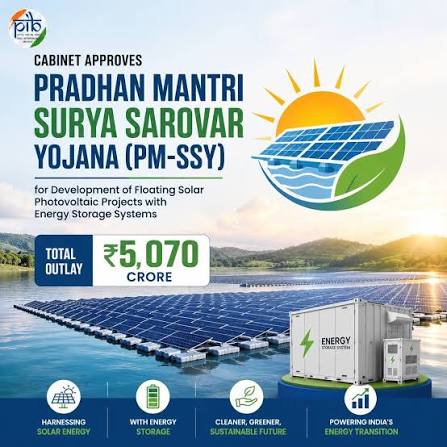
Minister Narendra Modi, on Friday approved the 'Pradhan Mantri Surya Sarovar Yojana
(PM-SSY)', a flagship scheme for the development of Floating Solar Photovoltaic
(FSPV) Projects integrated with Energy Storage Systems (ESS), with a total
financial outlay of Rs.5,070 crore.
The ambitious scheme envisages the
development of 5,000 MW of Floating Solar Photovoltaic projects with co-located
Energy Storage Systems having a minimum storage capacity of two hours,
equivalent to 10,000 MWh. The projects will be sanctioned over the period from
FY 2026-27 to FY 2030-31, while the disbursement of financial assistance will
continue until FY 2032-33.
The Cabinet's approval comes in the
wake of a recent assessment by the National Institute of Solar Energy (NISE),
which estimated India's floating solar potential at approximately 102.18 GWp
across reservoirs and other suitable inland water bodies, underscoring the vast
untapped opportunity for expanding renewable energy generation without placing
additional pressure on scarce land resources.
To accelerate project implementation
and improve financial viability, the scheme provides Central Financial Assistance
(CFA) of Rs. One crore per MW for eligible Floating Solar Photovoltaic projects
after successful commissioning. Additionally, developers will be eligible for
CFA of up to Rs.50 lakh per project to undertake critical feasibility studies,
including bathymetry and hydrography assessments, environmental studies, and
other preparatory activities aimed at de-risking project development.
The scheme is expected to benefit all
States and Union Territories, significantly expanding India's floating solar
capacity from the current level of around 700 MW to an additional 5,000 MW. By
utilizing existing reservoirs and industrial ponds for solar installations, the
initiative will help optimize water bodies for clean energy generation while
eliminating competition for limited land resources.
The integration of energy storage
systems alongside floating solar projects is expected to strengthen grid
reliability by enabling better management of intermittent renewable power
generation. Beyond enhancing energy security, the initiative is projected to
reduce approximately 10 million tonnes of CO₂ emissions annually, making
a substantial contribution to India's climate commitments.
The PM-SSY is also expected to deliver significant economic benefits by generating approximately 16,000–17,000 full-time equivalent employment opportunities across the project value chain. Furthermore, the scheme is designed to boost domestic manufacturing of floatation systems and other critical components, including photovoltaic cells, solar modules and energy storage systems, thereby reinforcing the government's vision of Aatmanirbhar Bharat.
With the approval of the PM Surya Sarovar Yojana, the government aims to accelerate renewable energy capacity addition, support the achievement of national energy and climate goals, promote optimal utilisation of water resources, and advance the broader vision of Viksit Bharat through sustainable infrastructure development.