
THEBUSINESSBYTES BUREAU
GURUGRAM, FEBRUARY 20, 2026
BMW India Foundation is
reinforcing its commitment to inclusive and sustainable development by
supporting and upskilling traditional artisans across India, positioning
cultural preservation and economic resilience at the heart of its Corporate
Social Responsibility vision. Anchored in the belief that heritage crafts can
become viable engines of livelihood when paired with contemporary skills and
market access, the Foundation’s initiatives are enabling artisan communities to
transition from vulnerability to long-term stability while safeguarding the
authenticity of India’s diverse indigenous art traditions.
Launched
in 2025, the artisan empowerment programme responds to structural challenges
that have historically constrained traditional artists, including limited
access to formal training, inadequate exposure to modern design sensibilities,
and the absence of organised market linkages. By collaborating with experienced
implementation partners and domain experts, BMW India Foundation is building a
comprehensive ecosystem that blends skill enhancement, design innovation, and
market readiness. This integrated approach allows artisans not only to refine
their craft but also to align their products with evolving consumer
preferences, thereby creating resilient and diversified income streams.
 Hardeep
Singh Brar, President & CEO, BMW Group India said, “At BMW India
Foundation, we deeply respect the incredible craftsmanship and rich traditions
of India’s artisans. For us, this is not just about preserving beautiful art
forms, it’s about supporting the talented people who bring them to life. Many
of these artisans face real challenges, from limited access to new skills to
difficulty reaching bigger marketplaces. We want to help change that by giving
them the tools, training, scope for experimentation and opportunities they need
to grow and sustain their livelihoods. Programs like Project Chitravan and
Project Phulkari are very close to our hearts. They allow artisans to stay
connected to their roots while exploring new ideas and designs that appeal to
modern customers.”
Hardeep
Singh Brar, President & CEO, BMW Group India said, “At BMW India
Foundation, we deeply respect the incredible craftsmanship and rich traditions
of India’s artisans. For us, this is not just about preserving beautiful art
forms, it’s about supporting the talented people who bring them to life. Many
of these artisans face real challenges, from limited access to new skills to
difficulty reaching bigger marketplaces. We want to help change that by giving
them the tools, training, scope for experimentation and opportunities they need
to grow and sustain their livelihoods. Programs like Project Chitravan and
Project Phulkari are very close to our hearts. They allow artisans to stay
connected to their roots while exploring new ideas and designs that appeal to
modern customers.”
In
central India, BMW India Foundation has partnered with the Craft and Community
Development Foundation (CCDF) to implement Project Chitravan, an initiative
that supports tribal artisans from Madhya Pradesh, Rajasthan, Jharkhand, and
Maharashtra who practise indigenous art forms such as Gond, Warli, Bhil, Baiga,
Sohrai, and Kohvar. These art traditions, deeply embedded in community memory
and ritual expression, are being revitalised through structured mentorship that
combines traditional storytelling with contemporary design perspectives.
Artisans are selected based on craftsmanship, creative potential, and economic
need, ensuring that support reaches those most capable of benefiting from
sustained engagement. Through curated workshops, hands-on guidance, and
exposure to new materials and formats, the programme enables artists to expand
their creative vocabulary while preserving the symbolic language, motifs, and
techniques that define their cultural identity. Around 40 tribal artisans
across central India are currently being nurtured under this initiative, with
the potential to scale both production capacity and market outreach in the
coming phases.
In
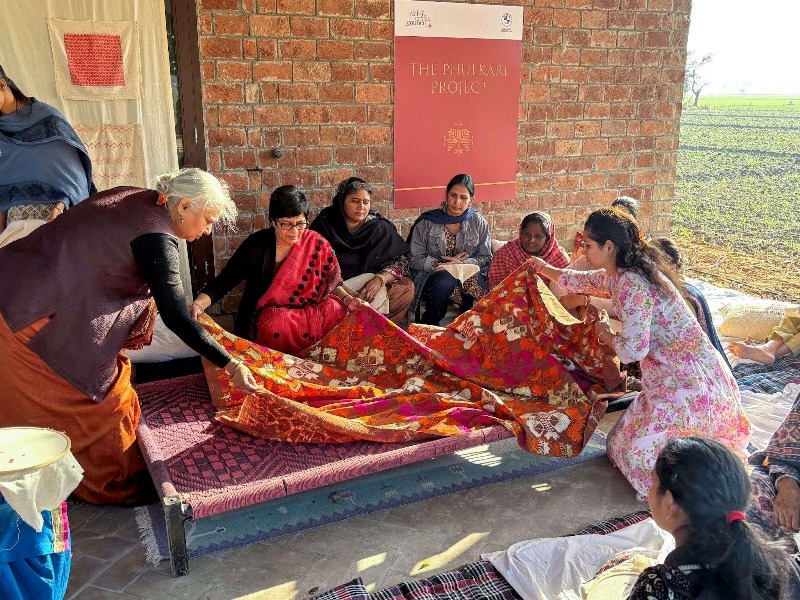
Punjab, the Foundation has joined hands with the Delhi Crafts Council to
strengthen and modernise the centuries-old tradition of Phulkari embroidery, a
craft synonymous with regional identity and generational knowledge. The
initiative focuses on reviving authentic techniques that had gradually declined
under the pressure of mass-produced imitations, while simultaneously
introducing sustainable practices such as the use of natural dyes and
responsibly sourced materials. By facilitating collaborations between artisans
and professional textile designers, the programme encourages the co-creation of
contemporary product lines that retain the essence of traditional Phulkari
while appealing to current aesthetic and functional demands. These include
stoles, apparel accents, home décor textiles, and accessories that are better
aligned with urban and global markets. Training modules in digital literacy,
pricing strategies, quality control, and buyer engagement are equipping artisans
with the confidence and competence required to participate in formal and online
marketplaces. Around 30 artisans in Punjab are currently benefiting from this
initiative, gaining not only enhanced technical skills but also improved
visibility and bargaining power within the value chain.
Beyond
individual projects, the Foundation’s broader strategy emphasises long-term
partnerships, measurable social outcomes, and scalable models of intervention.
By linking creative capacity with entrepreneurship, the programmes are
fostering a shift from subsistence-level production to structured
micro-enterprise development. This transformation is particularly significant
for women artisans and tribal communities, for whom access to stable income
sources contributes directly to improved education, healthcare, and social
mobility at the household level. The integration of sustainability principles
further ensures that traditional knowledge systems are preserved in ways that
are environmentally responsible and economically viable.
BMW India Foundation has been
established to implement Corporate Social Responsibility programmes on behalf
of BMW Group entities in India – BMW Group India, BMW India Financial Services
and BMW India Leasing. It carries forward existing community initiatives while
expanding their scale and impact through strategic collaborations and sustained
investment. By creating pathways that connect heritage crafts with contemporary
markets, the Foundation is not only protecting intangible cultural assets but
also enabling artisan communities to participate meaningfully in India’s
evolving economic landscape.