THEBUSINESSBYTES
BUREAU
BRIDGETOWN
(BARBADOS), JULY 17, 2026
Cricket on Friday
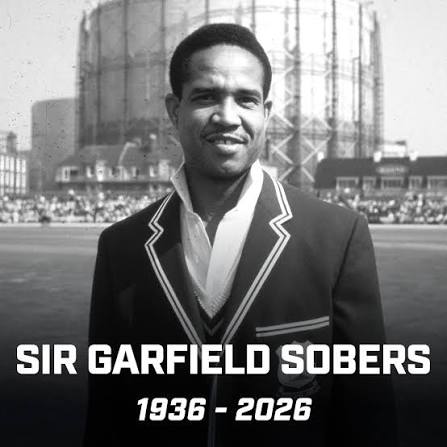
lost one of its tallest icons as Sir Garfield Sobers, the incomparable West
Indian all-rounder whose extraordinary brilliance with bat, ball and in the
field redefined the sport, passed away at the age of 89.
The death of the
legendary former West Indies captain was confirmed by his son, Daniel. Sobers,
born in Bridgetown, Barbados, on July 28, 1936, was just 11 days short of
celebrating his 90th birthday.
His passing marks the
end of a remarkable chapter in cricket history, but his legacy will continue to
inspire generations of cricketers and fans across the world.
Widely acclaimed as
the greatest all-rounder the game has ever produced, Sobers represented the
West Indies in 93 Test matches between March 1954 and April 1974, amassing
8,032 runs at a magnificent average of 57.78. His glittering batting record
included 26 centuries and 30 half-centuries, while his versatility with the
ball fetched him 235 Test wickets.
A naturally gifted
left-hander, Sobers possessed the rare ability to bowl left-arm fast-medium,
orthodox spin and wrist spin with equal effectiveness, making him one of
cricket’s most complete players. He also played one One-Day International,
claiming a wicket, and earned widespread acclaim as a superb fielder.
Sobers etched his
name permanently into cricket folklore in February 1958 when, at just 23, he
scored an unbeaten 365 against Pakistan at Kingston. The monumental knock
became the highest individual Test score in history at the time and remained
unbeaten for an astonishing 36 years.
His extraordinary
1958 season remains one of the finest ever by a batter. In only eight Tests,
Sobers amassed 1,299 runs at a staggering average of 144.33, including six
centuries and three half-centuries.
Another landmark came
in 1968 when, representing Nottinghamshire against Glamorgan, Sobers became the
first batter in First-Class cricket to smash six sixes in a single over, a feat
that elevated his legendary status even further.
Beyond his
international exploits, Sobers enjoyed a phenomenal First-Class career. In 383
matches, he scored 28,314 runs at 54.87 with 86 centuries and 121 fifties,
while also capturing an incredible 1,043 wickets.
As a batter, Sobers
was particularly dominant against India, compiling 1,920 runs with eight
centuries and seven fifties in just 18 Tests. England bore the brunt of his
brilliance as well, with Sobers scoring 3,214 runs at 60.64, including 10
centuries and 13 half-centuries. Against Australia, he amassed 1,510 runs with
four hundreds, while his average of 89.45 against Pakistan reflected his
remarkable consistency.
With the ball,
England was again his favourite opponent, yielding 102 wickets, while he also
claimed 59 wickets against India and 51 against Australia.
Sobers captained the
West Indies in 39 Tests between 1965 and 1972, guiding the Caribbean side to
nine victories, 20 draws and 10 defeats. He had begun his First-Class career at
the age of 16 before making his Test debut against England at Kingston just a
year later, launching one of cricket's most celebrated careers.
Even decades after
his retirement, Sobers' achievements remain benchmarks of excellence. He is
still the fourth-highest run-scorer in West Indies Test history and the
eighth-highest wicket-taker for the Caribbean side.
His immense
contribution to the game earned him a knighthood from Queen Elizabeth II in
1975, while in 2000 he was named one of Wisden's Five Cricketers of the
Century. The International Cricket Council also immortalised his name by
instituting the Sir Garfield Sobers Award, presented annually to the world's
outstanding international cricketer across all formats.
Few players have transformed cricket as profoundly as Sir Garfield Sobers. His unmatched versatility, elegance and competitive spirit elevated the sport to new heights, making him the gold standard for all-round excellence.
Though the cricketing world mourns the passing of one of its brightest stars, Sir Garfield Sobers' extraordinary legacy will forever endure—in record books, in memories, and in the dreams of every young cricketer aspiring to greatness.