
THEBUSINESSBYTES
BUREAU
BHUBANESWAR,
SEPTEMBER 4, 2026
“The prosperity of farmers is the real
foundation of Odisha’s progress,” Chief Minister Mohan Charan Majhi said on
Friday as he announced the release of more than Rs 833 crore under the fifth
instalment of the CM-KISAN scheme for over 41.49 lakh small and marginal
farmers and landless agricultural families ahead of Nuakhai and on the occasion
of Janmashtami.
Majhi
said CM-KISAN was not merely a financial assistance programme but a recognition
of the hard work of farmers, asserting that his government remained committed
to their welfare and that of landless agricultural families.
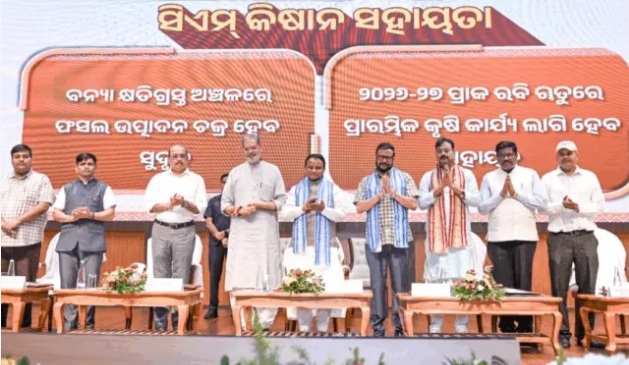
“The prosperity of farmers is the real
foundation of Odisha’s progress. CM-KISAN is not merely financial assistance;
it is due honour for the hard work of farmers,” he said while addressing a
state-level programme at Krushi Shiksha Sadan of the Odisha University of
Agriculture and Technology (OUAT) here.
The
fifth instalment, amounting to more than Rs 833 crore, was transferred through
Direct Benefit Transfer (DBT) into the bank accounts of 41,35,978 small and
marginal farmers and 13,949 landless agricultural families.
The
assistance has been released ahead of the 2026-27 Rabi season to help farmers
purchase seeds, fertilisers and pesticides.
The
Chief Minister said CM-KISAN supports farmers at various stages, from
agricultural inputs to allied livelihood activities and quality technical
education for their children.
Majhi
also announced that the deadline for paddy registration for the ongoing 2026-27
Kharif season has been extended till September 7.
He
announced a special assistance package of Rs 1,000 crore for farmers affected
by the recent floods in Mayurbhanj, Kendujhar, Baleshwar, Bhadrak, Kendrapada
and Sundaragada districts.
The
compensation will be released on the basis of damage assessment reports
prepared by revenue and agriculture field staff, he said, adding that no
eligible farmer would be left out of the assistance.
Under
the Samrudha Krushak Yojana, paddy is being procured at Rs 3,100 per quintal by
combining the Centre’s MSP with state input assistance, with the payment
credited to farmers’ bank accounts within 48 hours of sale.
During
the 2025-26 Kharif season, 77.48 lakh metric tonnes of paddy were procured from
18.84 lakh farmers, while a record Rs 5,663.84 crore was paid as input subsidy.
In the Rabi season, Rs 1,494.89 crore was provided to 3.63 lakh farmers, Majhi
said.
More
than 60 per cent of Odisha’s population depends on agriculture, he said, adding
that doubling farmers’ annual income remained one of the key goals of his
government.
Majhi
stressed the need for diversification in agriculture, saying farmers should not
depend solely on traditional cultivation and should explore allied sectors and
alternative sources of income.
Under
the Krushi Vidyanidhi Yojana, scholarships worth more than Rs 291.60 crore were
provided to 68,910 children of farmer families during 2025-26, he said.
The
Chief Minister also urged farmers to register themselves with the Farmers’
Registry along with their land details to access various government benefits.
He
said the government was giving special emphasis to animal husbandry, fisheries,
the Sri Anna Abhiyan for millet cultivation and the National Pulse Mission.
Last
year, 6.92 lakh quintals of millets were procured at an MSP of Rs 4,886 per
quintal. Under the agriculture industry scheme, subsidy of up to Rs 1 crore is
available, he said.
Taking
a swipe at the previous government, Majhi said the monthly income of
agricultural families in Odisha had remained very low for nearly two and a half
decades.
He
said the monthly income of an agricultural family in Odisha was only Rs 5,112
in 2022, making the state the second lowest in the country after Jharkhand.
Farmers
had little option but to continue cultivation despite hardships, he said,
adding that the situation had changed after the new government assumed office,
with paddy now being procured at Rs 3,100 per quintal.
With
around 92 per cent of Odisha’s farmers being small and marginal, Majhi urged
them to make greater use of government schemes to increase their earnings.
He
also highlighted challenges posed by climate change, erratic weather, water
scarcity and soil erosion, saying the state was promoting organic farming,
millet cultivation and regenerative agriculture.
Odisha
recorded high production of foodgrains, fruits and vegetables this year, while
cotton produced in the state has also been included in the country’s premium
“Kasturi Cotton” list, he said.
Deputy
Chief Minister Kanak Vardhan Singh Deo who also holds the Agriculture and
Farmers’ Empowerment portfolio, said ministers and officials had visited
flood-hit areas and assured that no eligible farmer would be left out of the
assistance.
He
said farmers could purchase vegetable mini-kits under a government scheme and
receive reimbursement through DBT after submitting bills. Adequate fertiliser
was available in the state and farmers should not believe rumours of shortages,
he added.
Revenue
and Disaster Management Minister Suresh Pujari said Odisha was the first state
in the country to provide the highest subsidy to farmers.
On
the chief minister’s direction, unseasonal rain has been officially notified as
a disaster so that affected farmers can receive government assistance, he said.
Khordha
MLA and District Planning Board Chairman Prasanta Kumar Jagadev attended the
programme as the guest of honour.
Senior
officials, including Agriculture and Farmers’ Empowerment Department
Commissioner-cum-Secretary Sachin Ramchandra Jadhav, Director of Agriculture
and Food Production Shubham Saxena, Director of Horticulture Kalunge Gorakh Waman
and OUAT Vice-Chancellor Dr Pravat Kumar Roul, were present.
More
than 750 farmers attended the Bhubaneswar programme, while the event was
livestreamed to all 30 districts, where parallel programmes were held in the
presence of ministers, MPs, MLAs, collectors, agriculture officials and
farmers.