THEBUSINESSBYTES
BUREAU
NEW
DELHI, MAY 21, 2026
Reinforcing India’s
growing shift towards next-generation healthcare, Union Minister of State (Independent Charge)
for Science & Technology, Earth Sciences, and Minister of State in the
Prime Minister’s Office, Personnel, Public Grievances & Pensions, Atomic
Energy and Space, Dr. Jitendra Singh on Thursday said
that genomic and precision medicine will define the future of healthcare
delivery, diagnosis and treatment, as he dedicated the UMMID (Unique Methods of
Management of Inherited Disorders) Programme for Rare Genetic Disorders and
Diseases to the nation. He said India is steadily moving towards a healthcare
system where medical care will be increasingly genome-based, precision-driven
and tailored to the genetic profile of each patient.
Speaking at a special
function organised by the Department of Biotechnology at Prithvi Bhawan in New
Delhi, the Minister underlined that inherited and rare genetic disorders have
long remained neglected due to diagnostic challenges, high treatment costs and
limited availability of medicines. He stressed the need for a coordinated
national mechanism to ensure affordable, accessible and timely diagnosis and
care for affected families.
Describing the UMMID
initiative as a landmark step in India’s transition towards precision medicine,
Dr. Singh said the programme is designed to strengthen the country’s readiness
for the next generation of gene and genome-based healthcare systems. On the
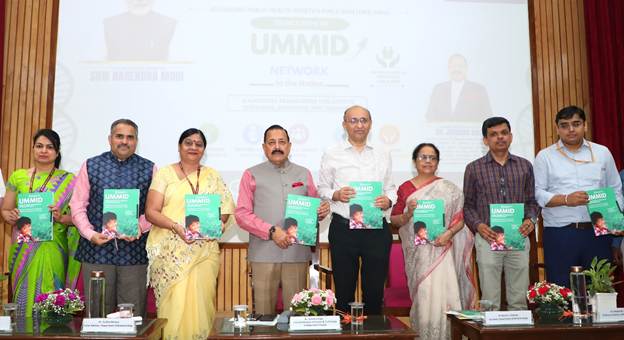
occasion, he dedicated the UMMID network to the nation and also released the
UMMID Compendium while launching the UMMID Dashboard aimed at improving access
to diagnostics, counselling, outreach and real-time monitoring of inherited disorders
across the country.
The event was
attended by Dr. Rajesh S. Gokhale, Senior Adviser Dr. Suchita Ninawe, leading
scientists, clinicians, healthcare professionals and representatives of
implementing institutions working under the programme. BRIC and other
scientific bodies also contributed to the discussions on strengthening India’s
genetic healthcare ecosystem.
Highlighting
healthcare reforms under the leadership of the Prime Minister, Dr. Singh noted
that Prime Minister’s Office has consistently prioritised affordable,
preventive and citizen-centric healthcare over the past decade. He said
expansion of wellness centres, improved health insurance coverage and access to
affordable medicines have collectively strengthened India’s public health
system, while also enabling early detection and preventive care.
The Minister observed
that rare genetic disorders, though affecting smaller populations, impose
severe emotional and financial burdens on families, often forcing prolonged
journeys across hospitals in search of diagnosis. He emphasised that such
conditions deserve equal policy attention and healthcare sensitivity as other
major diseases, given their long-term impact on affected communities.
Sharing his medical
perspective, Dr. Singh noted that rare diseases have historically received
limited attention in mainstream medical education due to low prevalence and
diagnostic complexity, leading to delayed identification and inadequate
treatment access. He pointed out that India’s vast genetic diversity further
complicates the challenge, necessitating robust systems for early screening,
prenatal counselling, clinician training and community outreach.
Appreciating the
Department of Biotechnology for spearheading the initiative, he said UMMID
represents a convergence of science, compassion and public policy, creating a
unified national framework integrating genetic diagnostics, newborn screening,
counselling and capacity building. He said the programme has already benefitted
nearly three lakh individuals and expanded outreach to Aspirational Districts
and underserved regions, while establishing around 30 NIDAN Kendras to
strengthen advanced diagnostic and counselling services.
Dr. Singh added that
the experience gained through UMMID will lay the foundation for India’s future
in precision medicine, where treatment protocols for major diseases such as
cancer, diabetes and cardiac conditions may increasingly be guided by
individual genetic profiles. He said both genetic medicine and nuclear medicine
are emerging as transformative frontiers in global healthcare.
Earlier, Dr. Gokhale said the UMMID initiative has provided renewed hope to thousands of families through early diagnosis, collaborative research and biotechnology-driven interventions, while Dr. Ninawe highlighted that the programme has significantly strengthened India’s national response to inherited genetic disorders through an integrated institutional network.
The programme also featured presentations on achievements, success stories and a short film showcasing the journey and future roadmap of the UMMID initiative.