THEBUSINESSBYTES
BUREAU
BHUBANESWAR,
JANUARY 11, 2026
India stands
at a decisive moment in its industrial evolution. Having recently emerged as
the world’s fourth-largest economy, surpassing Japan, the country’s growth
momentum has been propelled by a renewed thrust on domestic manufacturing,
infrastructure expansion and reduced import dependence. From electronics and
defence to renewable energy, policy initiatives aimed at strengthening local
value chains have begun to yield results. Yet, beneath this progress lies a
striking contradiction. Despite possessing vast reserves of bauxite — the
primary raw material for aluminium — India continues to rely heavily on imports
to sustain its expanding aluminium value chain. This paradox not only drains
valuable foreign exchange but also undermines strategic autonomy in critical
sectors such as defence, electric mobility, construction and clean energy,
while constraining job creation and regional development.
“India is resource-rich when it comes to
bauxite. Government and industry estimates place the country’s bauxite
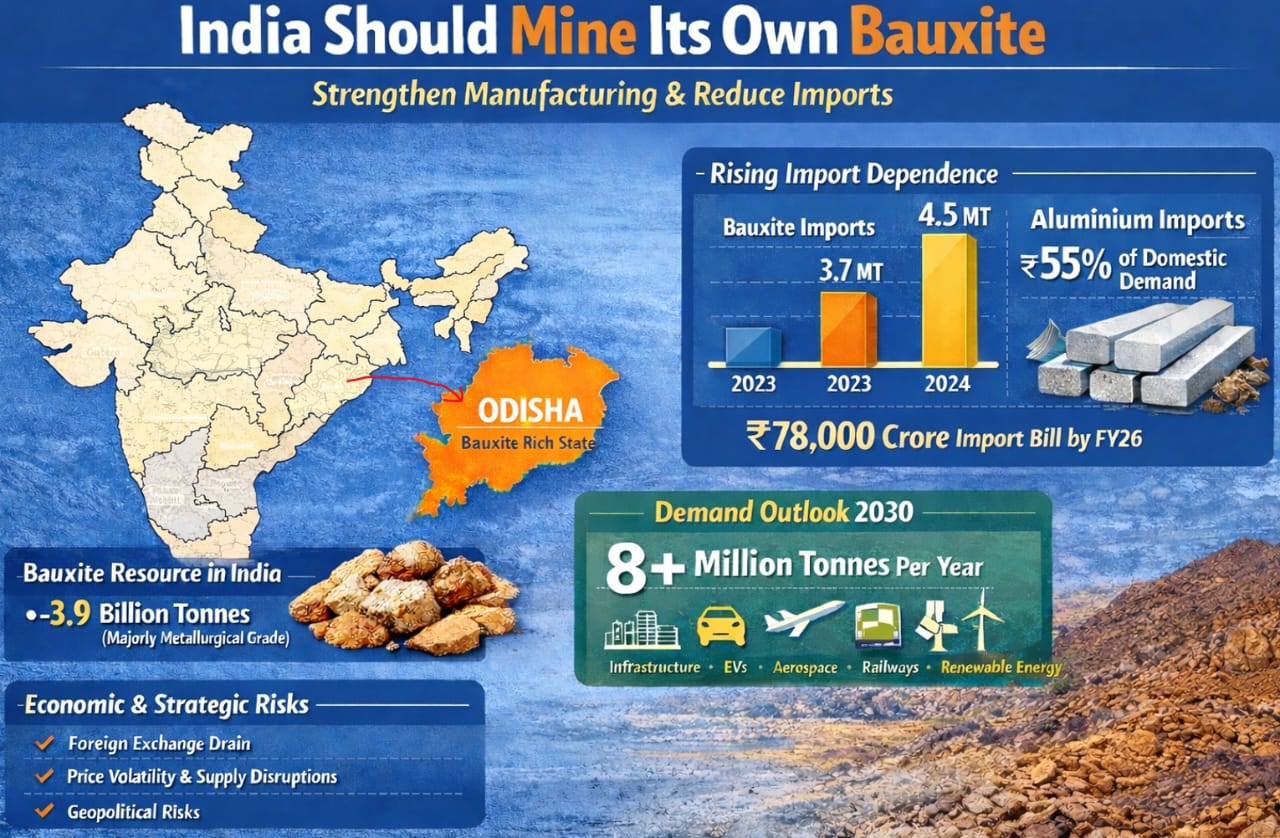
resources at nearly 3.9 billion tonnes, a significant share of which is
metallurgical grade and suitable for aluminium production. These reserves are
spread across Odisha, Jharkhand, Gujarat, Maharashtra, and Madhya Pradesh, with
the eastern belt, particularly Odisha, emerging as the leading
bauxite-producing state. Districts such as Kalahandi, Koraput, Sundargarh,
Bolangir, and Sambalpur host some of the country’s richest deposits, offering a
strong foundation for long-term raw material security if effectively
harnessed”, said Dr. Sridhar Panda, former Professor of Geology, Berhampur
University.
Despite this
abundance, India’s bauxite imports have climbed steadily in recent years, signalling
a widening gap between domestic supply and rising demand. In 2023, the country
imported over 3.7 million tonnes of bauxite, about 6 per cent higher than the
previous year. The trend intensified in 2024, with imports jumping by nearly 20
per cent to more than 4.5 million tonnes as aluminium plants and downstream
industries expanded capacity. Trade data from 2025 further reveal thousands of
bauxite consignments arriving from countries such as Guinea and China, as well
as European trading hubs like the Netherlands, highlighting the depth of
India’s growing import dependence.
Dr. Panda
added, “The consequences of this reliance extend well beyond raw material
volumes. Aluminium imports, including semi-finished products, now account for
more than 55 per cent of domestic demand, imposing a cost of tens of thousands
of crores on the economy each year. Import values have reportedly risen by 72
per cent over the past five years, reaching nearly ₹78,000 crore in FY26. This sustained outflow of foreign
exchange exposes Indian manufacturing to global price volatility, supply chain
disruptions,
and geopolitical risks. Such vulnerabilities sit uneasily with national
ambitions under Atmanirbhar Bharat and the Aluminium Vision 2047 released by
the Ministry of Mines, both of which emphasise resilient domestic supply chains
for critical materials.”
 Demand
pressures are set to intensify further as aluminium becomes increasingly
indispensable to modern infrastructure, electric vehicles, aerospace, railways
and renewable energy installations, owing to its light weight, strength and
recyclability. Projections under Aluminium Vision 2047 suggest that India’s
aluminium requirement could exceed 8 million tonnes per annum by 2030, up from
around 5.5 million tonnes currently. While domestic primary aluminium
production has reached about 4.2 million tonnes in FY2025 and major producers
are planning capacity expansions, long-term growth hinges on assured access to
raw materials — something imports alone cannot reliably ensure.
Demand
pressures are set to intensify further as aluminium becomes increasingly
indispensable to modern infrastructure, electric vehicles, aerospace, railways
and renewable energy installations, owing to its light weight, strength and
recyclability. Projections under Aluminium Vision 2047 suggest that India’s
aluminium requirement could exceed 8 million tonnes per annum by 2030, up from
around 5.5 million tonnes currently. While domestic primary aluminium
production has reached about 4.2 million tonnes in FY2025 and major producers
are planning capacity expansions, long-term growth hinges on assured access to
raw materials — something imports alone cannot reliably ensure.
“India’s reliance on bauxite imports is
therefore not a consequence of resource scarcity but a structural and policy
gap. Domestic bauxite production crossed 23 million tonnes in 2023, yet new
mine development has lagged due to complex land acquisition processes,
regulatory delays, and inadequate infrastructure in mineral-rich regions. As a
result, economically viable deposits remain underutilised while producers turn
to foreign ore to meet immediate needs. Streamlining approvals, investing in
logistics, strengthening community engagement, and adopting responsible mining
practices can unlock domestic reserves at scale and support long-term supply
security”, added Dr. Panda.
Reducing
import dependence offers dividends beyond economics. Aluminium is increasingly
recognised as a strategic metal, central to energy transition and national
security. Reliable access to domestic bauxite would shield India from external
shocks while catalysing employment, infrastructure development and value
addition in some of the country’s most underdeveloped regions.
With vast
reserves lying untapped and imports rising steadily, India now faces a clear
choice. Prioritising responsible and efficient domestic bauxite mining is no
longer optional — it is essential. For policymakers and industry alike, the
path forward is evident: sustainable industrial growth must be anchored in
India’s own mineral strength to secure long-term manufacturing resilience and
economic independence.