THEBUSINESSBYTES BUREAU
NEW DELHI, NOVEMBER 17, 2026
In a major push to strengthen India's agricultural diplomacy and expand
South-South cooperation, the Indian Council of Agricultural Research (ICAR) and
the Research and Information System for Developing Countries (RIS) on Tuesday
signed a Memorandum of Understanding (MoU) to promote the exchange of
agricultural technologies, research, best practices and capacity-building
initiatives across countries of the Global South.
The agreement, signed in New Delhi on November 17, seeks to leverage
India's extensive agricultural research capabilities and institutional network
to facilitate knowledge-sharing and develop locally relevant solutions to
common agricultural challenges faced by developing nations.
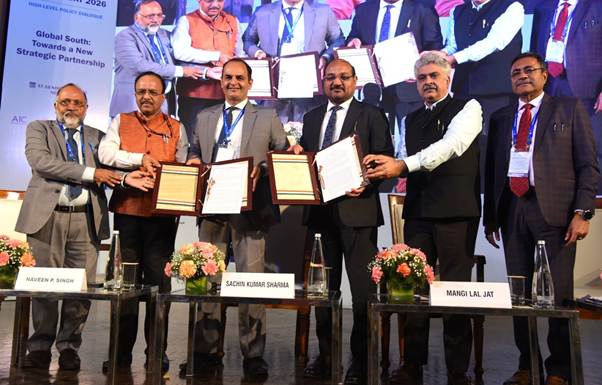
The MoU was exchanged between Dr M L Jat, Secretary, Department of
Agricultural Research and Education (DARE) and Director General of ICAR, and
Prof Sachin Kumar Sharma, Director General of RIS, under the aegis of DAKSHIN –
Global South Centre of Excellence.
The partnership comes at a time when developing countries are
increasingly seeking collaborative approaches to address food security, climate
challenges, agricultural productivity and technological gaps, while
strengthening their collective influence in global policy-making.
Addressing the inaugural session of the High-Level Policy Dialogue on
'Global South: Towards a New Strategic Partnership', Minister of State for
External Affairs Kirti Vardhan Singh called for a stronger and more coordinated
voice of developing nations in shaping global narratives, building economic
resilience and ensuring equitable access to emerging technologies, particularly
Artificial Intelligence.
He stressed the need to deepen India-Africa partnerships, promote
institutional collaboration and encourage young researchers and policymakers to
translate shared knowledge into meaningful policy outcomes.
Recalling Prime Minister Narendra Modi's vision articulated at the Second
Voice of the Global South Summit in November 2023, Singh underlined the
importance of developing common perspectives on shared challenges and moving
beyond conventional development assistance towards co-development and mutually
beneficial solutions.
Highlighting ICAR's institutional strength, Jat said the organisation,
with a legacy spanning over a century, has 114 research institutions, 152
regional research centres and 731 Krishi Vigyan Kendras (KVKs), besides
coordinating with nearly 80 agricultural universities across the country.
He said ICAR has signed 74 MoUs with various countries and institutions,
with nearly 60 per cent of these partnerships involving institutions from the
Global South.
The new collaboration with RIS and DAKSHIN would provide a stronger
institutional framework for sharing and applying agricultural technologies,
practices, systems and research tools across developing countries, Jat said.
Emphasising the importance of matching agricultural technologies with the
needs of partner countries, he said identifying common agro-climatic conditions
and relevant research domains would be crucial to ensuring that knowledge and
innovations deliver tangible benefits.
Jat also referred to the proposed Science and Partnership Week in April
2027, which is expected to bring together participants from countries of the
Global South and North in India to explore demand-driven research partnerships
and institutional cooperation.
Sharma said agriculture remains central to the development priorities of
the Global South and called for greater knowledge-sharing, mutual learning and
coordinated engagement among developing countries.
Drawing on his experience in agricultural negotiations at the World Trade
Organization, he highlighted the need to strengthen the concerns and collective
voice of developing nations in multilateral negotiations and global
decision-making.
While RIS brings an extensive network of institutional and policy
linkages across the Global South, ICAR offers a rich repository of agricultural
technologies, scientific research and field-level best practices, he said,
adding that the partnership would facilitate technology transfer as well as
reciprocal learning among countries with comparable agro-climatic conditions.
South African High Commissioner to India Prof Anil Sooklal described the
current global uncertainty as a defining moment for the Global South to assert
its leadership in shaping an emerging multipolar world order.
He called for reforms in global governance, stronger strategic
partnerships and greater efforts to generate knowledge and policy perspectives
from within developing countries.
Eritrean Ambassador to India and Dean of the Diplomatic Corps Alem
Tsehaye Woldemariam stressed the need to transform the longstanding solidarity
between India and Africa into concrete partnerships through economic
cooperation, connectivity, infrastructure development and youth engagement.
Archna Vyas, Country Director of the Gates Foundation in India,
identified digital public infrastructure, health security, agriculture and food
systems, Artificial Intelligence and institutional capacity-building as
promising areas for India-Africa cooperation.
She said effective partnerships must be anchored in country ownership,
co-creation and mutual learning, with an emphasis on affordable, scalable and
locally relevant solutions.
Dr Rajan Sudesh Ratna, Coordinator of DAKSHIN – Global South Centre of
Excellence, reaffirmed the institution's commitment to translating policy
dialogue into actionable partnerships through country-led priorities,
institutional cooperation and capacity-building.
The MoU was signed during the two-day High-Level Policy Dialogue being
organised by RIS–DAKSHIN in partnership with the Ministry of External Affairs
on November 17-18 at the India Habitat Centre here, coinciding with DAKSHIN Day
2026.
The dialogue has brought together diplomats, policymakers, researchers, development practitioners and representatives of academic and partner institutions to deliberate on strengthening South-South cooperation, with particular focus on the evolving India-Africa strategic partnership.
The ICAR-RIS collaboration is expected to provide fresh momentum to India's engagement with developing nations by positioning agricultural research, technology-sharing and institutional partnerships as key instruments of inclusive growth, food security and sustainable development across the Global South.