THEBUSINESSBYTES BUREAU
NEW DELHI, NOVEMBER 17, 2026
Tribal communities have been the guardians of biodiversity and their
traditional knowledge and practices continue to inspire modern science, Union
Minister of State (Independent Charge) for Science and Technology and Earth
Sciences Dr Jitendra Singh said on Tuesday, calling for their active
participation and leadership in India's scientific and innovation journey.
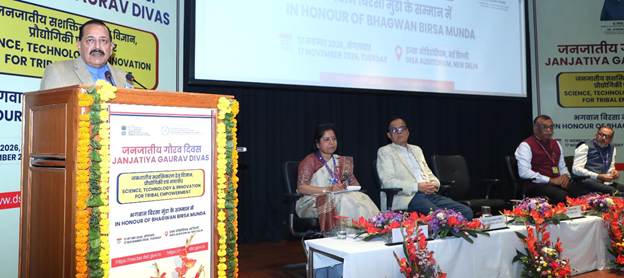
Addressing a programme organised to mark Janjatiya Gaurav Divas,
commemorating the birth anniversary of Bhagwan Birsa Munda, Singh said tribal
communities must be recognised as partners and leaders in India's scientific
and technological progress, with greater opportunities for innovation, entrepreneurship
and sustainable livelihoods.
The programme was organised by the Department of Science and Technology's
(DST) SEED Division and the North East Centre for Technology Application and
Reach (NECTAR). A technology compendium and a booklet on science, technology
and innovation for tribal empowerment were also released on the occasion.
Describing Bhagwan Birsa Munda as one of the greatest icons of India's
freedom struggle, Singh said he remains a symbol of courage, self-respect and
the aspirations of tribal communities. His life and contribution continue to
inspire the country's efforts towards social justice, equality and inclusive
development, he added.
Highlighting the close relationship between tribal communities and
nature, the minister said they have traditionally lived in harmony with
forests, rivers and mountains, preserving biodiversity and valuable indigenous
knowledge. Their traditional practices, he said, offer important insights for
modern scientific research and innovation.
Emphasising the need to connect tribal youth with emerging opportunities,
Singh said digital education and STEM training could enable them to become
active contributors to India's scientific journey. He also called for promoting
technology-based enterprises through skill development, mentoring, financial
support and market linkages to generate employment and strengthen local
economies, particularly in the North Eastern Region.
The minister said empowering tribal communities, especially those
residing in remote and geographically challenging areas, was essential to
realising the vision of Viksit Bharat @2047.
He stressed that scientific interventions must focus on affordable and
accessible technologies tailored to local requirements and designed to be easy
to operate and maintain. Referring to the challenge of sickle cell anaemia,
Singh cited a multi-institutional CRISPR-Cas9 gene therapy initiative involving
CSIR-IGIB, AIIMS New Delhi, CSIR-IICT Hyderabad, NII Mumbai and other
institutions.
Highlighting the government's efforts towards tribal empowerment through
science and technology, Singh said Prof. Umesh V. Waghmare and the Department
of Science and Technology had accomplished considerable work over the past few
years in supporting Scheduled Tribe communities.
He cited 124 new projects that benefited more than 75,000 people,
particularly members of Particularly Vulnerable Tribal Groups (PVTGs), along
with the establishment of 25 dedicated Science, Technology and Innovation (STI)
Hubs across the country. Eleven Scheduled Caste and Scheduled Tribe cells have
also been established in different states, while natural resource management
programmes have benefited over 20,000 members of Scheduled Tribe communities,
he said.
Singh further said the DST had invited proposals for establishing NIDHI
Technology Business Incubator (TBI) hubs to promote startups having at least
one founder from a Scheduled Tribe community.
"There is immense talent waiting to emerge from these communities,
which were not seeking charity but their due share of opportunities," the
minister said, underlining the need to create an enabling ecosystem for tribal
innovators and entrepreneurs.
Referring to the INSPIRE-MANAK programme, he said 21,087 students from
Scheduled Tribe communities studying in Classes 6 to 12 had participated,
accounting for a substantial share of the overall awardees.
Prof. Umesh V. Waghmare, Secretary, DST, said Janjatiya Gaurav Divas was
an occasion to remember other tribal leaders who contributed to India's freedom
struggle and national development, besides recognising the invaluable
contributions of tribal communities.
He said working closely with tribal communities and ensuring the
participation of all sections of society were essential for the country's
sustainable growth.
Prof. Ajay Sood, Principal Scientific Adviser to the Government of India,
highlighted India's strong research ecosystem and the potential to take
indigenous technologies to communities on a much larger scale.
Referring to RuTAG and Rural Smart Village Centers, Sood said tribal
communities, women and local entrepreneurs could play a leading role in
technology-driven enterprises, helping improve livelihoods and strengthen local
economies.
An exhibition organised alongside the programme showcased innovative technologies and interventions developed through projects supported by DST and NECTAR for the benefit of tribal communities.
Singh congratulated DST and all institutions and stakeholders associated with the programme, reiterating the need to ensure that the benefits of India's scientific and technological progress reach every corner of the country and every section of society.