THEBUSINESSBYTES BUREAU
NEW DELHI, NOVEMBER 17, 2026
India’s governance model over the past 25 years reflects how visionary
leadership, firm political commitment and effective administrative execution
can translate ambitious goals into tangible outcomes, Principal Secretary to
the Prime Minister P K Mishra said on Tuesday.
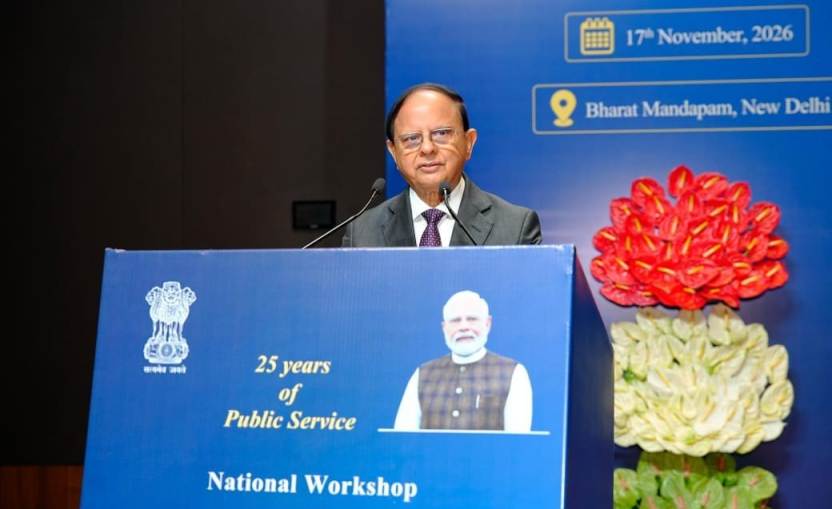
Addressing the first National Workshop on ‘Leadership as a Mission’,
organised to mark Prime Minister Narendra Modi’s completion of 25 years at the
helm of government, Mishra said the country’s development trajectory has been
shaped by landmark initiatives demonstrating the impact of decisive leadership
and a clear vision.
Highlighting major milestones, he cited India’s prompt response to the
2001 Kutch earthquake, the coordinated national effort during the COVID-19
pandemic, the expansion of the country’s presence in the global space economy
and the far-reaching impact of the Lakhpati Didi initiative.
“From swift response to the 2001
Kutch earthquake to the country’s coordinated response to the COVID-19
pandemic, from expanding India’s footprint in the global space economy to the
transformative impact of the Lakhpati Didi initiative, these actions reflect
how strong political will, responsive administration and mission-driven
governance can bring about meaningful change in people’s lives,” he said.
Modi took over as Gujarat Chief Minister in October 2001 before assuming
the office of Prime Minister in May 2014. He has continued to lead governments
at both the state and national levels without interruption since October 2001.
NITI Aayog Chief Executive Officer Anurag Jain, who also addressed the
workshop, said the initiative seeks to capture the experiences and
institutional lessons emerging from Modi’s 25-year leadership journey and
preserve them as a valuable knowledge resource for future generations of
administrators.
Jain identified four fundamental principles that, he said, define the
leadership approach and offer important lessons for governance. Emphasising the
importance of collective purpose over individual authority, he said, “First,
purpose must take precedence over hierarchical position, shifting the focus
from individual leadership to a shared collective mission. Second, service must
replace command, with governance centred on reaching the last person in the
queue,” he said.
He further explained that personal conviction and a strong sense of
purpose help leaders withstand challenges and convert difficult circumstances
into opportunities for wider social transformation. The fourth principle, he
said, is to create institutions, develop capable teams and establish
sustainable systems that continue to deliver results beyond the tenure of
individual leaders.
NITI Aayog Vice Chairman Ashok Kumar Lahiri underscored the significance
of strong political direction and effective administrative leadership in
accelerating the country's development ambitions.
“The transformational vision of
our Hon’ble Prime Minister marks a significant shift in India’s national
aspiration to become Viksit by 2047, reflecting the country’s transition
towards a developed, prosperous and globally competitive nation,” Lahiri said.
He also drew attention to NITI Aayog’s comprehensive development roadmap
aimed at positioning India as a USD 30-40 trillion economy by 2047, with per
capita income projected to reach USD 15,000-18,000. Achieving this ambitious
target, he said, would require sustained real GDP growth of 7-10 per cent
annually.
The workshop marks the beginning of a series of five National Workshops
designed to examine the experiences, governance practices and leadership
lessons accumulated over the past quarter-century.
The discussions, insights and first-hand accounts emerging from these engagements will be converted into structured case studies and educational resources for civil services training academies, universities and other academic institutions.
The broader exercise will also involve developing research-based and teaching materials to guide future policymaking and public administration, ensuring that the lessons of the past 25 years contribute to India's preparations for achieving the Viksit Bharat @2047 vision.