
THEBUSINESSBYTES
BUREAU
NEW
DELHI, APRIL 16, 2026
Including
women in the highest levels of decision-making is essential to shaping a truly
developed India, Prime Minister Narendra Modi asserted in the Lok Sabha on
Thursday, calling the moment a historic turning point in the nation’s democratic
journey.
Addressing
the House during a discussion on a crucial bill, the Prime Minister
acknowledged the depth and substance of the debate, noting that members had
raised important issues grounded in facts and logic. He emphasized that certain
defining moments in a nation’s life demand visionary leadership and a
progressive societal mindset to leave behind a lasting legacy. According to
him, India stands at such a juncture today—one that could have been realized
decades earlier but now presents an opportunity that must not be missed.
Highlighting
India’s identity as the “Mother of Democracy,” Shri Modi said that lawmakers
have been entrusted with a rare chance to strengthen this legacy by making
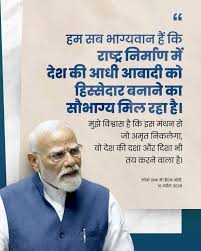
governance more inclusive. He described the inclusion of women — who constitute
nearly half the population — in policymaking as not only a necessity but also a
privilege. Urging members to rise above political considerations, he remarked,
“We stand at such a crucial turning point where the nectar emerging from this
churning will decide the nation's direction.”
 The
Prime Minister underlined that the vision of a Viksit Bharat extends beyond
infrastructure and economic growth. It must reflect the ethos of ‘Sabka Saath,
Sabka Vikas,’ with meaningful participation from all sections of society,
particularly women. He noted that despite delays in implementing such reforms,
there had been no principled opposition to the bill during his consultations
with political leaders. Stressing collective responsibility, he said the credit
for such a transformative step belongs to the entire House. “Therefore, I feel
there is absolutely no need to give this a political color, as everyone's true
benefit lies in supporting it,” he affirmed.
The
Prime Minister underlined that the vision of a Viksit Bharat extends beyond
infrastructure and economic growth. It must reflect the ethos of ‘Sabka Saath,
Sabka Vikas,’ with meaningful participation from all sections of society,
particularly women. He noted that despite delays in implementing such reforms,
there had been no principled opposition to the bill during his consultations
with political leaders. Stressing collective responsibility, he said the credit
for such a transformative step belongs to the entire House. “Therefore, I feel
there is absolutely no need to give this a political color, as everyone's true
benefit lies in supporting it,” he affirmed.
Drawing
from his earlier experiences, Modi pointed to a long-standing paradox in Indian
politics, where reservations for women were more easily accepted at the
grassroots level than in higher legislative bodies. He observed that reluctance
among political leaders often stemmed from fears of losing power. “This
protective mindset allowed local reservations to successfully reach 50 percent
without affecting the Parliament,” he noted.
He
further highlighted a significant shift in the political consciousness of women
in recent decades. Millions of women who have served in Panchayati Raj
institutions have evolved into assertive leaders, actively shaping public
discourse and demanding representation at higher levels. Warning against
underestimating this change, he said these women now hold considerable
influence over electoral outcomes. “Why do we doubt their capabilities; let the
women come forward and decide,” he stated, expressing confidence in their
ability to manage further policy decisions, including sub-allocations.
The
Prime Minister lauded the achievements of women across sectors, noting their
vital role in enhancing the nation’s pride globally. He questioned the
resistance to empowering such a capable demographic and urged lawmakers to
assess the bill through the lens of national interest rather than political
gain. “I appeal to you not to weigh this on the scales of politics,” he said.
Modi
also cautioned that the intentions behind legislative actions would be closely
scrutinized, particularly by women voters. Any perceived insincerity, he
warned, could have serious repercussions. “The Nari Shakti of this country will
never forgive any flaw in our intentions,” he stated.
Addressing
concerns around implementation delays, the Prime Minister cited disruptions
caused by the COVID-19 pandemic and the complexities of census and delimitation
processes. However, he stressed that further delay would erode public trust.
“It is the absolute demand of the time that we do not delay this any further,”
he said.
Reaffirming
his commitment to fairness, Modi dismissed fears of regional discrimination in
delimitation, assuring that established demographic balances would be
maintained. “This decision-making process will absolutely not do injustice to
anyone,” he affirmed.
In
a strong message to the House, the Prime Minister rejected the notion that
women’s representation is a concession. Instead, he described it as a
long-overdue right. “You have stopped it for three decades, now you must
finally do it,” he urged, calling the bill an act of collective atonement for
past inaction.
Citing
data, he highlighted the extensive experience of women in governance, noting
that nearly 275 women lead district panchayats, while over 2,700 block
panchayats and hundreds of urban bodies are under female leadership. He
emphasized that integrating this vast administrative experience into Parliament
would significantly enhance legislative effectiveness. “Their voices will
become a powerful new strength and deeply enrich the House,” he observed.
Concluding
his address, PM Modi reiterated that empowering women in governance is not
merely a policy reform but a reaffirmation of India’s democratic values. He
called for unanimous support to ensure that half the population rightfully
takes its place in shaping the nation’s future, stating that collective resolve
would yield exceptional outcomes for the country.