THEBUSINESSBYTES
BUREAU
NEW
DELHI, MARCH 2, 2026
India and Canada on
Monday formally launched negotiations for a Comprehensive Economic Partnership
Agreement (CEPA) after signing the Terms of Reference (ToR) at Hyderabad House,
signalling a renewed push to deepen economic ties and unlock large trade
potential between the two economies.
The ToR was signed by
Commerce and Industry Minister Piyush Goyal and Canada’s Minister of
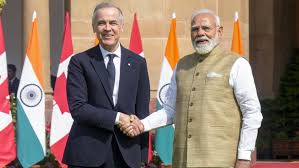
International Trade Maninder Sidhu and exchanged in the presence of Prime
Minister Narendra Modi and Canadian Prime Minister Mark Carney, setting the
framework for the structure, frequency and modalities of the negotiations. The
agreement is expected to be concluded at the earliest, with both sides
committing to an ambitious, balanced and mutually beneficial pact.
 Prime Minister Modi
underscored that India and Canada have set a target of achieving $50 billion in
bilateral trade by 2030, emphasising that the CEPA would help unlock the full
potential of economic cooperation across sectors. Prime Minister Carney
described the initiative as an expansion of a valued partnership marked by “new
ambition, focus and foresight,” reflecting the confidence of both countries in
shaping their economic future.
Prime Minister Modi
underscored that India and Canada have set a target of achieving $50 billion in
bilateral trade by 2030, emphasising that the CEPA would help unlock the full
potential of economic cooperation across sectors. Prime Minister Carney
described the initiative as an expansion of a valued partnership marked by “new
ambition, focus and foresight,” reflecting the confidence of both countries in
shaping their economic future.
The CEPA negotiations
will cover trade in goods and services along with other mutually agreed policy
areas, providing a comprehensive roadmap to enhance market access, reduce trade
barriers and boost investment flows. The move follows the leaders’ discussions
on the margins of the G7 meeting in Kananaskis in October 2025, after which
both countries accelerated work on finalising the ToR.
Canada, with a
population of 41.65 million and a GDP of $2.34 trillion at PPP, represents a
significant market for Indian exporters. Bilateral trade currently stands at
$8.66 billion in FY 2024-25, with India exporting $4.22 billion worth of goods
and importing $4.44 billion. Key Indian exports include pharmaceuticals, iron
and steel, seafood, cotton garments, electronics and chemicals, while imports
from Canada are led by pulses, coal, fertilisers, crude petroleum, paper and
precious stones.
Services trade is
also expected to gain momentum, particularly in telecommunications, computer
and information services and business services, which hold strong growth
potential post-CEPA. The agreement is likely to provide greater mobility for
professionals and enhance digital and technology partnerships.
Beyond trade, the
pact is expected to reinforce strong people-to-people ties, with Canada hosting
over 425,000 Indian students and a vibrant Indian diaspora. Officials said
these “One Family” linkages would gain further strength as economic integration
deepens through the proposed CEPA, positioning both countries for a more robust
and future-ready partnership.